Yu ChuanTing, Li JiXia, Sun FengNan, Cui JinPeng, Fang HuaLi, Sui GuoLang
Department of Clinical Laboratory, Yantaishan Hospital, Yantai, Shandong, China (mainland).
Department of Endocrinology, Yantaishan Hospital, Yantai, Shandong, China (mainland).
Med Sci Monit. 2016 Dec 24;22:5101-5108. doi: 10.12659/msm.898908.
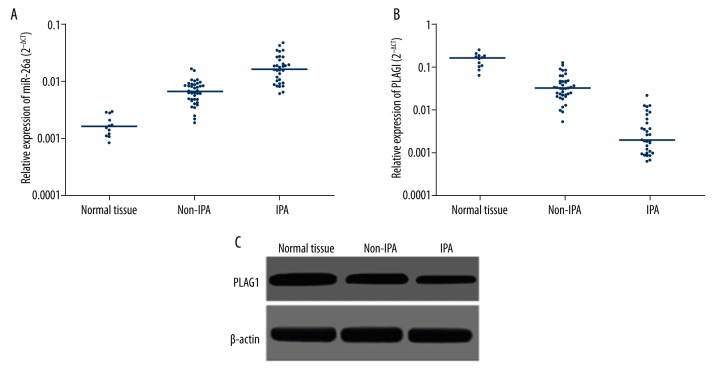
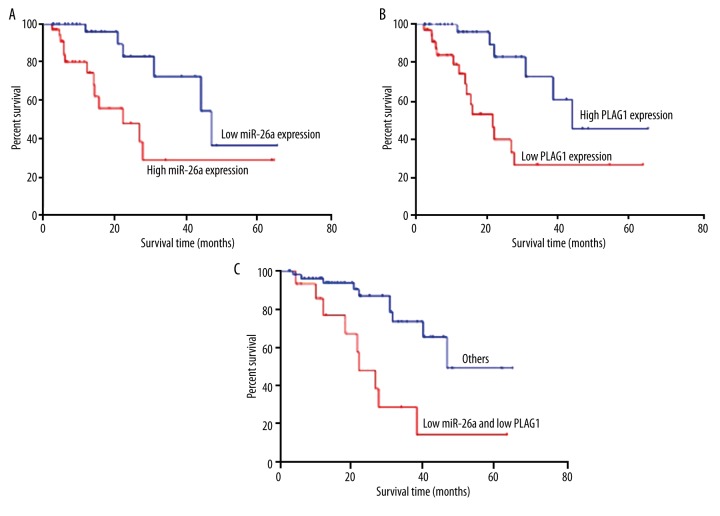
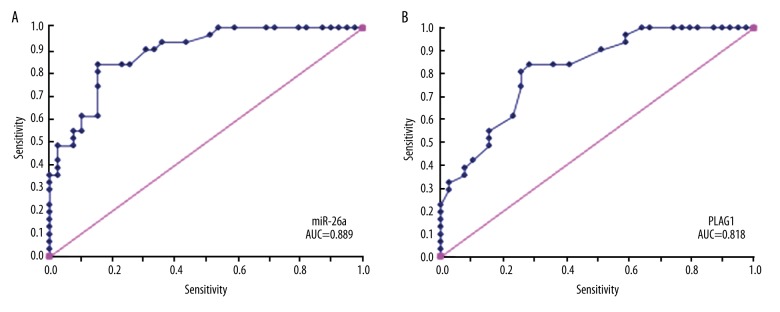
BACKGROUND Although pituitary adenoma is a malignant tumor, it can present as invasive growth in some cases. MicroRNA (miR)-26a has been found to be abnormally highly expressed in pituitary adenoma, indicating possible involvement in pathogenesis. As a known target gene of miR-26a, PLAG1 has abnormally low expression in pituitary adenoma. The correlation between miR-26a or PLAG1 expressional abnormality and occurrence of pituitary adenoma is still unknown, as is its association with invasiveness of pituitary adenoma. MATERIAL AND METHODS Pituitary adenoma tissues, including both invasive and non-invasive subtypes, were collected from our Neurosurgery Department, in parallel with normal pituitary tissues from postmortem autopsy. qRT-PCR was used to detect mRNA expression of miR-26a and PLAG1, while Western blotting was used to test PLAG1 protein expression. The correlation between miR-26a and PLAG1, and with pathological features, were analyzed. ROC analysis revealed the utility of miR-26a and PLAG1 in differential diagnosis of invasive/non-invasive pituitary tumors and in analyzing their effects on patient prognosis. RESULTS MiR-26a was remarkably upregulated in pituitary tumors, while PLAG1 was downregulated, especially in invasive pituitary tumors. miR-26a and PLAG1 had higher diagnostic values for differentiating between invasive and non-invasive pituitary tumors (AUC=0.889 and 0.818, respectively). Those patients with miR-26 overexpression and PLAG1 downregulation had unfavorable prognosis. miR-26 and PLAG1 are independent factors affecting patient diagnosis. CONCLUSIONS MiR-26a can facilitate occurrence of pituitary tumor and invasiveness, probably via inhibiting PLAG1 expression.
尽管垂体腺瘤是一种恶性肿瘤,但在某些情况下可呈侵袭性生长。已发现微小RNA(miR)-26a在垂体腺瘤中异常高表达,提示其可能参与发病机制。作为miR-26a的已知靶基因,PLAG1在垂体腺瘤中表达异常低。miR-26a或PLAG1表达异常与垂体腺瘤发生之间的相关性仍不清楚,其与垂体腺瘤侵袭性的关系也不明确。
从我院神经外科收集包括侵袭性和非侵袭性亚型的垂体腺瘤组织,并与尸检获得的正常垂体组织进行对照。采用qRT-PCR检测miR-26a和PLAG1的mRNA表达,同时用蛋白质印迹法检测PLAG1蛋白表达。分析miR-26a与PLAG1之间的相关性及其与病理特征的关系。ROC分析揭示了miR-26a和PLAG1在鉴别侵袭性/非侵袭性垂体肿瘤及分析其对患者预后影响方面的作用。
miR-26a在垂体肿瘤中显著上调,而PLAG1下调,尤其是在侵袭性垂体肿瘤中。miR-26a和PLAG1在鉴别侵袭性和非侵袭性垂体肿瘤方面具有较高的诊断价值(AUC分别为0.889和0.818)。miR-26过表达和PLAG1下调的患者预后不良。miR-26和PLAG1是影响患者诊断的独立因素。
miR-26a可能通过抑制PLAG1表达促进垂体肿瘤的发生和侵袭。