Science for Life Laboratory, Department of Cell and Molecular Biology, Uppsala University , S-751 24 Uppsala, Sweden.
Department of Biological Chemistry, Weizmann Institute of Science , Rehovot 76100, Israel.
J Am Chem Soc. 2017 Jan 25;139(3):1155-1167. doi: 10.1021/jacs.6b10801. Epub 2017 Jan 11.
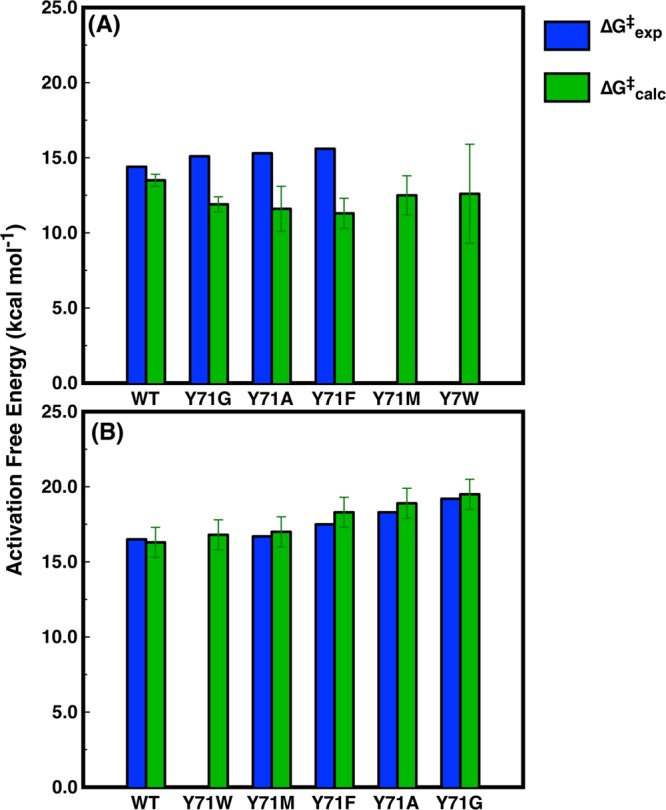
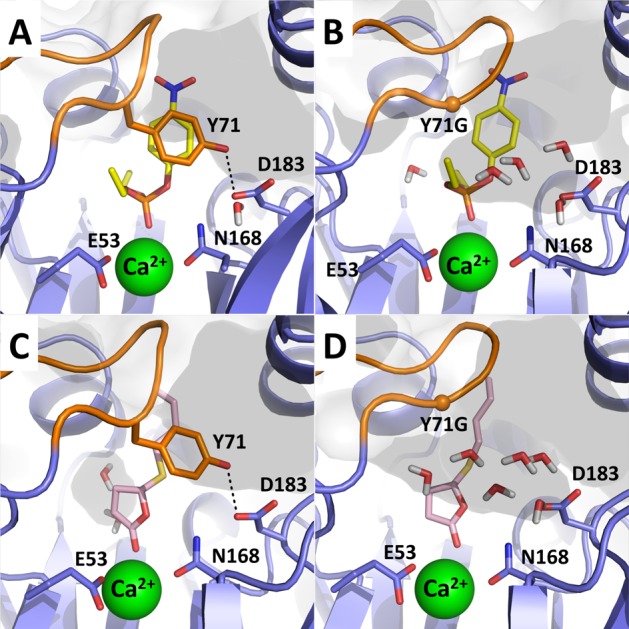
Serum paraoxonase 1 (PON1) is a native lactonase capable of promiscuously hydrolyzing a broad range of substrates, including organophosphates, esters, and carbonates. Structurally, PON1 is a six-bladed β-propeller with a flexible loop (residues 70-81) covering the active site. This loop contains a functionally critical Tyr at position 71. We have performed detailed experimental and computational analyses of the role of selected Y71 variants in the active site stability and catalytic activity in order to probe the role of Y71 in PON1's lactonase and organophosphatase activities. We demonstrate that the impact of Y71 substitutions on PON1's lactonase activity is minimal, whereas the k for the paraoxonase activity is negatively perturbed by up to 100-fold, suggesting greater mutational robustness of the native activity. Additionally, while these substitutions modulate PON1's active site shape, volume, and loop flexibility, their largest effect is in altering the solvent accessibility of the active site by expanding the active site volume, allowing additional water molecules to enter. This effect is markedly more pronounced in the organophosphatase activity than the lactonase activity. Finally, a detailed comparison of PON1 to other organophosphatases demonstrates that either a similar "gating loop" or a highly buried solvent-excluding active site is a common feature of these enzymes. We therefore posit that modulating the active site hydrophobicity is a key element in facilitating the evolution of organophosphatase activity. This provides a concrete feature that can be utilized in the rational design of next-generation organophosphate hydrolases that are capable of selecting a specific reaction from a pool of viable substrates.
血清对氧磷酶 1(PON1)是一种天然的内酯酶,能够随意水解广泛的底物,包括有机磷化合物、酯类和碳酸盐。结构上,PON1 是一个六叶 β-螺旋桨,带有一个灵活的环(残基 70-81)覆盖活性部位。该环包含一个功能关键的 Tyr 位于 71 位。我们已经对选定的 Y71 变体在活性部位稳定性和催化活性中的作用进行了详细的实验和计算分析,以探究 Y71 在 PON1 的内酯酶和有机磷酸酶活性中的作用。我们证明,Y71 取代对 PON1 的内酯酶活性的影响最小,而对氧磷酶活性的 k 值受到高达 100 倍的负干扰,表明天然活性的突变稳健性更高。此外,尽管这些取代会调节 PON1 的活性部位形状、体积和环的灵活性,但它们的最大影响是通过扩大活性部位体积来改变活性部位的溶剂可及性,从而允许更多的水分子进入。这种影响在有机磷酸酶活性中比在内酯酶活性中更为明显。最后,对 PON1 与其他有机磷酸酶的详细比较表明,类似的“门控环”或高度埋藏的溶剂排斥活性部位是这些酶的共同特征。因此,我们认为调节活性部位疏水性是促进有机磷酸酶活性进化的关键因素。这提供了一个具体的特征,可以在合理设计能够从可行的底物池中选择特定反应的下一代有机磷水解酶中得到利用。