Kwon David Soonil, Kim Kyuwoong, Park Sang Min
Department of Internal Medicine, Seoul National University Hospital, Seoul, South Korea.
Department of Biomedical Sciences, Seoul National University College of Medicine, Seoul, South Korea.
BMJ Open. 2016 Dec 28;6(12):e012618. doi: 10.1136/bmjopen-2016-012618.
The annual outbreak of influenza is one of the major causes of morbidity and mortality among the elderly population around the world. While there is an annual vaccine available to prevent or reduce the incidence of disease, not all older people in Korea choose to be vaccinated. There have been few previous studies to examine the factors influencing influenza vaccination in Korea. Thus, this study identifies nationwide factors that affect influenza vaccination rates in elderly Koreans.
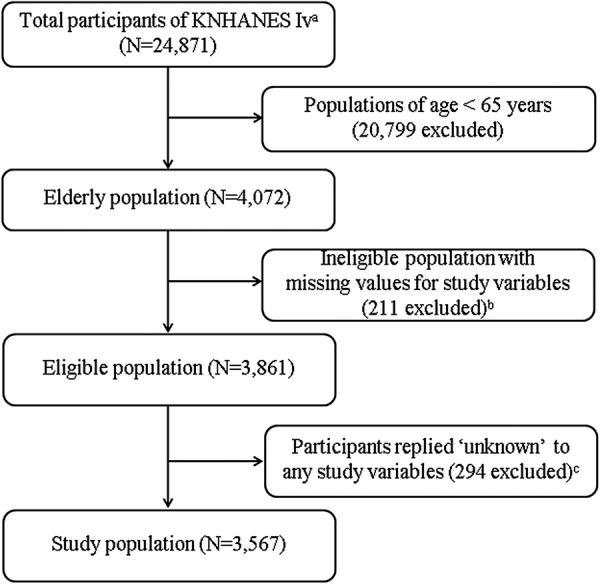
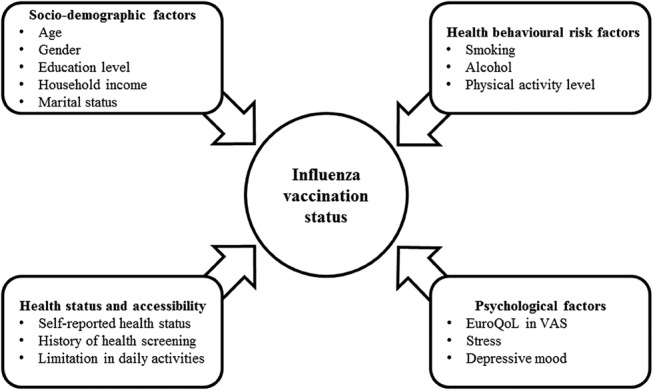
We obtained data from the Fourth Korean National Health and Nutrition Examination Survey 2007-2009 (KNHANES IV), a nationwide health survey in Korea. To assess influenza vaccination status, we analysed answers to a single question from the survey. From the respondents, we selected 3567 elderly population aged 65 years or older, to analyse the effects of variables including sociodemographic, health behavioural risk, health status and psychological factors on vaccination coverage. We identified factors that affect vaccination status using a multiple logistic regression analysis.
The rate of influenza vaccination in this elderly population was 75.8%. Overall, the most significant determinants for choosing influenza vaccination were a recent history of health screening (adjusted OR (aOR) 2.26, 95% CI 1.92 to 2.66) and smoking (aOR 0.78, 95% CI 0.62 to 0.98). Other contributing factors were age, household income, marital status, alcohol consumption, physical activity level, self-reported health status and a limitation in daily activities. In contrast, psychological factors, including self-perceived quality of life, stress and depressive mood, did not show close association with vaccination coverage.
To boost influenza vaccination rates in the elderly, an influenza campaign should focus on under-represented groups, especially smokers. Additionally, promoting routine health screening for the elderly may be an efficient way to help achieve higher vaccination rates. Our results highlight the need for a new strategy for the vaccination campaign.
全球范围内,流感的年度爆发是老年人群发病和死亡的主要原因之一。虽然有年度疫苗可用于预防或降低疾病发病率,但韩国并非所有老年人都选择接种疫苗。此前很少有研究探讨影响韩国流感疫苗接种的因素。因此,本研究确定了影响韩国老年人流感疫苗接种率的全国性因素。
我们从2007 - 2009年第四次韩国国民健康与营养检查调查(KNHANES IV)获取数据,这是韩国的一项全国性健康调查。为评估流感疫苗接种状况,我们分析了该调查中一个单一问题的答案。我们从受访者中选取了3567名65岁及以上的老年人群,以分析社会人口统计学、健康行为风险、健康状况和心理因素等变量对疫苗接种覆盖率的影响。我们使用多元逻辑回归分析确定影响疫苗接种状况的因素。
该老年人群的流感疫苗接种率为75.8%。总体而言,选择接种流感疫苗的最显著决定因素是近期的健康筛查史(调整后比值比(aOR)为2.26,95%置信区间为1.92至2.66)和吸烟(aOR为0.78,95%置信区间为0.62至0.98)。其他影响因素包括年龄、家庭收入、婚姻状况、饮酒、身体活动水平、自我报告的健康状况以及日常活动受限情况。相比之下,心理因素,包括自我感知的生活质量、压力和抑郁情绪,与疫苗接种覆盖率没有密切关联。
为提高老年人的流感疫苗接种率,流感宣传活动应关注代表性不足的群体,尤其是吸烟者。此外,推动老年人进行常规健康筛查可能是帮助实现更高疫苗接种率的有效途径。我们的结果凸显了疫苗接种宣传活动新策略的必要性。