Varna Mariana, Juenet Maya, Bayles Richard, Mazighi Mikael, Chauvierre Cédric, Letourneur Didier
Inserm, U1148, Cardiovascular Bio-Engineering, X. Bichat Hospital, 75018, Paris, France; Institut Galilée, Université Paris 13, Sorbonne Paris Cité, 93430, Villetaneuse, France; Inserm, U1148, Cardiovascular Bio-Engineering, X. Bichat Hospital, 75018, Paris, France; Institut Galilée, Université Paris 13, Sorbonne Paris Cité, 93430, Villetaneuse, France.
Inserm, U1148, Cardiovascular Bio-Engineering, X. Bichat Hospital, 75018, Paris, France; Inserm, U1148, Cardiovascular Bio-Engineering, X. Bichat Hospital, 75018, Paris, France.
Future Sci OA. 2015 Nov 1;1(4):FSO46. doi: 10.4155/fso.15.46. eCollection 2015 Nov.
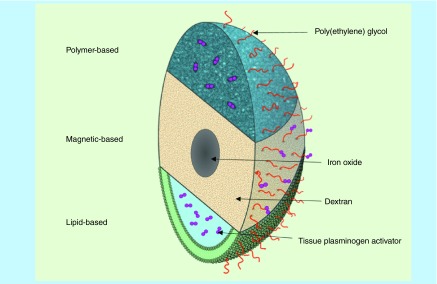
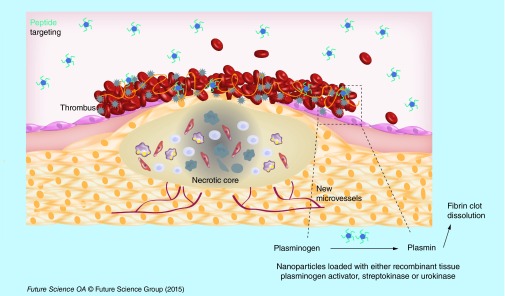
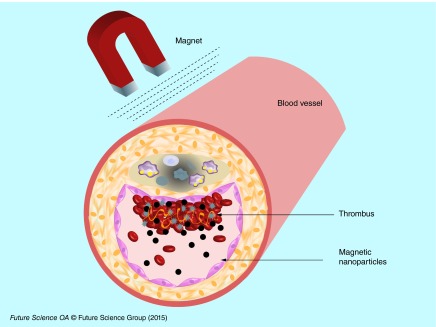
This review highlights the preclinical and clinical research based on the use of nano- and micro-carriers in thrombolytic drug delivery. Ischemic heart and stroke caused by thrombosis are the main causes of death in the world. Because of their inactivation in the blood, high doses of thrombolytics are administered to patients, increasing the risk of intracranial hemorrhage. Preclinical research conducted with lipid, polymer or magnetic nanoparticles loaded with thrombolytic drugs showed an enhancement of thrombolysis and a reduction of undesirable side effects. Targeted nanocarriers exhibited an increased accumulation into clot. Clinical trials were already conducted with lipid-based microbubbles combined with ultrasound and thrombolytic drug and showed thrombolysis improvement. Future validation of nanosystems is awaited in clinic. This research opens new strategies for the management of thrombotic diseases.
本综述重点介绍了基于纳米和微载体在溶栓药物递送中的应用的临床前和临床研究。由血栓形成引起的缺血性心脏病和中风是全球主要的死亡原因。由于溶栓药物在血液中会失活,因此患者需要服用高剂量的溶栓药物,这增加了颅内出血的风险。对负载溶栓药物的脂质、聚合物或磁性纳米颗粒进行的临床前研究表明,溶栓作用增强,不良副作用减少。靶向纳米载体在凝块中的积累增加。已经开展了基于脂质的微泡与超声和溶栓药物联合使用的临床试验,并显示溶栓效果有所改善。纳米系统的未来临床验证值得期待。这项研究为血栓性疾病的治疗开辟了新策略。