Hoang Van Dong, Lee Andy H, Pham Ngoc Minh, Xu Dan, Binns Colin W
School of Public Health, Curtin University, GPO Box U 1987, Perth, WA 6845, Australia
National Institute of Hygiene and Epidemiology, 1-Yersin Street, Hanoi City, Vietnam. Email:
Asian Pac J Cancer Prev. 2016 Nov 1;17(11):4939-4944. doi: 10.22034/APJCP.2016.17.11.4939.
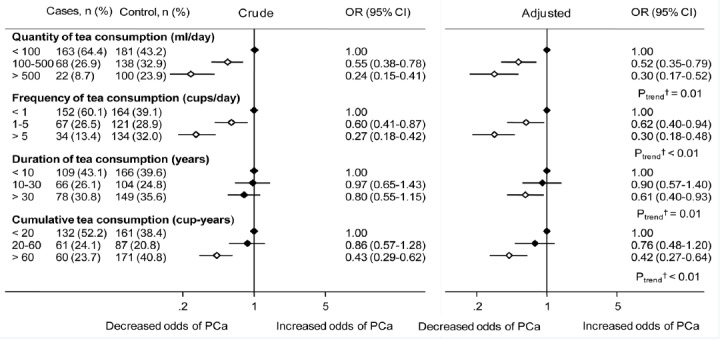
Background: An upward trend has been noted for the incidence of prostate cancer (PCa) in Vietnam, but information is limited on modifiable factors associated with this form of cancer. This case-control study was conducted to ascertain any relationship between habitual tea consumption and PCa risk. Materials and Methods: Two hundred and fifty-three incident patients with histologically confirmed PCa and 419 (340 community-based and 79 hospital-based) controls, matched by age, were recruited in Ho Chi Minh City during 2013-2015. Information on frequency, quantity and duration of tea consumption, together with demographics, habitual diet and lifestyle characteristics, was obtained by direct interviews using a validated questionnaire. Logistic regression analyses were performed to assess associations between tea consumption variables and PCa risk. Results: The control subjects reported higher tea consumption levels in terms of cumulative exposure, frequency and quantity of tea drank than the PCa patients. After accounting for confounding factors, increasing tea consumption was found to be associated with reduced risk of PCa. The adjusted odds ratios (95% confidence intervals) were 0.52 (95% CI 0.35-0.79) and 0.30 (95% CI 0.18-0.48) for participants drinking 100-500 ml/day and > 500 ml/day, respectively, relative to those drinking < 100 ml/day. Significant inverse dose-response relationships were also observed for years of drinking and number of cups consumed daily (P <0.01). Conclusion: Habitual tea consumption is associated with a reduced risk of PCa in Vietnamese men.
越南前列腺癌(PCa)的发病率呈上升趋势,但与这种癌症相关的可改变因素的信息有限。本病例对照研究旨在确定习惯性饮茶与PCa风险之间的关系。
2013年至2015年期间,在胡志明市招募了253例经组织学确诊的PCa新发病例患者和419例(340例社区对照和79例医院对照)按年龄匹配的对照。通过使用经过验证的问卷进行直接访谈,获取了关于饮茶频率、数量和持续时间以及人口统计学、习惯性饮食和生活方式特征的信息。进行逻辑回归分析以评估饮茶变量与PCa风险之间的关联。
对照受试者在茶的累积暴露量、饮用频率和数量方面报告的饮茶水平高于PCa患者。在考虑混杂因素后,发现增加饮茶与降低PCa风险相关。相对于每天饮用<100毫升的参与者,每天饮用100 - 500毫升和>500毫升的参与者的调整优势比(95%置信区间)分别为0.52(95%CI 0.35 - 0.79)和0.30(95%CI 0.18 - 0.48)。在饮茶年限和每日饮茶杯数方面也观察到显著的剂量反应负相关关系(P<0.01)。
习惯性饮茶与越南男性PCa风险降低相关。