Bikker Paul, van Krimpen Marinus M, van Wikselaar Piet, Houweling-Tan Bwee, Scaccia Nazareno, van Hal Jaap W, Huijgen Wouter J J, Cone John W, López-Contreras Ana M
Livestock Research, Wageningen University and Research Centre, De Elst 1, 6708 WD Wageningen, The Netherlands.
Food and Biobased Research, Wageningen University and Research Centre, Bornse Weilanden 9, 6708 WG Wageningen, The Netherlands.
J Appl Phycol. 2016;28(6):3511-3525. doi: 10.1007/s10811-016-0842-3. Epub 2016 Apr 23.
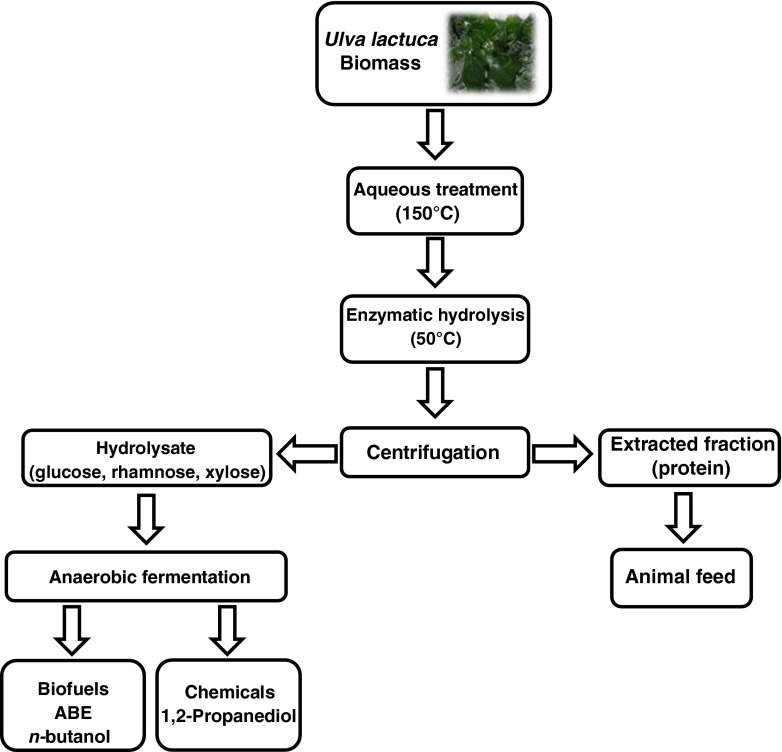
The growing world population demands an increase in animal protein production. Seaweed may be a valuable source of protein for animal feed. However, a biorefinery approach aimed at cascading valorisation of both protein and non-protein seaweed constituents is required to realise an economically feasible value chain. In this study, such a biorefinery approach is presented for the green seaweed containing 225 g protein ( × 4.6) kg dry matter (DM). The sugars in the biomass were solubilised by hot water treatment followed by enzymatic hydrolysis and centrifugation resulting in a sugar-rich hydrolysate (38.8 g L sugars) containing glucose, rhamnose and xylose, and a protein-enriched (343 g kg in DM) extracted fraction. This extracted fraction was characterised for use in animal feed, as compared to biomass. Based on the content of essential amino acids and the in vitro N (85 %) and organic matter (90 %) digestibility, the extracted fraction seems a promising protein source in diets for monogastric animals with improved characteristics as compared to the intact . The gas production test indicated a moderate rumen fermentation of and the extracted fraction, about similar to that of alfalfa. Reduction of the high content of minerals and trace elements may be required to allow a high inclusion level of products in animal diets. The hydrolysate was used successfully for the production of acetone, butanol, ethanol and 1,2-propanediol by clostridial fermentation, and the rhamnose fermentation pattern was studied.
不断增长的世界人口需要增加动物蛋白产量。海藻可能是动物饲料中一种有价值的蛋白质来源。然而,需要一种旨在对海藻的蛋白质和非蛋白质成分进行级联增值的生物精炼方法,以实现经济上可行的价值链。在本研究中,针对含有225克蛋白质(×4.6)/千克干物质(DM)的绿藻提出了这样一种生物精炼方法。通过热水处理、酶解和离心将生物质中的糖溶解,得到富含糖的水解产物(38.8克/升糖),其中含有葡萄糖、鼠李糖和木糖,以及富含蛋白质的(干物质中343克/千克)提取部分。与生物质相比,对该提取部分进行了用于动物饲料的特性表征。基于必需氨基酸的含量以及体外氮(85%)和有机物(90%)的消化率,与完整的相比,该提取部分似乎是单胃动物日粮中一种有前景的蛋白质来源,其特性有所改善。产气试验表明,和提取部分在瘤胃中的发酵适中,与苜蓿的情况大致相似。可能需要降低矿物质和微量元素的高含量,以使海藻产品在动物日粮中的添加水平较高。水解产物通过梭菌发酵成功用于生产丙酮、丁醇、乙醇和1,2 - 丙二醇,并研究了鼠李糖的发酵模式。