Nandagopal Lakshminarayanan, Sonpavde Guru
Department of Medicine, Section of Hematology-Oncology, University of Alabama at Birmingham (UAB) , Birmingham, AL, USA.
Bladder Cancer. 2016 Oct 27;2(4):369-379. doi: 10.3233/BLC-160075.
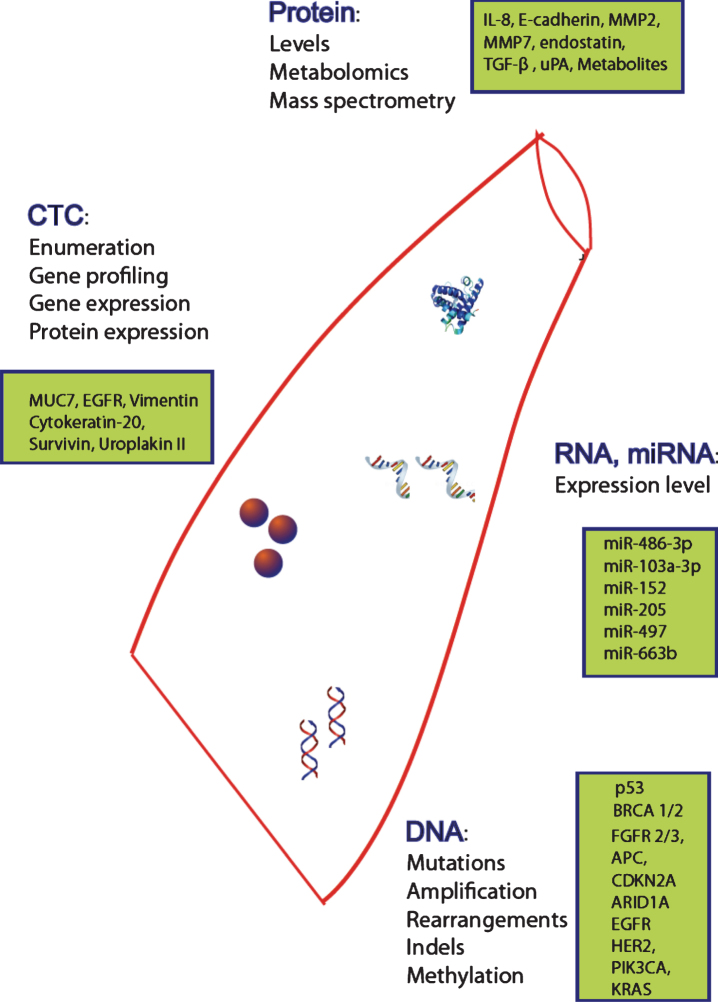
Bladder cancer is a molecularly heterogeneous disease characterized by multiple unmet needs in the realm of diagnosis, clinical staging, monitoring and therapy. There is an urgent need to develop precision medicine for advanced urothelial carcinoma. Given the difficulty of serial analyses of metastatic tumor tissue to identify resistance and new therapeutic targets, development of non-invasive monitoring using circulating molecular biomarkers is critically important. Although the development of circulating biomarkers for the management of bladder cancer is in its infancy and may currently suffer from lower sensitivity of detection, they have inherent advantages owing to non-invasiveness. Additionally, circulating molecular alterations may capture tumor heterogeneity without the sampling bias of tissue biopsy. This review describes the accumulating data to support further development of circulating biomarkers including circulating tumor cells, cell-free circulating tumor (ct)-DNA, RNA, micro-RNA and proteomics to improve the management of bladder cancer.
膀胱癌是一种分子异质性疾病,在诊断、临床分期、监测和治疗领域存在多种未满足的需求。迫切需要为晚期尿路上皮癌开发精准医学。鉴于对转移性肿瘤组织进行系列分析以确定耐药性和新治疗靶点存在困难,利用循环分子生物标志物进行非侵入性监测的开发至关重要。尽管用于膀胱癌管理的循环生物标志物的开发尚处于起步阶段,目前可能存在检测灵敏度较低的问题,但由于其非侵入性,它们具有固有的优势。此外,循环分子改变可以捕捉肿瘤异质性,而不会出现组织活检的取样偏差。本综述描述了越来越多的数据,以支持循环生物标志物的进一步开发,包括循环肿瘤细胞、游离循环肿瘤(ct)-DNA、RNA、微小RNA和蛋白质组学,以改善膀胱癌的管理。