de Vries Sieta T, Wong Lisa, Sutcliffe Alastair, Houÿez François, Ruiz Carmen Lasheras, Mol Peter G M
Department of Clinical Pharmacy and Pharmacology, University of Groningen, University Medical Center Groningen, Groningen, The Netherlands.
Population, Policy and Practice Programme, UCL Institute of Child Health, 30 Guilford Street, London, WC1N 1EH, UK.
Drug Saf. 2017 May;40(5):443-455. doi: 10.1007/s40264-016-0494-x.
A mobile app may increase the reporting of adverse drug reactions (ADRs) and improve the communication of new drug safety information. Factors that influence the use of an app for such two-way risk communication need to be considered at the development stage.
Our aim was to reveal the factors that may influence healthcare professionals (HCPs) and patients to use an app for two-way risk communication.
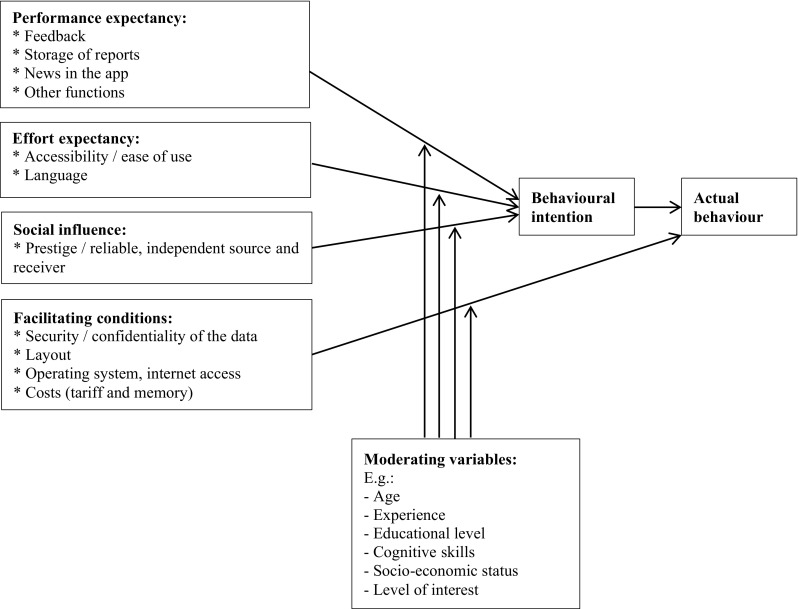
Focus group discussions and face-to-face interviews were conducted in the Netherlands, Spain and the UK. Patients with type 2 diabetes mellitus, patients with a rare disease or their caregivers and adolescents with health conditions were eligible to participate. HCPs included pharmacists, paediatricians, general practitioners, internists, practice nurses and professionals caring for patients with a rare disease. Patients and HCPs were recruited through various channels. The recorded discussions and interviews were transcribed verbatim. The dataset was analysed using thematic analysis and arranged according to the Unified Theory of Acceptance and Use of Technology.
Seven focus group discussions and 13 interviews were conducted. In total, 21 HCPs and 50 patients participated. Identified factors that may influence the use of the app were the type of feedback given on reported ADRs, how ADR reports are stored and the type of drug news. Also mentioned were other functions of the app, ease of use, type of language, the source of safety information provided through the app, security of the app, layout, the operating systems on which the app can be used and the costs.
Further research is needed to assess associations between user characteristics and the direction (positive or negative) of the factors potentially influencing app use.
移动应用程序可能会增加药品不良反应(ADR)的报告,并改善新药安全信息的交流。在开发阶段需要考虑影响此类双向风险沟通应用程序使用的因素。
我们的目的是揭示可能影响医疗保健专业人员(HCP)和患者使用应用程序进行双向风险沟通的因素。
在荷兰、西班牙和英国进行了焦点小组讨论和面对面访谈。2型糖尿病患者、罕见病患者或其护理人员以及患有健康问题的青少年有资格参与。HCP包括药剂师、儿科医生、全科医生、内科医生、执业护士以及照顾罕见病患者的专业人员。通过各种渠道招募患者和HCP。对记录的讨论和访谈进行逐字转录。使用主题分析对数据集进行分析,并根据技术接受与使用统一理论进行整理。
进行了7次焦点小组讨论和13次访谈。共有21名HCP和50名患者参与。确定的可能影响应用程序使用的因素包括对报告的ADR给出的反馈类型、ADR报告的存储方式以及药品新闻的类型。还提到了应用程序的其他功能、易用性、语言类型、通过应用程序提供的安全信息来源、应用程序的安全性、布局、可使用该应用程序的操作系统以及成本。
需要进一步研究以评估用户特征与可能影响应用程序使用的因素的方向(正向或负向)之间的关联。