Gururani Kunal, Jose John, George Paul V
Department of Cardiology, Christian Medical College Hospital, Vellore, India.
Department of Cardiology, Christian Medical College Hospital, Vellore, India.
Indian Heart J. 2016 Dec;68 Suppl 3(Suppl 3):S16-S20. doi: 10.1016/j.ihj.2016.07.002. Epub 2016 Aug 8.
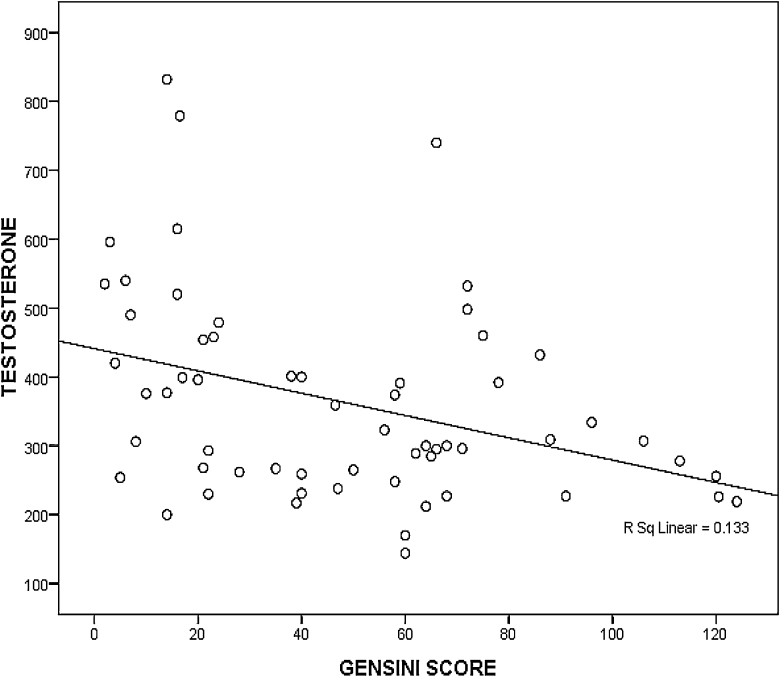
Historically, higher levels of serum testosterone were presumed deleterious to the cardiovascular system. In the last two decades, studies have suggested that low testosterone levels are associated with increased prevalence of risk factors for cardiovascular disease (CVD), including dyslipidemia and diabetes. This is a cross sectional study. The aim of our study was to determine the relationship between serum testosterone levels and angiographic severity of coronary artery disease (CAD). Serum testosterone levels were also correlated with flow mediated dilation of brachial artery (BAFMD) - an indicator of endothelial function. Consecutive male patients, aged 40-60 years, admitted for coronary angiography (CAG) with symptoms suggestive of CAD, were included in the study. Out of the 92 patients included in the study, 32 patients had normal coronaries and 60 had CAD on coronary angiography. Severity of CAD was determined by Gensini coronary score. The group with CAD had significantly lower levels of total serum testosterone (363±147.1 vs 532.09±150.5ng/dl, p<0.001), free testosterone (7.1215±3.012 vs 10.4419±2.75ng/dl, p<0.001) and bioavailable testosterone (166.17±64.810 vs 247.94±62.504ng/dl, p<0.001) when compared to controls. Adjusting for the traditional risk factors for CAD, a multiple linear regression analysis showed that low testosterone was an independent predictor of severity of CAD (β=-0.007, p<0.001). This study also showed that levels of total, free and bioavailable testosterone correlated positively with BAFMD %.
从历史上看,较高水平的血清睾酮被认为对心血管系统有害。在过去二十年中,研究表明低睾酮水平与心血管疾病(CVD)危险因素的患病率增加有关,包括血脂异常和糖尿病。这是一项横断面研究。我们研究的目的是确定血清睾酮水平与冠状动脉疾病(CAD)血管造影严重程度之间的关系。血清睾酮水平还与肱动脉血流介导的扩张(BAFMD)相关,BAFMD是内皮功能的一个指标。纳入研究的是年龄在40 - 60岁之间、因疑似CAD症状而接受冠状动脉造影(CAG)的连续男性患者。在纳入研究的92名患者中,32名患者冠状动脉正常,60名患者冠状动脉造影显示患有CAD。CAD的严重程度通过Gensini冠状动脉评分确定。与对照组相比,CAD组的总血清睾酮水平(363±147.1 vs 532.09±150.5ng/dl,p<0.001)、游离睾酮水平(7.1215±3.012 vs 10.4419±2.75ng/dl,p<0.001)和生物可利用睾酮水平(166.17±64.810 vs 247.94±62.504ng/dl,p<0.001)显著更低。在对CAD的传统危险因素进行校正后,多元线性回归分析表明低睾酮是CAD严重程度的独立预测因素(β=-0.007,p<0.001)。这项研究还表明,总睾酮、游离睾酮和生物可利用睾酮水平与BAFMD%呈正相关。