Département de Sexologie, Université du Québec à Montréal, C.P. 8888, Succursale Centre-Ville, Montréal, Québec H3C 3P8, Canada.
Child Abuse Negl. 2017 Feb;64:79-88. doi: 10.1016/j.chiabu.2016.12.008. Epub 2016 Dec 29.
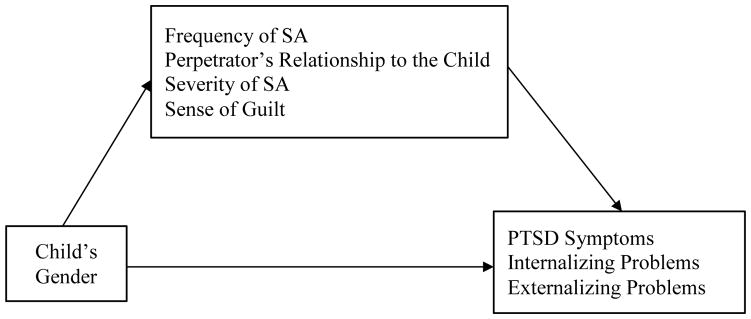
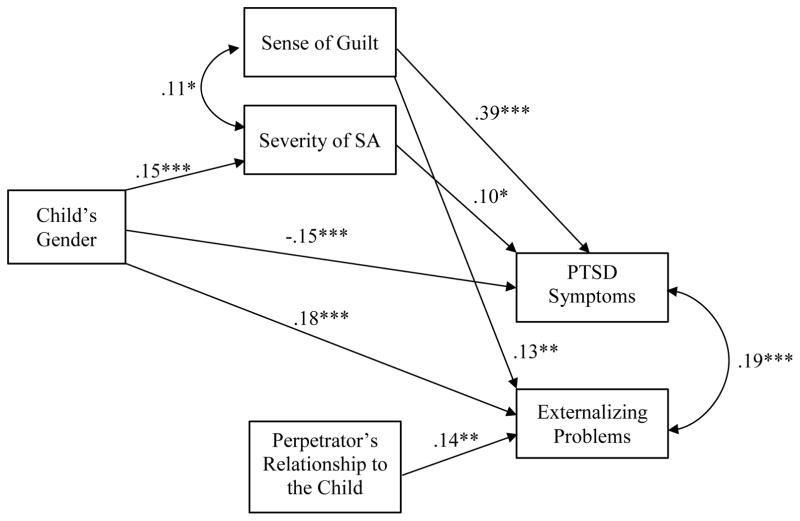
Despite the proliferation of studies documenting outcomes in sexually abused victims, gender differences remain understudied. The bulk of studies have relied on retrospective samples of adults with insufficient representation of male victims to explore gender specificities. This study examined differential outcomes among boy and girl victims of sexual abuse. A predictive model of outcomes including abuse characteristics and sense of guilt as mediators was proposed. Path analysis was conducted with a sample of 447 sexually abused children (319 girls and 128 boys), aged 6-12. Being a girl was a predictor of posttraumatic stress symptoms, while being a boy was a predictor of externalizing problems. Being a boy was also associated with more severe abuse, which in turn predicted posttraumatic stress symptoms. Child's gender was not related to perpetrator's relationship to the child or sense of guilt. However, sense of guilt predicted posttraumatic stress symptoms and externalizing problems while perpetrator's relationship to the child predicted externalizing problems. Gender specificities should be further studied among sexually abused children, as boys and girls appear to manifest different outcomes. Sense of guilt should be a target in intervention for sexually abused children, as results highlight its link to heightened negative outcomes.
尽管有大量研究记录了性虐待受害者的结局,但性别差异仍未得到充分研究。大多数研究依赖于成人的回顾性样本,这些样本中男性受害者的代表性不足,无法探索性别特异性。本研究探讨了性虐待男童和女童受害者的不同结局。提出了一个包括虐待特征和内疚感作为中介的结果预测模型。对 447 名 6-12 岁的性虐待儿童(319 名女孩和 128 名男孩)进行了路径分析。女孩是创伤后应激症状的预测因素,而男孩是外化问题的预测因素。男孩也与更严重的虐待有关,而这种虐待反过来又预测了创伤后应激症状。儿童的性别与施虐者与儿童的关系或内疚感无关。然而,内疚感预测了创伤后应激症状和外化问题,而施虐者与儿童的关系则预测了外化问题。应该进一步研究性虐待儿童中的性别特异性,因为男孩和女孩似乎表现出不同的结果。内疚感应该是性虐待儿童干预的目标,因为研究结果强调了它与更严重的负面结果的联系。