Gargano Lisa M, Gershon Robyn R, Brackbill Robert M
New York City Department of Health and Mental Hygiene, World Trade Center Health Registry, Division of Epidemiology, Long Island City, New York, USA.
Philip R. Lee Institute for Health Policy Studies and Department of Epidemiology and Biostatistics, School of Medicine, University of California, San Francisco, California, USA.
PLoS Curr. 2016 Oct 27;8:ecurrents.dis.7c70f66c1e6c5f41b43c797cb2a04793. doi: 10.1371/currents.dis.7c70f66c1e6c5f41b43c797cb2a04793.
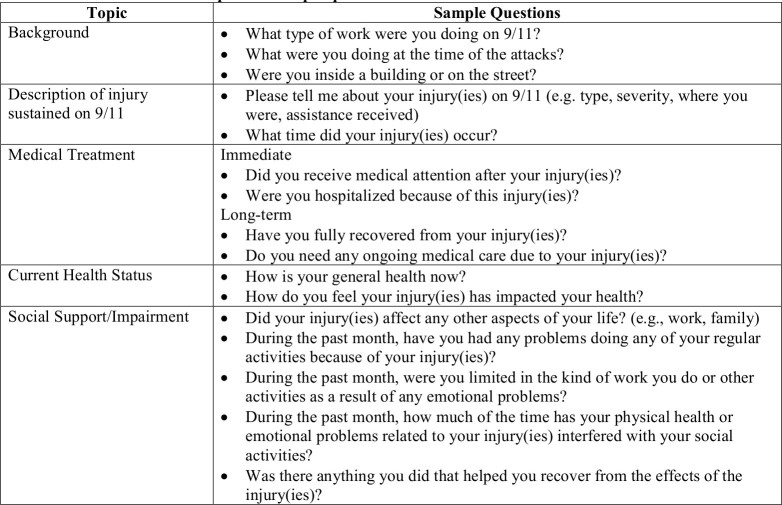
A number of studies published by the World Trade Center Health Registry (Registry) document the prevalence of injuries sustained by victims of the World Trade Center Disaster (WTCD) on 9/11. Injury occurrence during or in the immediate aftermath of this event has been shown to be a risk factor for long-term adverse physical and mental health status. More recent reports of ongoing physical health and mental health problems and overall poor quality of life among survivors led us to undertake this qualitative study to explore the long-term impact of having both disaster-related injuries and peri-event traumatic exposure on quality of life in disaster survivors. Methods: Semi-structured, in-depth individual telephone interviews were conducted with 33 Registry enrollees who reported being injured on 9/11/01. Topics included: extent and circumstance of the injury(ies), description of medical treatment for injury, current health and functional status, and lifestyle changes resulting from the WTCD. The interviews were recorded, transcribed, and inductively open-coded for thematic analysis.
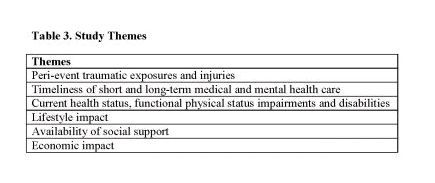
Six themes emerged with respect to long term recovery and quality of life: concurrent experience of injury with exposure to peri-event traumatic exposure (e.g., witnessing death or destruction, perceived life threat, etc.); sub-optimal quality and timeliness of short- and long-term medical care for the injury reported and mental health care; poor ongoing health status, functional limitations, and disabilities; adverse impact on lifestyle; lack of social support; and adverse economic impact. Many study participants, especially those reporting more serious injuries, also reported self-imposed social isolation, an inability to participate in or take enjoyment from previously enjoyable leisure and social activities and greatly diminished overall quality of life.
This study provided unique insight into the long-term impact of disasters on survivors. Long after physical injuries have healed, some injured disaster survivors report having serious health and mental health problems, economic problems due to loss of livelihood, limited sources of social support, and profound social isolation. Strategies for addressing the long-term health problems of disaster survivors are needed in order to support recovery.
世界贸易中心健康登记处(登记处)发表的多项研究记录了9·11事件中世界贸易中心灾难(WTCD)受害者所受伤害的发生率。事实表明,在此事件期间或刚结束后受伤是长期身心健康状况不佳的一个风险因素。最近有关幸存者持续存在的身体健康和心理健康问题以及总体生活质量较差的报告促使我们开展这项定性研究,以探讨与灾难相关的伤害和事件发生期间的创伤暴露对灾难幸存者生活质量的长期影响。
对33名登记在册且报告在2001年9月11日受伤的人员进行了半结构化的深入个人电话访谈。主题包括:受伤的程度和情况、受伤的医疗治疗描述、当前的健康和功能状况以及由WTCD导致的生活方式变化。访谈进行了录音、转录,并进行归纳开放式编码以进行主题分析。
出现了六个与长期康复和生活质量相关的主题:受伤与事件发生期间的创伤暴露(例如,目睹死亡或破坏、感觉到生命受到威胁等)同时发生;所报告的受伤的短期和长期医疗护理以及心理健康护理的质量欠佳且不及时;持续的健康状况不佳、功能受限和残疾;对生活方式的不利影响;缺乏社会支持;以及不利的经济影响。许多研究参与者,尤其是那些报告伤势更严重的人,还报告了自我施加的社会隔离、无法参与以前喜欢的休闲和社交活动或从中获得乐趣,以及总体生活质量大幅下降。
本研究为灾难对幸存者的长期影响提供了独特的见解。在身体伤害愈合很久之后,一些受伤的灾难幸存者报告仍存在严重的健康和心理健康问题、因生计丧失导致的经济问题、社会支持来源有限以及严重的社会隔离。为了支持康复,需要制定应对灾难幸存者长期健康问题的策略。