Roman Adrienne S, Pisoni David B, Kronenberger William G, Faulkner Kathleen F
1Department of Hearing and Speech Sciences, Vanderbilt University Medical Center, Nashville, Tennessee, USA; 2Department of Psychological and Brain Sciences, Indiana University, Bloomington, Indiana, USA; and 3Department of Psychiatry, Indiana University School of Medicine, Indianapolis, Indiana, USA.
Ear Hear. 2017 May/Jun;38(3):344-356. doi: 10.1097/AUD.0000000000000393.
Noise-vocoded speech is a valuable research tool for testing experimental hypotheses about the effects of spectral degradation on speech recognition in adults with normal hearing (NH). However, very little research has utilized noise-vocoded speech with children with NH. Earlier studies with children with NH focused primarily on the amount of spectral information needed for speech recognition without assessing the contribution of neurocognitive processes to speech perception and spoken word recognition. In this study, we first replicated the seminal findings reported by ) who investigated effects of lexical density and word frequency on noise-vocoded speech perception in a small group of children with NH. We then extended the research to investigate relations between noise-vocoded speech recognition abilities and five neurocognitive measures: auditory attention (AA) and response set, talker discrimination, and verbal and nonverbal short-term working memory.
Thirty-one children with NH between 5 and 13 years of age were assessed on their ability to perceive lexically controlled words in isolation and in sentences that were noise-vocoded to four spectral channels. Children were also administered vocabulary assessments (Peabody Picture Vocabulary test-4th Edition and Expressive Vocabulary test-2nd Edition) and measures of AA (NEPSY AA and response set and a talker discrimination task) and short-term memory (visual digit and symbol spans).
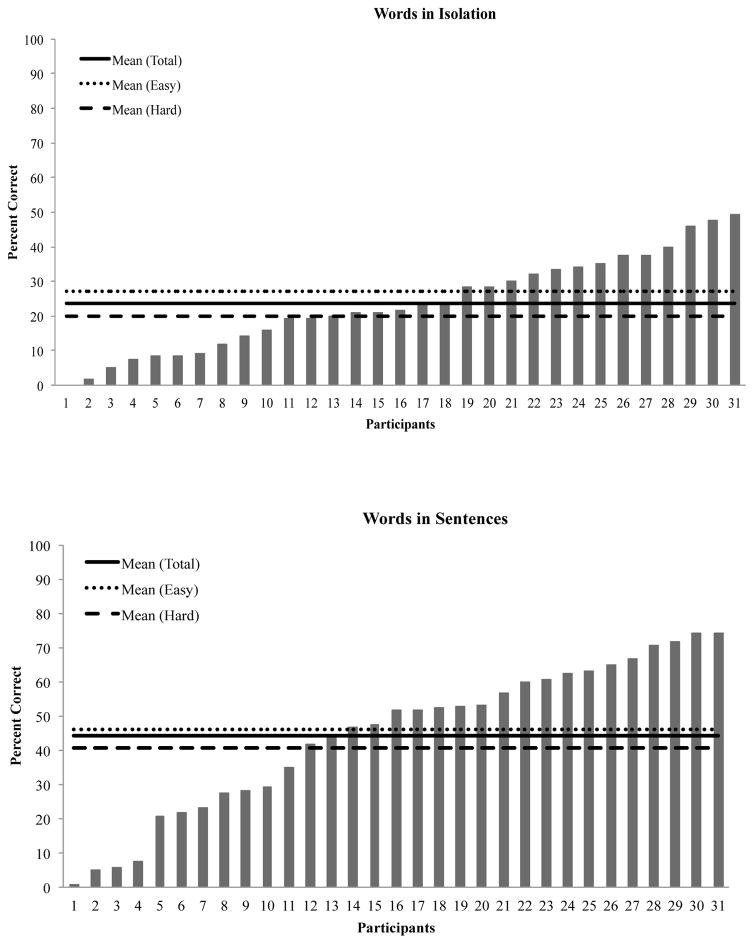
Consistent with the findings reported in the original ) study, we found that children perceived noise-vocoded lexically easy words better than lexically hard words. Words in sentences were also recognized better than the same words presented in isolation. No significant correlations were observed between noise-vocoded speech recognition scores and the Peabody Picture Vocabulary test-4th Edition using language quotients to control for age effects. However, children who scored higher on the Expressive Vocabulary test-2nd Edition recognized lexically easy words better than lexically hard words in sentences. Older children perceived noise-vocoded speech better than younger children. Finally, we found that measures of AA and short-term memory capacity were significantly correlated with a child's ability to perceive noise-vocoded isolated words and sentences.
First, we successfully replicated the major findings from the ) study. Because familiarity, phonological distinctiveness and lexical competition affect word recognition, these findings provide additional support for the proposal that several foundational elementary neurocognitive processes underlie the perception of spectrally degraded speech. Second, we found strong and significant correlations between performance on neurocognitive measures and children's ability to recognize words and sentences noise-vocoded to four spectral channels. These findings extend earlier research suggesting that perception of spectrally degraded speech reflects early peripheral auditory processes, as well as additional contributions of executive function, specifically, selective attention and short-term memory processes in spoken word recognition. The present findings suggest that AA and short-term memory support robust spoken word recognition in children with NH even under compromised and challenging listening conditions. These results are relevant to research carried out with listeners who have hearing loss, because they are routinely required to encode, process, and understand spectrally degraded acoustic signals.
噪声编码语音是一种有价值的研究工具,可用于检验关于频谱退化对听力正常(NH)成年人语音识别影响的实验假设。然而,很少有研究将噪声编码语音用于NH儿童。早期针对NH儿童的研究主要集中在语音识别所需的频谱信息量上,而没有评估神经认知过程对语音感知和口语单词识别的贡献。在本研究中,我们首先重复了(某人)报告的开创性发现,该研究调查了词汇密度和词频对一小群NH儿童噪声编码语音感知的影响。然后,我们扩展了研究范围,以调查噪声编码语音识别能力与五种神经认知指标之间的关系:听觉注意力(AA)和反应定势、说话者辨别能力,以及言语和非言语短期工作记忆。
对31名5至13岁的NH儿童进行评估,以了解他们在孤立状态下以及在被编码到四个频谱通道的句子中感知词汇控制单词的能力。还对儿童进行了词汇评估(皮博迪图片词汇测试第4版和表达性词汇测试第2版)以及AA测量(NEPSY AA和反应定势以及一个说话者辨别任务)和短期记忆测量(视觉数字和符号广度)。
与原始(某人)研究报告的结果一致,我们发现儿童对噪声编码的词汇简单的单词的感知优于词汇复杂的单词。句子中的单词也比孤立呈现的相同单词识别得更好。在使用语言商数控制年龄效应的情况下,噪声编码语音识别分数与皮博迪图片词汇测试第4版之间未观察到显著相关性。然而,在表达性词汇测试第2版中得分较高的儿童在句子中对词汇简单的单词的识别优于词汇复杂的单词。年龄较大的儿童比年龄较小的儿童对噪声编码语音的感知更好。最后,我们发现AA和短期记忆容量的测量与儿童感知噪声编码孤立单词和句子的能力显著相关。
首先,我们成功重复了(某人)研究的主要发现。由于熟悉度、语音独特性和词汇竞争会影响单词识别,这些发现为以下提议提供了额外支持,即几种基础的基本神经认知过程是频谱退化语音感知的基础。其次,我们发现神经认知测量的表现与儿童识别编码到四个频谱通道的单词和句子的能力之间存在强烈且显著的相关性。这些发现扩展了早期的研究,表明频谱退化语音的感知反映了早期外周听觉过程,以及执行功能的额外贡献,具体而言,是口语单词识别中的选择性注意力和短期记忆过程。目前的发现表明,即使在受损和具有挑战性的听力条件下,AA和短期记忆也支持NH儿童强大的口语单词识别。这些结果与对听力损失听众进行的研究相关,因为他们经常需要对频谱退化的声学信号进行编码、处理和理解。