Department of Otolaryngology-Head and Neck Surgery, Indiana University School of Medicine, Indianapolis, Indiana, USA.
Department of Psychological and Brain Sciences, Indiana University, Bloomington, Indiana, USA.
Ear Hear. 2019 Sep/Oct;40(5):1149-1161. doi: 10.1097/AUD.0000000000000691.
The objective of the present study was to determine whether long-term cochlear implant (CI) users would show greater variability in rapid phonological coding skills and greater reliance on slow-effortful compensatory executive functioning (EF) skills than normal-hearing (NH) peers on perceptually challenging high-variability sentence recognition tasks. We tested the following three hypotheses: First, CI users would show lower scores on sentence recognition tests involving high speaker and dialect variability than NH controls, even after adjusting for poorer sentence recognition performance by CI users on a conventional low-variability sentence recognition test. Second, variability in fast-automatic rapid phonological coding skills would be more strongly associated with performance on high-variability sentence recognition tasks for CI users than NH peers. Third, compensatory EF strategies would be more strongly associated with performance on high-variability sentence recognition tasks for CI users than NH peers.
Two groups of children, adolescents, and young adults aged 9 to 29 years participated in this cross-sectional study: 49 long-term CI users (≥7 years) and 56 NH controls. All participants were tested on measures of rapid phonological coding (Children's Test of Nonword Repetition), conventional sentence recognition (Harvard Sentence Recognition Test), and two novel high-variability sentence recognition tests that varied the indexical attributes of speech (Perceptually Robust English Sentence Test Open-set test and Perceptually Robust English Sentence Test Open-set test-Foreign Accented English test). Measures of EF included verbal working memory (WM), spatial WM, controlled cognitive fluency, and inhibition concentration.
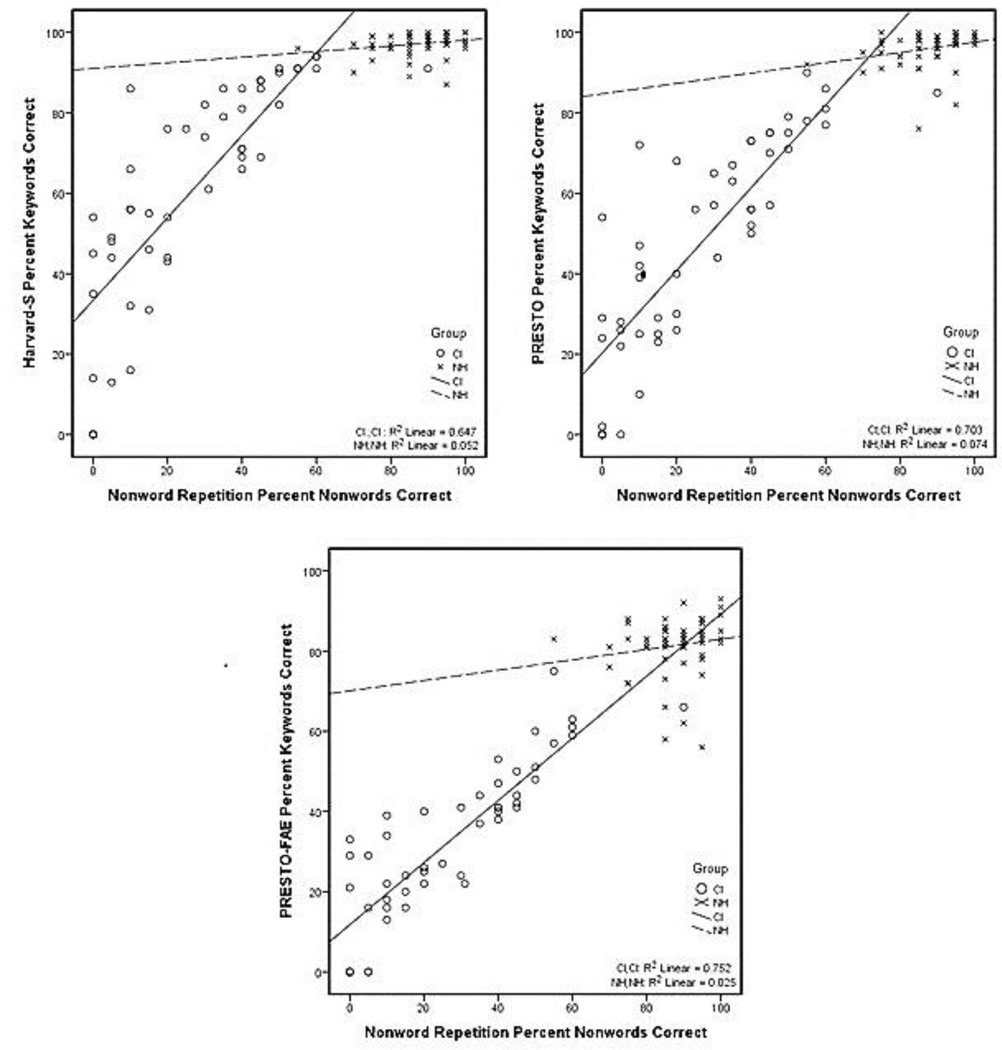
CI users scored lower than NH peers on both tests of high-variability sentence recognition even after conventional sentence recognition skills were statistically controlled. Correlations between rapid phonological coding and high-variability sentence recognition scores were stronger for the CI sample than for the NH sample even after basic sentence perception skills were statistically controlled. Scatterplots revealed different ranges and slopes for the relationship between rapid phonological coding skills and high-variability sentence recognition performance in CI users and NH peers. Although no statistically significant correlations between EF strategies and sentence recognition were found in the CI or NH sample after use of a conservative Bonferroni-type correction, medium to high effect sizes for correlations between verbal WM and sentence recognition in the CI sample suggest that further investigation of this relationship is needed.
These findings provide converging support for neurocognitive models that propose two channels for speech-language processing: a fast-automatic channel that predominates whenever possible and a compensatory slow-effortful processing channel that is activated during perceptually-challenging speech processing tasks that are not fully managed by the fast-automatic channel (ease of language understanding, framework for understanding effortful listening, and auditory neurocognitive model). CI users showed significantly poorer performance on measures of high-variability sentence recognition than NH peers, even after simple sentence recognition was controlled. Nonword repetition scores showed almost no overlap between CI and NH samples, and correlations between nonword repetition scores and high-variability sentence recognition were consistent with greater reliance on engagement of fast-automatic phonological coding for high-variability sentence recognition in the CI sample than in the NH sample. Further investigation of the verbal WM-sentence recognition relationship in CI users is recommended. Assessment of fast-automatic phonological processing and slow-effortful EF skills may provide a better understanding of speech perception outcomes in CI users in the clinical setting.
本研究旨在确定长期使用人工耳蜗(CI)的患者在感知挑战性高变异性句子识别任务中是否会表现出比正常听力(NH)对照组更大的快速语音编码技能变异性和更大的依赖于缓慢费力的补偿执行功能(EF)技能。我们检验了以下三个假设:首先,即使在对 CI 用户在常规低变异性句子识别测试中的较差句子识别表现进行调整后,CI 用户在涉及高说话者和方言变异性的句子识别测试中的得分仍低于 NH 对照组。其次,快速自动语音编码技能的变异性与 CI 用户在高变异性句子识别任务上的表现比 NH 同龄人更为密切相关。第三,补偿 EF 策略与 CI 用户在高变异性句子识别任务上的表现比 NH 同龄人更为密切相关。
本研究纳入了两组年龄在 9 至 29 岁之间的儿童、青少年和年轻成年人:49 名长期使用 CI(≥7 年)的患者和 56 名 NH 对照组。所有参与者均接受了快速语音编码(儿童非词重复测试)、常规句子识别(哈佛句子识别测试)和两项新的高变异性句子识别测试(感知稳健英语句子测试开放式测试和感知稳健英语句子测试开放式测试-外国口音英语测试)的测试。EF 测量包括言语工作记忆(WM)、空间 WM、控制认知流畅性和抑制集中。
即使在统计控制了常规句子识别技能后,CI 用户在两项高变异性句子识别测试中的得分仍低于 NH 对照组。即使在统计控制了基本句子感知技能后,CI 样本的语音编码与高变异性句子识别评分之间的相关性也强于 NH 样本。散点图显示了 CI 用户和 NH 对照组中快速语音编码技能与高变异性句子识别表现之间的关系的不同范围和斜率。尽管在 CI 或 NH 样本中使用保守的 Bonferroni 型校正后,EF 策略与句子识别之间没有统计学显著的相关性,但在 CI 样本中 WM 与句子识别之间的相关性的中到高效应大小表明需要进一步研究这种关系。
这些发现为神经认知模型提供了一致的支持,该模型提出了言语处理的两个通道:一个是优先的快速自动通道,另一个是补偿性的缓慢费力处理通道,当感知挑战性的言语处理任务不能完全由快速自动通道管理时,该通道就会被激活(语言理解的容易程度、费力聆听的框架和听觉神经认知模型)。CI 用户在高变异性句子识别测试中的表现明显比 NH 对照组差,即使在简单的句子识别得到控制后也是如此。在 CI 和 NH 样本中,非词重复分数几乎没有重叠,并且非词重复分数与高变异性句子识别之间的相关性表明,CI 样本比 NH 样本更依赖于快速自动语音编码的参与,以便在高变异性句子识别中进行处理。建议进一步研究 CI 用户的言语 WM-句子识别关系。对快速自动语音处理和缓慢费力的 EF 技能的评估可以更好地理解 CI 用户在临床环境中的言语感知结果。
