Cho Sang-A, Joo Hyung Joon, Cho Jae-Young, Lee Seung Hun, Park Jae Hyoung, Hong Soon Jun, Yu Cheol Woong, Lim Do-Sun
Department of Cardiology, Cardiovascular Center, Korea University Anam Hospital, Seoul, Korea.
PLoS One. 2017 Jan 3;12(1):e0169289. doi: 10.1371/journal.pone.0169289. eCollection 2017.
Although it has been demonstrated that visceral adipose tissue content and serum levels of adiponectin are associated with metabolic syndrome, their predictive potential for the development of metabolic syndrome remains to be elucidated.
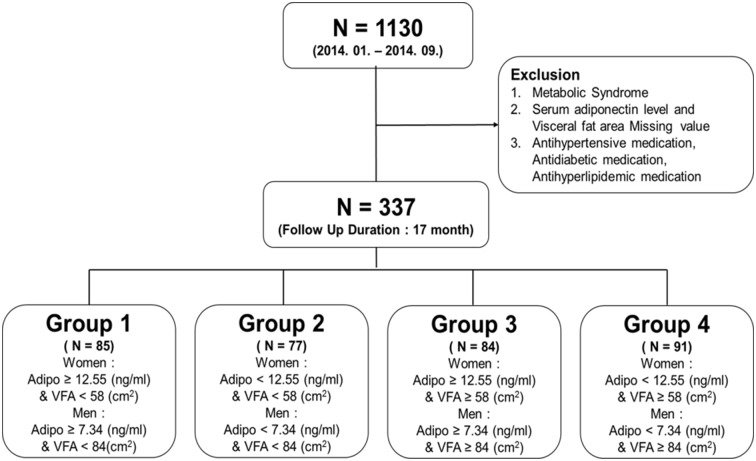
We studied 1,130 participants of the Seoul Metabolic Syndrome cohort. A total of 337 subjects without metabolic syndrome underwent the follow-up evaluation and finally analyzed. Visceral fat area (VFA) was measured using dual bioelectrical impedance analysis. We compared the 1-year incidence rate of metabolic syndrome among four different groups: Group 1 (high adiponectin level and low VFA), Group 2 (low adiponectin level and low VFA), Group 3 (high adiponectin level and high VFA) and Group 4 (low adiponectin level and high VFA).
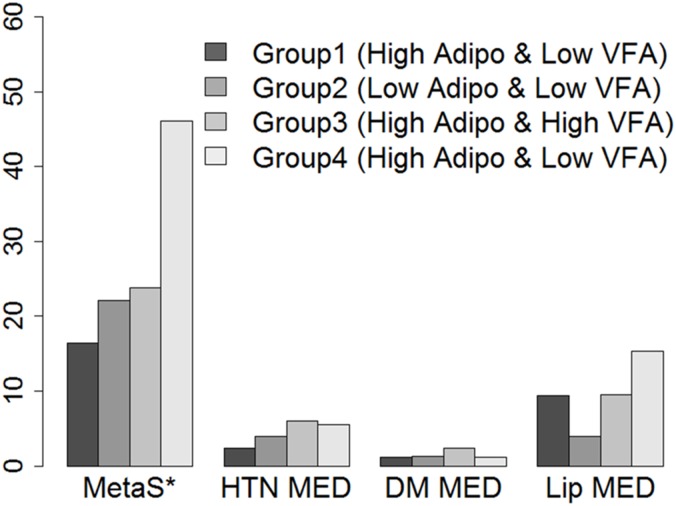
Median follow-up duration was 17 months. Cut-off points of adiponectin level and VFA for metabolic syndrome were 7.34 ng/ml and 84 cm2 for men, and 12.55 and 58 cm2 ng/ml for women, respectively. The incidence of metabolic syndrome was the highest in Group 4 (Group 1; 16.47%, Group 2; 22.08%, Group 3; 25%, and Group 4; 46.15%, p<0.001). Adjusted logistic regression analyses for metabolic syndrome prediction demonstrated that Group 4 exhibited the highest odds ratio compared with Group 1 (4.918 [2.05-11.795]), which was predominantly affected by waist circumference and serum triglyceride levels. Notably, triglyceride/high-density lipoprotein cholesterol (TG/HDL) ratio was significantly higher in Group 4 (p = 0.017).
Incidence rate of metabolic syndrome was the highest in subjects with low serum adiponectin levels and high visceral fat area. Higher TG/HDL ratio in these subjects suggested insulin resistance may contribute to the development of metabolic syndrome.
尽管已有研究表明内脏脂肪组织含量和脂联素血清水平与代谢综合征相关,但其对代谢综合征发生的预测潜力仍有待阐明。
我们对首尔代谢综合征队列中的1130名参与者进行了研究。共有337名无代谢综合征的受试者接受了随访评估并最终进行分析。使用双频生物电阻抗分析测量内脏脂肪面积(VFA)。我们比较了四个不同组的代谢综合征1年发病率:第1组(脂联素水平高且VFA低)、第2组(脂联素水平低且VFA低)、第3组(脂联素水平高且VFA高)和第4组(脂联素水平低且VFA高)。
中位随访时间为17个月。男性代谢综合征的脂联素水平和VFA切点分别为7.34 ng/ml和84 cm²,女性分别为12.55 ng/ml和58 cm²。代谢综合征的发病率在第4组中最高(第1组为16.47%,第2组为22.08%,第3组为25%,第4组为46.15%,p<0.001)。对代谢综合征预测的校正逻辑回归分析表明,与第1组相比,第4组的优势比最高(4.918 [2.05 - 11.795]),主要受腰围和血清甘油三酯水平影响。值得注意的是,第4组的甘油三酯/高密度脂蛋白胆固醇(TG/HDL)比值显著更高(p = 0.017)。
血清脂联素水平低且内脏脂肪面积高的受试者中代谢综合征的发病率最高。这些受试者中较高的TG/HDL比值表明胰岛素抵抗可能促成代谢综合征的发生。