Hyun Young Youl, Lee Kyu Beck, Han Seung Hyeok, Kim Yeong Hoon, Kim Yong Soo, Lee Sung Woo, Oh Yun Kyu, Chae Dong Wan, Ahn Curie
Division of Nephrology, Department of Internal Medicine, Kangbuk Samsung Hospital, Sungkyunkwan University School of Medicine, Seoul, Korea.
Department of Internal Medicine, Severance Hospital, Yonsei University College of Medicine, Seoul, Korea.
J Korean Med Sci. 2017 Feb;32(2):257-263. doi: 10.3346/jkms.2017.32.2.257.
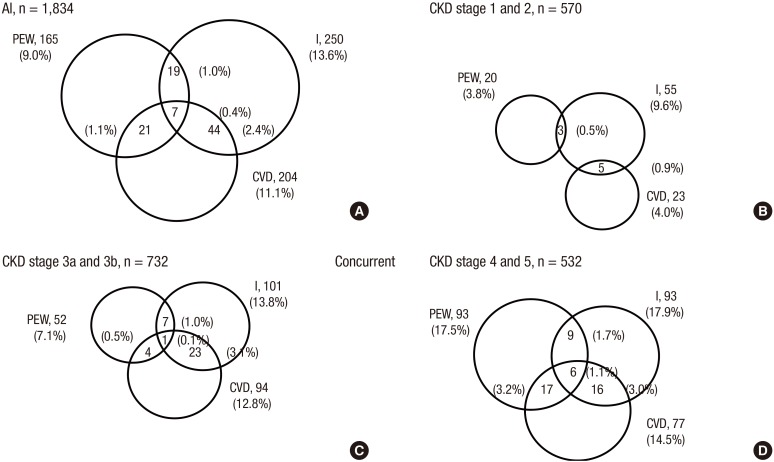
Adverse changes in nutrition are prevalent and are strong indicators of adverse outcomes in patients with chronic kidney disease (CKD). The International Society of Renal Nutrition and Metabolism (ISRNM) proposed a common nomenclature and diagnostic criteria to identify protein-energy wasting (PEW) in CKD patients. We examined the nutritional status in 1,834 adults with predialysis CKD enrolled in the KoreaN cohort study for Outcome in patients With Chronic Kidney Disease (KNOW-CKD) study. As there was a need for further understanding of nutritional status and associated factors in CKD, we evaluated the prevalence and associated factors of PEW in adults with predialysis CKD. The prevalence of PEW was about 9.0% according to ISRNM criteria and tended to increase with advanced stage in predialysis CKD. Those who concurrently had PEW, inflammation, and CVD were a small proportion (0.4%). In multivariate logistic regression model, PEW was independently associated with estimated glomerular filtration rate (eGFR) (odds ratio [OR], 0.98; 95% confidence interval [CI], 0.96-0.99), total CO₂ (OR, 0.93; 95% CI, 0.87-0.99), physical activity (OR, 0.43; 95% CI, 0.26-0.69), comorbid diabetes (OR, 1.68; 95% CI, 1.09-2.59), and high sensitivity C-reactive protein (hs-CRP) (OR, 1.03; 95% CI, 1.01-1.06). Our study suggests that PEW increases with advanced CKD stage. PEW is independently associated with renal function, low total CO₂, low physical activity, comorbid diabetes, and increased hs-CRP in adults with predialysis CKD.
营养方面的不良变化很普遍,并且是慢性肾脏病(CKD)患者不良结局的有力指标。国际肾脏营养与代谢学会(ISRNM)提出了一种通用的命名法和诊断标准,以识别CKD患者中的蛋白质能量消耗(PEW)。我们在韩国慢性肾脏病患者结局队列研究(KNOW-CKD)中,对1834例未透析的CKD成年患者的营养状况进行了检查。由于需要进一步了解CKD患者的营养状况及其相关因素,我们评估了未透析CKD成年患者中PEW的患病率及其相关因素。根据ISRNM标准,PEW的患病率约为9.0%,并且在未透析CKD患者中,其患病率往往随着疾病进展而增加。同时患有PEW、炎症和心血管疾病的患者占比很小(0.4%)。在多因素逻辑回归模型中,PEW与估计肾小球滤过率(eGFR)(比值比[OR],0.98;95%置信区间[CI],0.96-0.99)、总二氧化碳(OR,0.93;95%CI,0.87-0.99)、身体活动(OR,0.43;95%CI,0.26-0.69)、合并糖尿病(OR,1.68;95%CI,1.09-2.59)以及高敏C反应蛋白(hs-CRP)(OR,1.03;95%CI,1.01-1.06)独立相关。我们的研究表明,PEW随着CKD疾病进展而增加。在未透析的CKD成年患者中,PEW与肾功能、低总二氧化碳、低身体活动、合并糖尿病以及hs-CRP升高独立相关。