Department of Internal Medicine, Seoul National University College of Medicine, Seoul, Korea.
Department of Internal Medicine, Seoul National University College of Medicine, Seoul, Korea; Kidney Research Institute, Seoul National University, Seoul, Korea.
Kidney Res Clin Pract. 2013 Dec;32(4):164-70. doi: 10.1016/j.krcp.2013.09.001. Epub 2013 Nov 12.
Periodontitis and chronic kidney disease (CKD) are important health issues; however, the association between periodontitis and CKD markers, especially in Korean adults, remains elusive.
Data on 15,729 Korean adults were obtained from the Korean National Health and Nutritional Examination Surveys IV and V. The CKD markers included a decreased estimated glomerular filtration rate (eGFR;<60 mL/min/1.73 m(2)), proteinuria, and hematuria. Odds ratios (ORs) and 95% confidence intervals were measured using stepwise multivariate logistic regression analyses for CKD markers based on the presence of periodontitis.
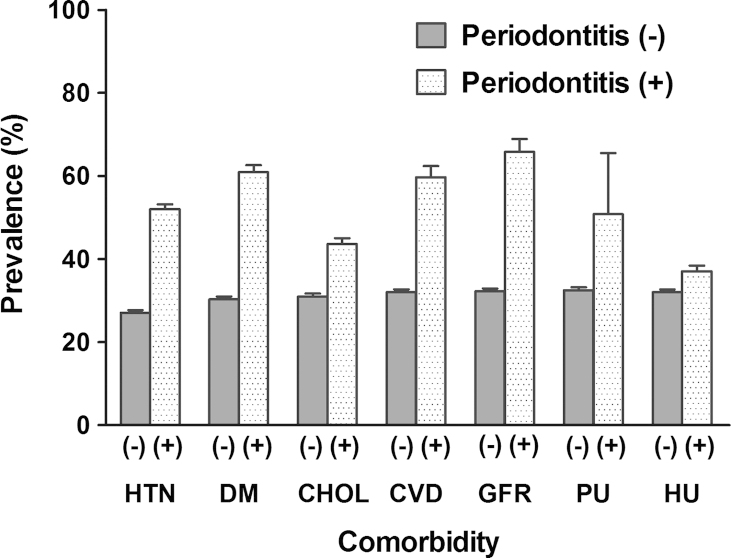
Patients with periodontitis had greater unadjusted ORs for CKD markers compared to those without periodontitis, as follows: decreased eGFR, 4.07 (3.11-5.33); proteinuria, 2.12 (1.48-3.05); and hematuria, 1.25 (1.13-1.39, all P<0.001). Periodontitis was a significant predictor of decreased eGFR independent of all covariates [1.39 (1.03-1.89), P=0.034]. However, the effect of periodontitis on decreased eGFR seemed to be affected by hypertension and diabetes mellitus. Periodontitis was not an independent predictor of proteinuria; the significance disappeared after adjusting for hypertension and diabetes mellitus. Periodontitis was significantly correlated with hematuria, leading to similar ORs regardless of the adjustment for covariates [1.29 (1.15-1.46), P<0.001].
This study confirms the correlation between periodontitis and CKD markers, including decreased eGFR, proteinuria, and hematuria in Korean adults.
牙周炎和慢性肾脏病(CKD)是重要的健康问题;然而,牙周炎与 CKD 标志物之间的关系,特别是在韩国成年人中,仍然难以确定。
本研究的数据来自韩国第四次和第五次全国健康和营养调查,共纳入 15729 名韩国成年人。CKD 标志物包括估算肾小球滤过率(eGFR)降低(<60mL/min/1.73m2)、蛋白尿和血尿。采用逐步多元逻辑回归分析,根据是否存在牙周炎,评估牙周炎与 CKD 标志物之间的比值比(OR)及其 95%置信区间。
与无牙周炎者相比,有牙周炎者 CKD 标志物的未经校正 OR 更高,具体如下:eGFR 降低(4.07,3.11-5.33)、蛋白尿(2.12,1.48-3.05)和血尿(1.25,1.13-1.39,均 P<0.001)。牙周炎是 eGFR 降低的独立预测因素,不受所有协变量影响[1.39(1.03-1.89),P=0.034]。然而,牙周炎对 eGFR 降低的影响似乎受高血压和糖尿病的影响。牙周炎不是蛋白尿的独立预测因素;调整高血压和糖尿病后,其显著性消失。牙周炎与血尿显著相关,调整协变量后 OR 相似[1.29(1.15-1.46),P<0.001]。
本研究证实了牙周炎与 CKD 标志物,包括韩国成年人的 eGFR 降低、蛋白尿和血尿之间的相关性。