Kungu Joseph M, Dione Michel M, Ejobi Francis, Ocaido Michael, Grace Delia
National Livestock Resources Research Institute, P. O. Box 96, Tororo, Uganda.
College of Veterinary Medicine Animal Resources and Biosecurity, Makerere University, P. O. Box 7062, Kampala, Uganda.
BMC Infect Dis. 2017 Jan 3;17(1):1. doi: 10.1186/s12879-016-2122-x.
Prevalence studies report Taenia solium cysticercosis in pig and human populations in Uganda. However, the factors influencing occurrence in smallholder pig production systems are not well documented and little is known about farmers' perceptions of T. solium cysticercosis or farmer practices that could reduce transmission.
To determine the risk factors, perceptions and practices regarding T. solium cysticercosis, a household survey using a semi-structured questionnaire was conducted in 1185 households in the rural and urban pig production systems in Masaka, Mukono and Kamuli Districts. Logistic regression was used to measure associations of risk factors with infection. Performance scores were calculated to summarise perceptions and practices of farmers regarding taeniosis, human cysticercosis and porcine cysticercosis as well as farmer behavior related to control or breaking transmission.
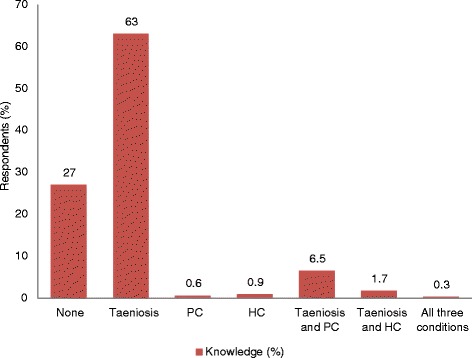
Pig breed type, farmers' knowledge about transmission, sources of water used, and pig keeping homes where family members were unable to use the latrine were all significantly associated with T. solium cysticercosis in pigs. Performance scores indicated that farmers were more aware of taeniosis (63.0%; 95% Confidence Interval 60.0-65.8) than human or porcine cysticercosis; only three farmers (0.3%, 95% CI = 0.1-0.8) had knowledge on all three conditions. More farmers reported that they dewormed pigs (94.1%) than reported deworming themselves and their family members (62.0%). Albendazole was the most commonly used drug for deworming both pigs and humans (85.0 and 81.5% respectively). Just over half (54.6%) of the farmers interviewed had clean water near the latrines for washing hands. Of these, only 41.9% used water with soap to wash hands after latrine use.
Factors that significantly influenced occurrence of T. solium cysticercosis in pigs were identified. Farmers had some knowledge about the disease but did not link taeniosis, human cysticercosis, and porcine cysticercosis. Therefore, there is need to employ strategies that raise awareness and interrupt transmission.
患病率研究报告了乌干达猪群和人群中的猪带绦虫囊尾蚴病情况。然而,关于影响小农户养猪生产系统中该病发生的因素,目前尚无充分记录,而且对于农民对猪带绦虫囊尾蚴病的认知以及可能减少传播的养殖行为知之甚少。
为了确定与猪带绦虫囊尾蚴病相关的风险因素、认知和行为,在马萨卡、穆科诺和卡穆利地区的农村和城市养猪生产系统中,对1185户家庭进行了一项使用半结构化问卷的家庭调查。采用逻辑回归分析来衡量风险因素与感染之间的关联。计算绩效得分,以总结农民对绦虫病、人体囊尾蚴病和猪囊尾蚴病的认知和行为,以及农民与控制或阻断传播相关的行为。
猪的品种类型、农民对传播途径的了解、用水来源以及家庭成员无法使用厕所的养猪场所,均与猪带绦虫囊尾蚴病显著相关。绩效得分表明,农民对绦虫病(63.0%;95%置信区间60.0 - 65.8)的了解比对人体或猪囊尾蚴病的了解更多;只有三名农民(0.3%,95%CI = 0.1 - 0.8)对所有三种情况都有了解。更多农民报告说他们给猪驱虫(94.1%),而给自己和家人驱虫的比例为62.0%。阿苯达唑是最常用于给猪和人驱虫的药物(分别为85.0%和81.5%)。接受采访的农民中,略超过一半(54.6%)在厕所附近有清洁用水用于洗手。其中,只有41.9%的人在使用厕所后用肥皂洗手。
确定了显著影响猪带绦虫囊尾蚴病发生的因素。农民对该疾病有一定了解,但并未将绦虫病、人体囊尾蚴病和猪囊尾蚴病联系起来。因此,需要采取提高认识和阻断传播的策略。