One Health Center for Zoonoses and Tropical Veterinary Medicine, Ross University School of Veterinary Medicine, Basseterre, Saint Kitts and Nevis.
Department of Parasitology, Institute of Ecology and Biological Resources, Vietnam Academy of Science and Technology, Hanoi, Vietnam.
Parasit Vectors. 2018 Nov 29;11(1):613. doi: 10.1186/s13071-018-3203-z.
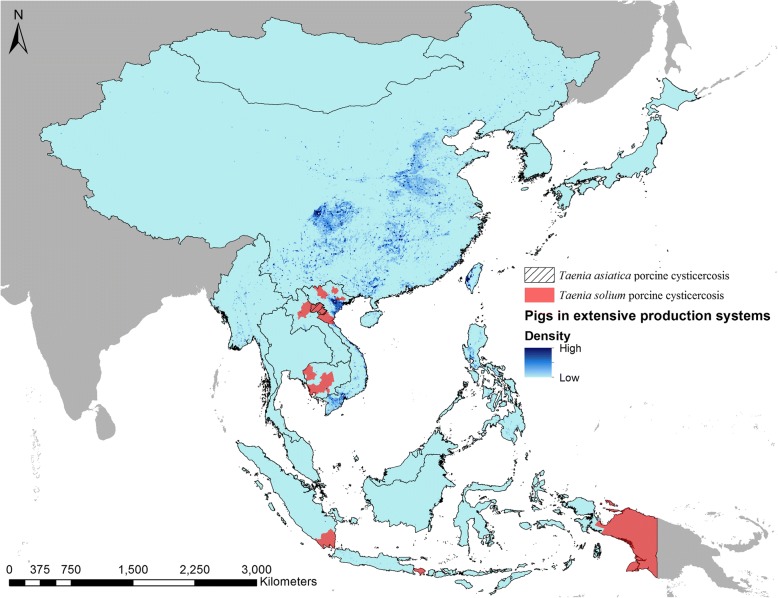
Due to the relative short life span and the limited spatial movement, porcine cysticercosis is an excellent indicator of current local active transmission. The aim of this study was to map at province-level, the occurrence of T. solium and T. asiatica in pigs and areas at risk of transmission to pigs in East and Southeast Asia, based on the density of extensive pig production systems and confirmed reports of porcine cysticercosis.
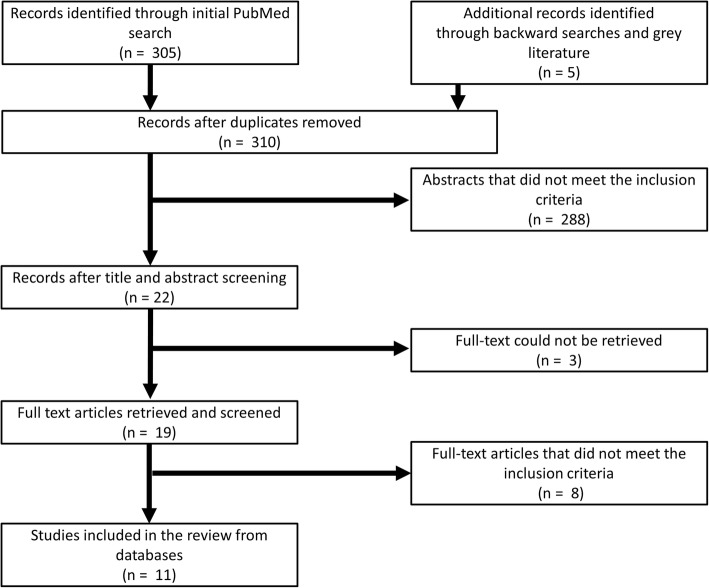
This study covered East and Southeast Asia, which consist of the following countries: Brunei, Cambodia, China, East Timor, Indonesia, Japan, Laos, Malaysia, Mongolia, Myanmar, North Korea, Philippines, Singapore, South Korea, Thailand and Vietnam. Literature searches were carried out to identify current epidemiological data on the occurrence of porcine cysticercosis caused by T. solium and T. asiatica infections. Modelled densities of pigs in extensive production systems were mapped and compared to available data on porcine cysticercosis.
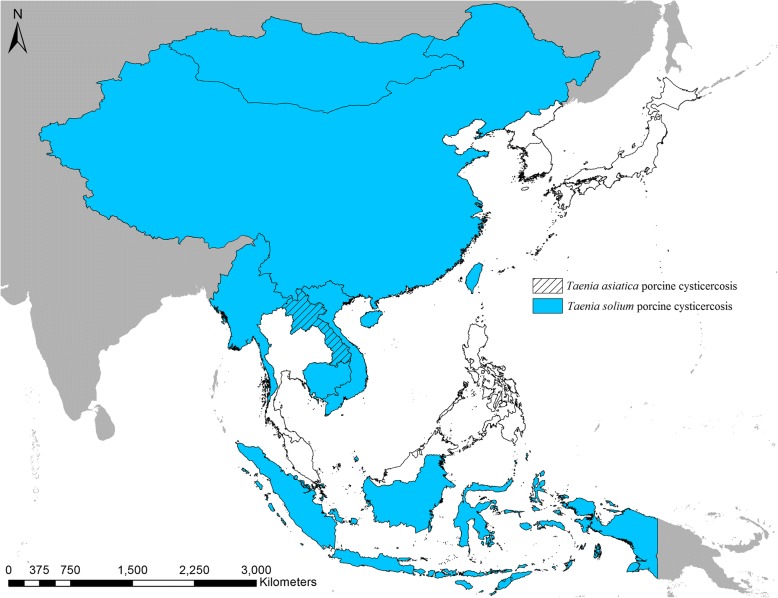
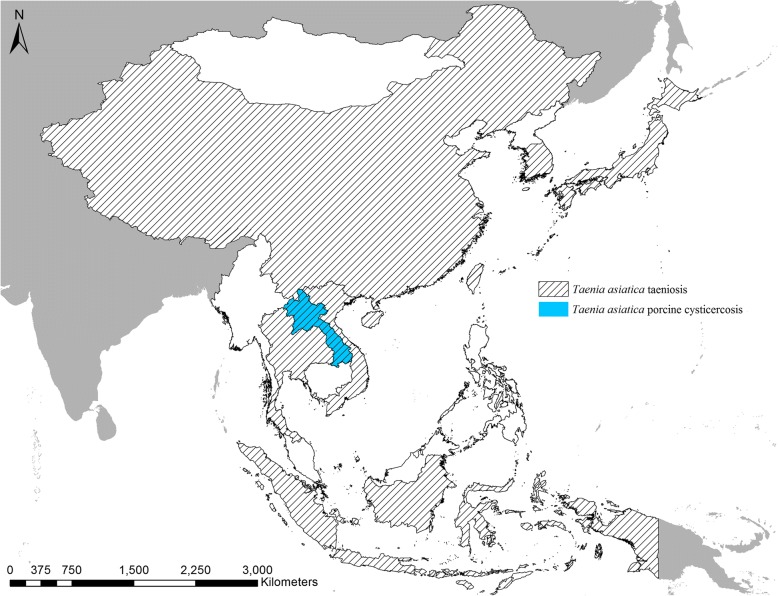
Porcine cysticercosis was confirmed to be present during the period 2000 to 2018 in eight out of the 16 countries included in this study. Taenia solium porcine cysticercosis was confirmed from all eight countries, whereas only one country (Laos) could confirm the presence of T. asiatica porcine cysticercosis. Province-level occurrence was identified in five countries (Cambodia, Indonesia, Laos, Myanmar, and Vietnam) across 19 provinces. Smallholder pig keeping is believed to be widely distributed throughout the region, with greater densities predicted to occur in areas of China, Myanmar, Philippines and Vietnam.
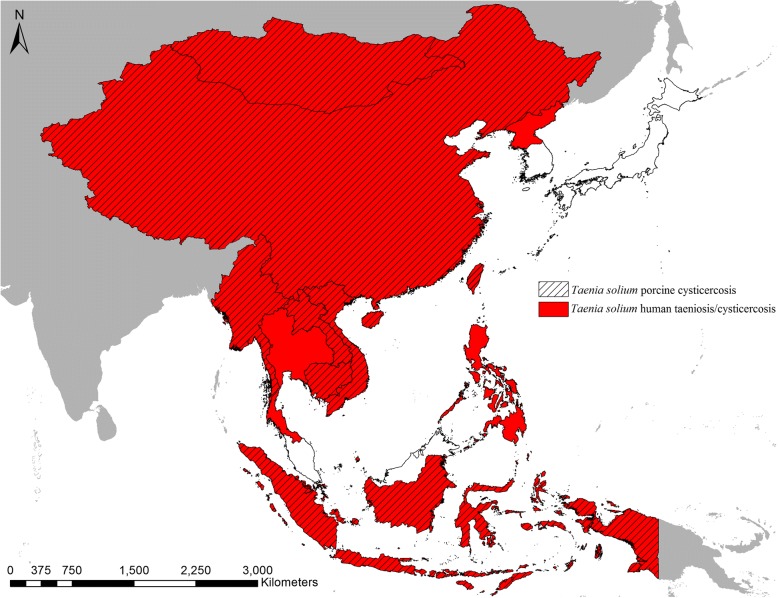
The discrepancies between countries reporting taeniosis and the occurrence of porcine cysticercosis, both for T. solium and T. asiatica, suggests that both parasites are underreported. More epidemiological surveys are needed to determine the societal burden of both parasites. This study highlights a straightforward approach to determine areas at risk of porcine cysticercosis in the absence of prevalence data.
由于相对较短的寿命和有限的空间运动,猪囊尾蚴病是当前当地活动性传播的极好指标。本研究的目的是根据广泛的养猪系统的密度和已证实的猪囊尾蚴病报告,在省级范围内绘制东亚和东南亚地区猪和猪感染风险区的猪带绦虫和亚洲带绦虫的发生情况。
本研究涵盖东亚和东南亚,包括以下国家:文莱、柬埔寨、中国、东帝汶、印度尼西亚、日本、老挝、马来西亚、蒙古、缅甸、朝鲜、菲律宾、新加坡、韩国、泰国和越南。进行了文献检索,以确定当前由猪带绦虫和亚洲带绦虫感染引起的猪囊尾蚴病的流行情况的流行病学数据。对广泛生产系统中猪的模拟密度进行了映射,并与猪囊尾蚴病的现有数据进行了比较。
在本研究包括的 16 个国家中的 8 个国家中,确认在 2000 年至 2018 年期间存在猪囊尾蚴病。确认所有 8 个国家均存在猪带绦虫猪囊尾蚴病,而只有一个国家(老挝)能够确认存在亚洲带绦虫猪囊尾蚴病。在五个国家(柬埔寨、印度尼西亚、老挝、缅甸和越南)的 19 个省确定了省级发生情况。该地区广泛分布着小农户养猪,预计在中国、缅甸、菲律宾和越南的地区密度更大。
报告带绦虫病和猪囊尾蚴病(无论是猪带绦虫还是亚洲带绦虫)的国家之间存在差异,表明这两种寄生虫的报告都不足。需要进行更多的流行病学调查,以确定这两种寄生虫的社会负担。本研究强调了在缺乏流行率数据的情况下确定猪囊尾蚴病风险地区的简单方法。