Wanasuntronwong Aree, Jansri Ukkrit, Srikiatkhachorn Anan
Department of Oral Biology, Faculty of Dentistry, Mahidol University, 6 Yothi Road, Ratchathewi, Bangkok, 10400, Thailand.
Department of Physiology, Faculty of Medicine, Chulalongkorn University, 1874 Rama 4 Road, Pathumwan, Bangkok, 10330, Thailand.
BMC Neurosci. 2017 Jan 3;18(1):1. doi: 10.1186/s12868-016-0326-z.
Patients with medication-overuse headache suffer not only from chronic headache, but often from psychiatric comorbidities, such as anxiety and depression. The mechanisms underlying these comorbidities are unclear, but the amygdala is likely to be involved in their pathogenesis. To investigate the mechanisms underlying the comorbidities we used elevated plus maze and open field tests to assess anxiety-like behavior in rats chronically treated with analgesics. We measured the electrical properties of neurons in the amygdala, and examined the cortical spreading depression (CSD)-evoked expression of Fos in the trigeminal nucleus caudalis (TNC) and amygdala of rats chronically treated with analgesics. CSD, an analog of aura, evokes Fos expression in the TNC of rodents suggesting trigeminal nociception, considered to be a model of migraine.
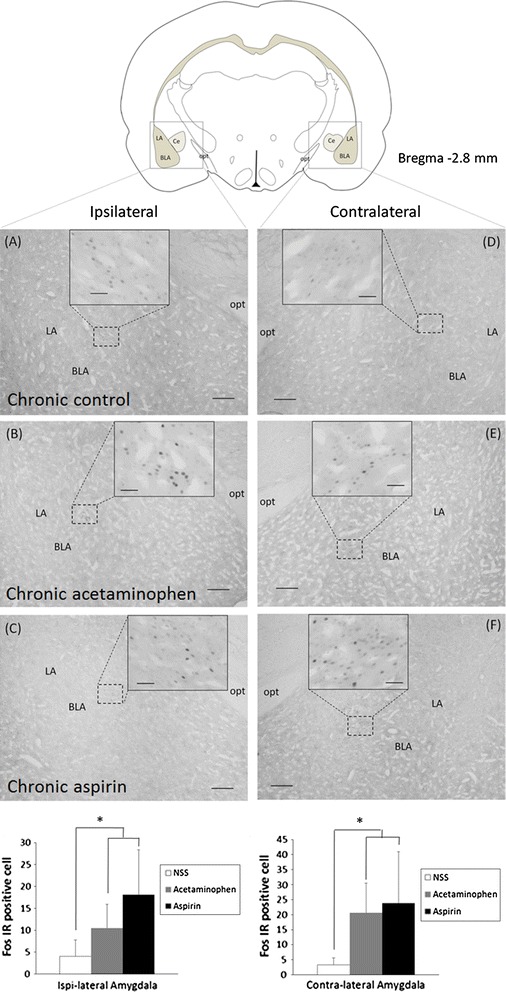
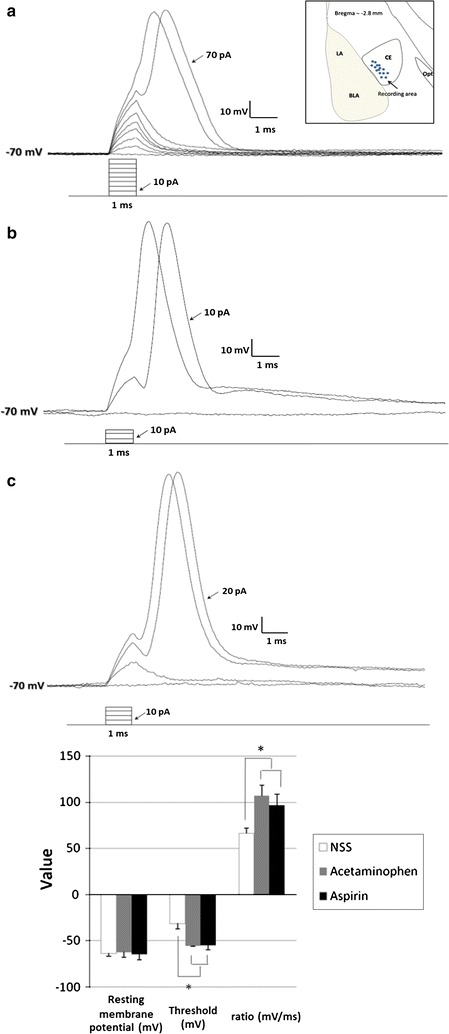
Increased anxiety-like behavior was seen both in elevated plus maze and open field tests in a model of medication overuse produced in male rats by chronic treatment with aspirin or acetaminophen. The time spent in the open arms of the maze by aspirin- or acetaminophen-treated rats (53 ± 36.1 and 37 ± 29.5 s, respectively) was significantly shorter than that spent by saline-treated vehicle control rats (138 ± 22.6 s, P < 0.001). Chronic treatment with the analgesics increased the excitability of neurons in the central nucleus of the amygdala as indicated by their more negative threshold for action potential generation (-54.6 ± 5.01 mV for aspirin-treated, -55.2 ± 0.97 mV for acetaminophen-treated, and -31.50 ± 5.34 mV for saline-treated rats, P < 0.001). Chronic treatment with analgesics increased the CSD-evoked expression of Fos in the TNC and amygdala [18 ± 10.2 Fos-immunoreactive (IR) neurons per slide in the amygdala of rats treated with aspirin, 11 ± 5.4 IR neurons per slide in rats treated with acetaminophen, and 4 ± 3.7 IR neurons per slide in saline-treated control rats, P < 0.001].
Chronic treatment with analgesics can increase the excitability of neurons in the amygdala, which could underlie the anxiety seen in patients with medication-overuse headache.
药物过量使用性头痛患者不仅患有慢性头痛,还常常伴有精神共病,如焦虑和抑郁。这些共病的潜在机制尚不清楚,但杏仁核可能参与其发病过程。为了研究这些共病的潜在机制,我们使用高架十字迷宫和旷场试验来评估长期接受镇痛药治疗的大鼠的焦虑样行为。我们测量了杏仁核中神经元的电特性,并检测了慢性接受镇痛药治疗的大鼠三叉神经尾侧核(TNC)和杏仁核中皮层扩散性抑制(CSD)诱发的Fos表达。CSD是先兆的类似物,可诱发啮齿动物TNC中的Fos表达,提示三叉神经伤害感受,被认为是偏头痛的一种模型。
在雄性大鼠中,通过长期给予阿司匹林或对乙酰氨基酚建立药物过量使用模型,在高架十字迷宫和旷场试验中均观察到焦虑样行为增加。阿司匹林或对乙酰氨基酚处理的大鼠在迷宫开放臂上花费的时间(分别为53±36.1秒和37±29.5秒)显著短于生理盐水处理的对照大鼠(138±22.6秒,P<0.001)。镇痛药的长期治疗增加了杏仁核中央核中神经元的兴奋性,表现为其产生动作电位的阈值更负(阿司匹林处理的大鼠为-54.6±5.01mV,对乙酰氨基酚处理的大鼠为-55.2±0.97mV,生理盐水处理的大鼠为-31.50±5.34mV,P<0.001)。镇痛药的长期治疗增加了TNC和杏仁核中CSD诱发的Fos表达[阿司匹林处理的大鼠杏仁核中每张切片有18±10.2个Fos免疫反应性(IR)神经元,对乙酰氨基酚处理的大鼠每张切片有11±5.4个IR神经元,生理盐水处理的对照大鼠每张切片有4±3.7个IR神经元,P<0.001]。
镇痛药的长期治疗可增加杏仁核中神经元的兴奋性,这可能是药物过量使用性头痛患者出现焦虑的原因。