Servant Geraldine, Streva Vincent A, Derbes Rebecca S, Wijetunge Madushani I, Neeland Marc, White Travis B, Belancio Victoria P, Roy-Engel Astrid M, Deininger Prescott L
Department of Epidemiology, School of Public Health and Tropical Medicine, Tulane Cancer Center, Tulane University, New Orleans, Louisiana 70112.
Department of Structural and Cellular Biology, School of Medicine, Tulane Cancer Center, Tulane University, New Orleans, Louisiana 70112.
Genetics. 2017 Jan;205(1):139-153. doi: 10.1534/genetics.116.188680. Epub 2016 Nov 14.
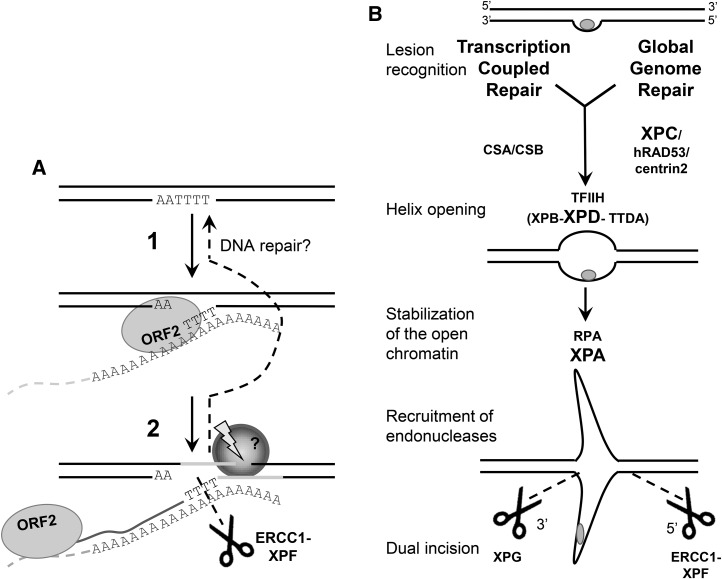
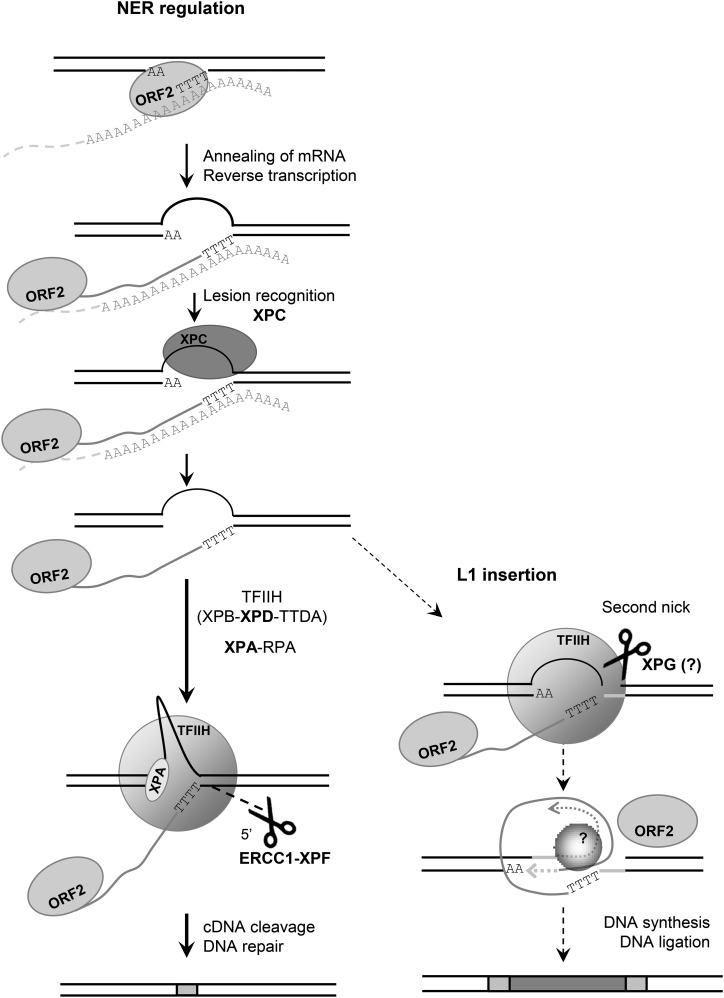
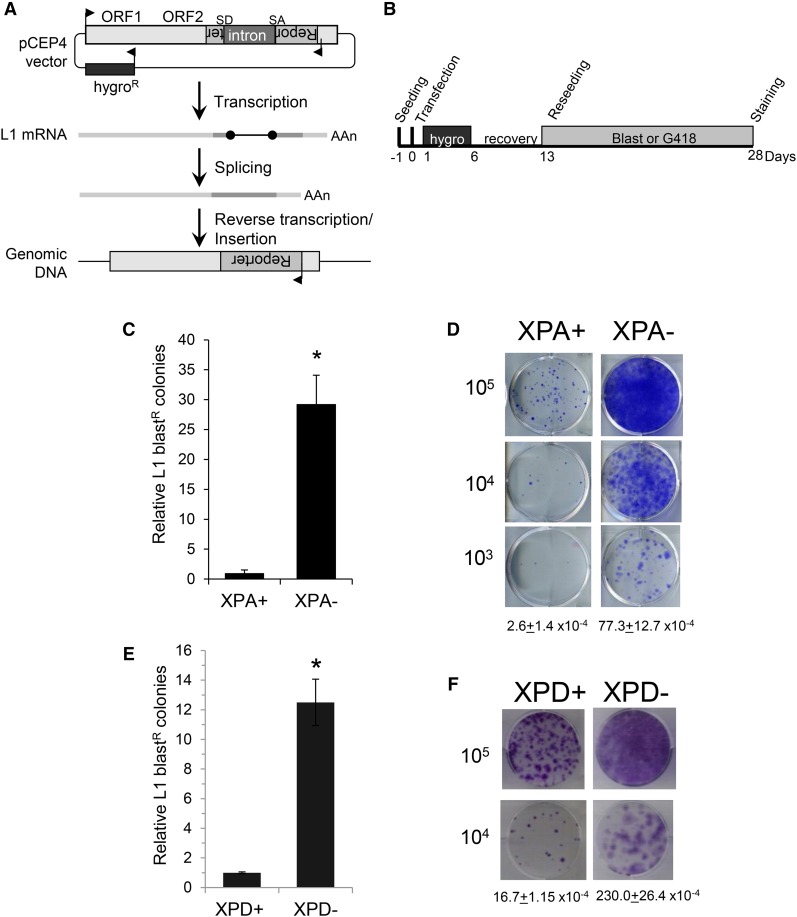
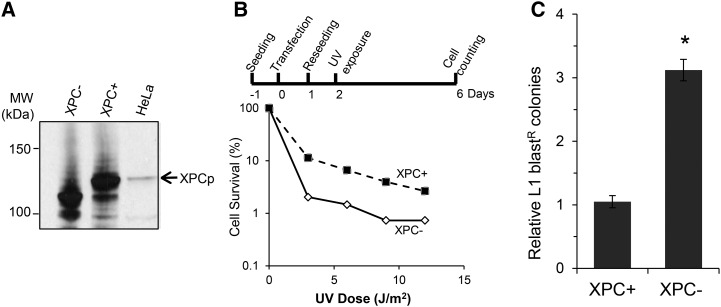
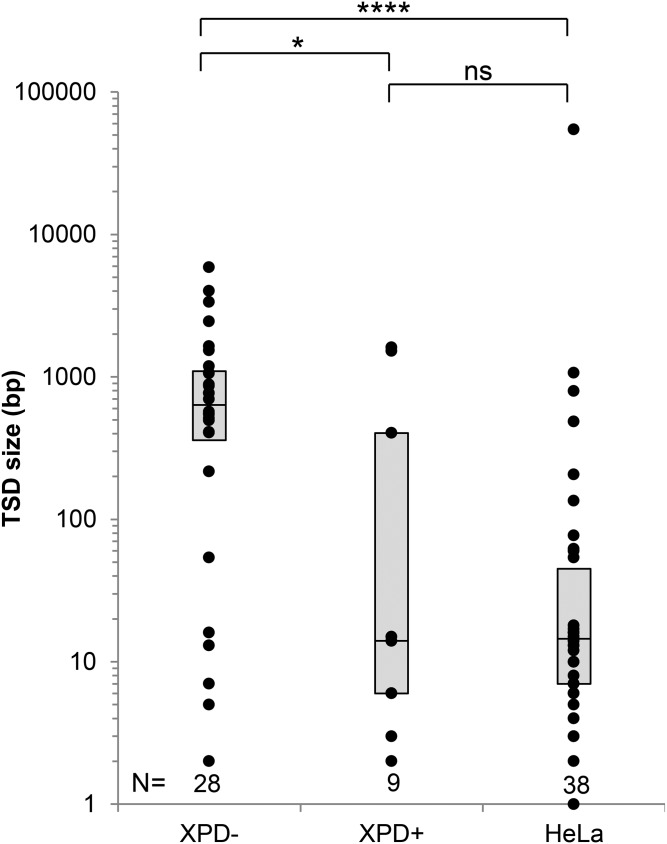
Long interspersed elements 1 (L1) are active mobile elements that constitute almost 17% of the human genome. They amplify through a "copy-and-paste" mechanism termed retrotransposition, and de novo insertions related to these elements have been reported to cause 0.2% of genetic diseases. Our previous data demonstrated that the endonuclease complex ERCC1-XPF, which cleaves a 3' DNA flap structure, limits L1 retrotransposition. Although the ERCC1-XPF endonuclease participates in several different DNA repair pathways, such as single-strand annealing, or in telomere maintenance, its recruitment to DNA lesions is best characterized in the nucleotide excision repair (NER) pathway. To determine if the NER pathway prevents the insertion of retroelements in the genome, we monitored the retrotransposition efficiencies of engineered L1 elements in NER-deficient cells and in their complemented versions. Core proteins of the NER pathway, XPD and XPA, and the lesion binding protein, XPC, are involved in limiting L1 retrotransposition. In addition, sequence analysis of recovered de novo L1 inserts and their genomic locations in NER-deficient cells demonstrated the presence of abnormally large duplications at the site of insertion, suggesting that NER proteins may also play a role in the normal L1 insertion process. Here, we propose new functions for the NER pathway in the maintenance of genome integrity: limitation of insertional mutations caused by retrotransposons and the prevention of potentially mutagenic large genomic duplications at the site of retrotransposon insertion events.
长散在元件1(L1)是活跃的移动元件,几乎占人类基因组的17%。它们通过一种称为逆转录转座的“复制粘贴”机制进行扩增,据报道与这些元件相关的从头插入会导致0.2%的遗传疾病。我们之前的数据表明,切割3' DNA瓣状结构的核酸内切酶复合物ERCC1-XPF限制了L1逆转录转座。尽管ERCC1-XPF核酸内切酶参与了几种不同的DNA修复途径,如单链退火,或端粒维持,但其在DNA损伤处的募集在核苷酸切除修复(NER)途径中得到了最好的表征。为了确定NER途径是否能防止逆转录元件插入基因组,我们监测了工程化L1元件在NER缺陷细胞及其互补细胞中的逆转录转座效率。NER途径的核心蛋白XPD和XPA,以及损伤结合蛋白XPC,都参与限制L1逆转录转座。此外,对NER缺陷细胞中回收的从头L1插入序列及其基因组位置的分析表明,插入位点存在异常大的重复序列,这表明NER蛋白可能在正常L1插入过程中也发挥作用。在此,我们提出NER途径在维持基因组完整性方面的新功能:限制逆转录转座子引起的插入突变,并防止逆转录转座子插入事件位点出现潜在的诱变大基因组重复。