Ito Koji, Miyata Kenji, Mohri Masahiro, Origuchi Hideki, Yamamoto Hideo
Department of Medical Informatics, Japan Community Health care Organization, Kyushu Hospital, Japan.
Intern Med. 2017;56(1):23-29. doi: 10.2169/internalmedicine.56.7538. Epub 2017 Jan 1.
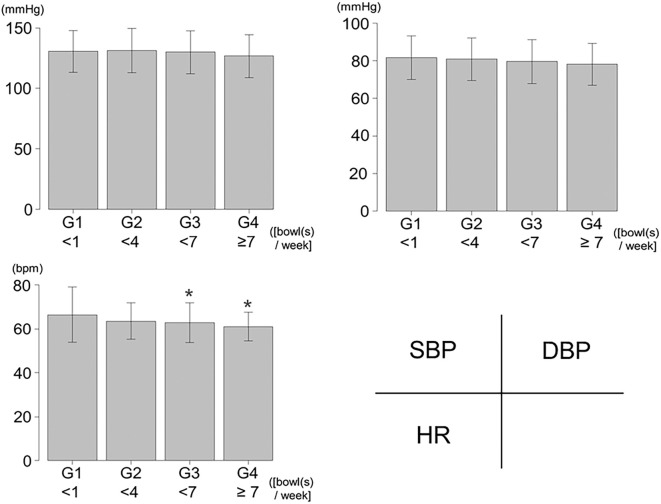
Objective It is recommended that middle-aged and elderly individuals reduce their salt intake because of the high prevalence of hypertension. The consumption of miso soup is associated with salt intake, and the reduced consumption of miso soup has been recommended. Recent studies have demonstrated that the consumption of miso soup can attenuate an autonomic imbalance in animal models. However, it is unclear whether these results are applicable to humans. This study examined the cross-sectional association between the frequency of miso soup consumption and the blood pressure and heart rate of human subjects. Methods A total of 527 subjects of 50 to 81 years of age who participated in our hospital health examination were enrolled in the present study and divided into four groups based on the frequency of their miso soup consumption ([bowl(s) of miso soup/week] Group 1, <1; Group2, <4; Group3, <7; Group4, ≥7). The blood pressure levels and heart rates of the subjects in each group were compared. Furthermore, a multivariable analysis was performed to determine whether miso soup consumption was an independent factor affecting the incidence of hypertension or the heart rate. Results The frequency of miso soup consumption was not associated with blood pressure. The heart rate was, however, lower in the participants who reported a high frequency of miso soup consumption. A multivariable analysis revealed that the participants who reported a high frequency of miso soup consumption were more likely to have a lower heart rate, but that the consumption of miso soup was not associated with the incidence of hypertension. Conclusion These results indicate that miso soup consumption might decrease the heart rate, but not have a significant effect on the blood pressure of in middle-aged and elderly Japanese individuals.
目的 鉴于高血压的高患病率,建议中老年人减少盐的摄入量。味噌汤的食用与盐摄入有关,因此有人建议减少味噌汤的食用量。最近的研究表明,在动物模型中,食用味噌汤可减轻自主神经失衡。然而,这些结果是否适用于人类尚不清楚。本研究探讨了味噌汤食用频率与人类受试者血压和心率之间的横断面关联。方法 本研究纳入了527名年龄在50至81岁之间参加我院健康体检的受试者,并根据他们味噌汤的食用频率([味噌汤/周的碗数]第1组,<1;第2组,<4;第3组,<7;第4组,≥7)分为四组。比较了每组受试者的血压水平和心率。此外,进行了多变量分析,以确定味噌汤的食用是否是影响高血压发病率或心率的独立因素。结果 味噌汤的食用频率与血压无关。然而,味噌汤食用频率高的参与者心率较低。多变量分析显示,味噌汤食用频率高的参与者心率更有可能较低,但味噌汤的食用与高血压发病率无关。结论 这些结果表明,食用味噌汤可能会降低心率,但对日本中年和老年人的血压没有显著影响。