Nagy-Reis Mariana B, Nichols James D, Chiarello Adriano G, Ribeiro Milton Cezar, Setz Eleonore Z F
Department of Animal Biology, Universidade Estadual de Campinas (UNICAMP), Campinas, São Paulo, Brazil.
Patuxent Wildlife Research Center, U.S. Geological Survey, Laurel, Maryland, United States of America.
PLoS One. 2017 Jan 4;12(1):e0168441. doi: 10.1371/journal.pone.0168441. eCollection 2017.
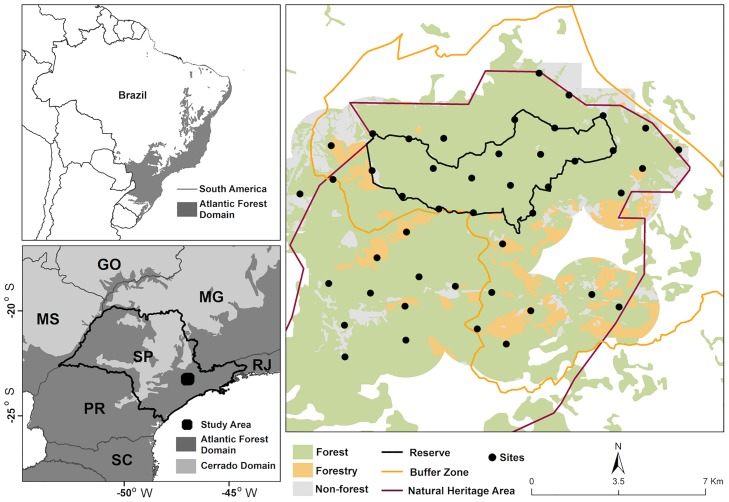
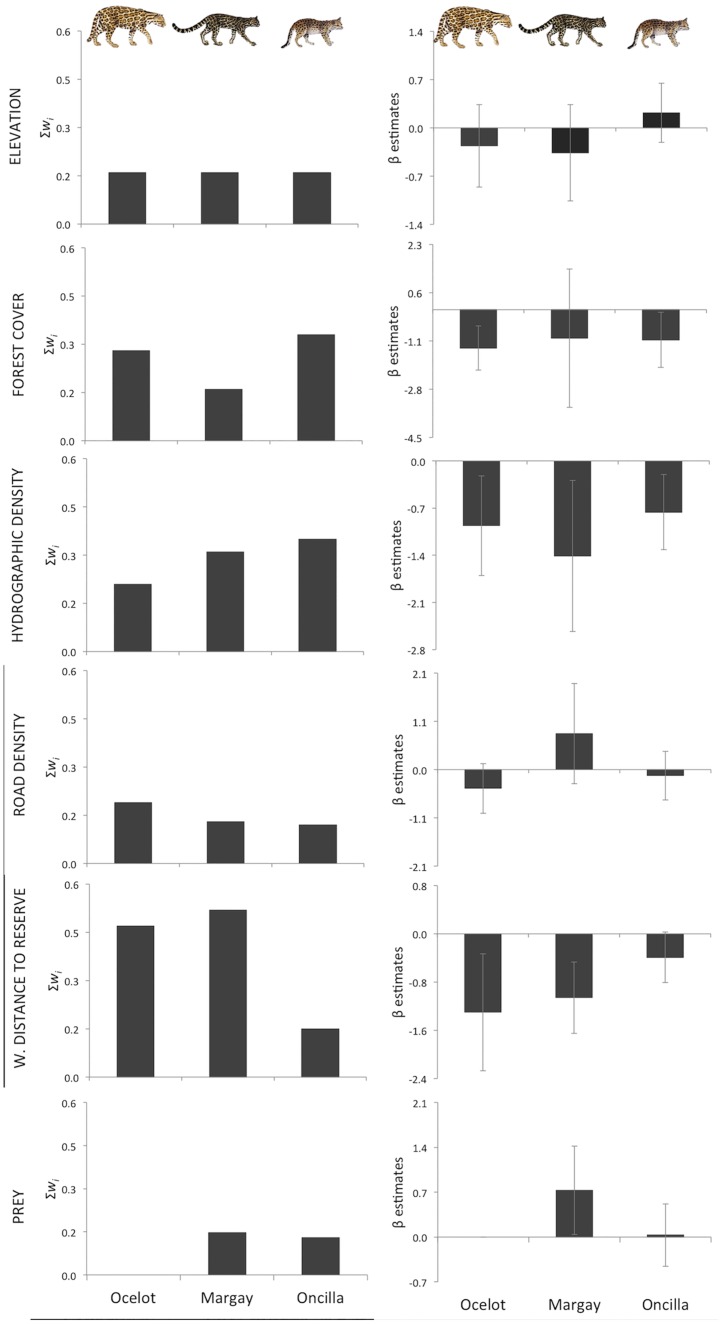
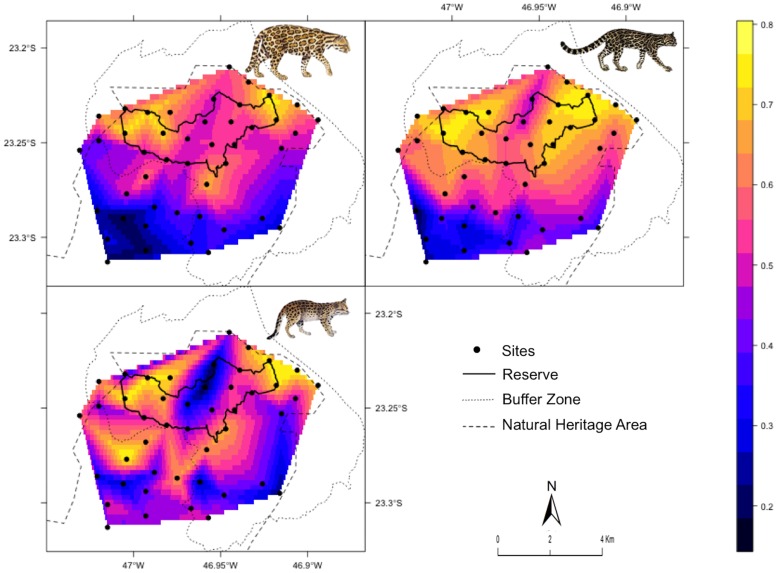
Small felids influence ecosystem dynamics through prey and plant population changes. Although most of these species are threatened, they are accorded one of the lowest research efforts of all felids, and we lack basic information about them. Many felids occur in sympatry, where intraguild competition is frequent. Therefore, assessing the role of interspecific interactions along with the relative importance of landscape characteristics is necessary to understand how these species co-occur in space. Here, we selected three morphologically similar and closely related species of small Neotropical cats to evaluate the roles of interspecific interactions, geomorphometry, environmental, and anthropogenic landscape characteristics on their habitat use. We collected data with camera trapping and scat sampling in a large protected Atlantic forest remnant (35,000 ha). Throughout occupancy modeling we investigated whether these species occur together more or less frequently than would be expected by chance, while dealing with imperfect detection and incorporating possible habitat preferences into the models. We used occupancy as a measure of their habitat use. Although intraguild competition can be an important determinant of carnivore assemblages, in our system, we did not find evidence that one species affects the habitat use of the other. Evidence suggested that proximity to the nature reserve (a more protected area) was a more important driver of Neotropical spotted cats' occurrence than interspecific interactions or geomorphometry and environmental landscape characteristics-even though our entire study area is under some type of protection. This suggests that small felids can be sensitive to the area protection status, emphasizing the importance of maintaining and creating reserves and other areas with elevated protection for the proper management and conservation of the group.
小型猫科动物通过猎物和植物种群变化影响生态系统动态。尽管这些物种大多受到威胁,但它们在所有猫科动物中得到的研究投入却是最少的之一,而且我们对它们缺乏基本信息。许多猫科动物同域分布,种内竞争频繁。因此,评估种间相互作用的作用以及景观特征的相对重要性对于理解这些物种如何在空间中共存是必要的。在这里,我们选择了三种形态相似且亲缘关系密切的新热带小型猫科动物,以评估种间相互作用、地貌测量、环境和人为景观特征对它们栖息地利用的作用。我们在一片大型受保护的大西洋森林遗迹(35000公顷)中通过相机陷阱和粪便采样收集数据。在整个占有率建模过程中,我们研究了这些物种共同出现的频率是否高于或低于偶然预期,同时处理不完美的检测情况并将可能的栖息地偏好纳入模型。我们将占有率作为它们栖息地利用的一种衡量标准。尽管种内竞争可能是食肉动物群落的一个重要决定因素,但在我们的系统中,我们没有发现一个物种会影响另一个物种栖息地利用的证据。有证据表明,靠近自然保护区(一个保护程度更高的区域)是新热带豹猫出现的一个比种间相互作用、地貌测量和环境景观特征更重要的驱动因素——尽管我们的整个研究区域都受到某种形式的保护。这表明小型猫科动物可能对区域保护状况敏感,强调了维护和创建保护区以及其他具有更高保护水平的区域对于该类群的妥善管理和保护的重要性。