Bassi Roberto, Niewczas Monika A, Biancone Luigi, Bussolino Stefania, Merugumala Sai, Tezza Sara, D'Addio Francesca, Ben Nasr Moufida, Valderrama-Vasquez Alessandro, Usuelli Vera, De Zan Valentina, El Essawy Basset, Venturini Massimo, Secchi Antonio, De Cobelli Francesco, Lin Alexander, Chandraker Anil, Fiorina Paolo
Nephrology Division, Boston Children's Hospital, Harvard Medical School, Boston, MA, United States of America.
Transplant Medicine, IRCCS Ospedale San Raffaele, Milan, Italy.
PLoS One. 2017 Jan 4;12(1):e0169077. doi: 10.1371/journal.pone.0169077. eCollection 2017.
Alteration of certain metabolites may play a role in the pathophysiology of renal allograft disease.
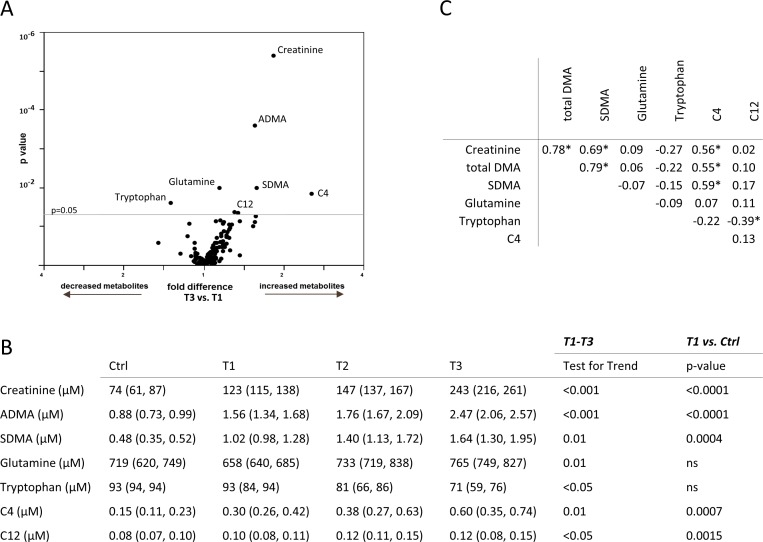
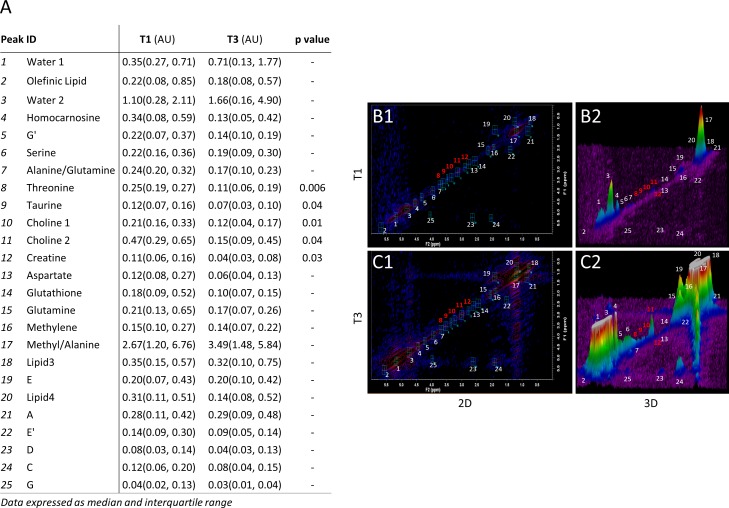
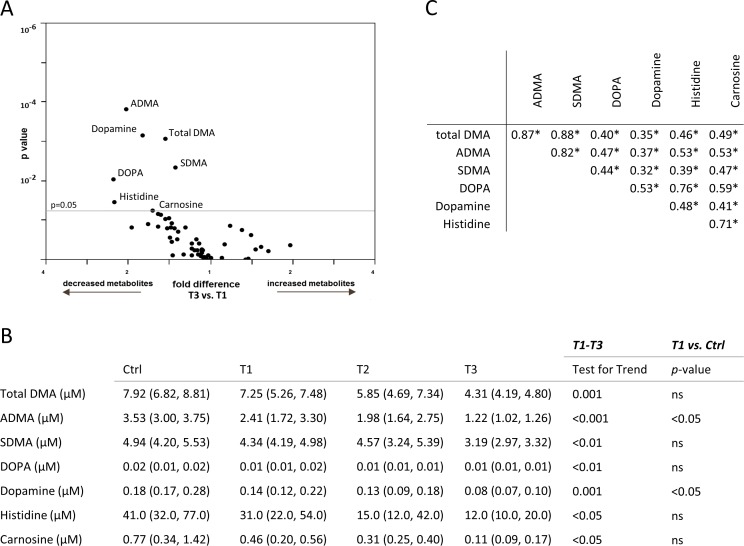
To explore metabolomic abnormalities in individuals with a failing kidney allograft, we analyzed by liquid chromatography-mass spectrometry (LC-MS/MS; for ex vivo profiling of serum and urine) and two dimensional correlated spectroscopy (2D COSY; for in vivo study of the kidney graft) 40 subjects with varying degrees of chronic allograft dysfunction stratified by tertiles of glomerular filtration rate (GFR; T1, T2, T3). Ten healthy non-allograft individuals were chosen as controls.
LC-MS/MS analysis revealed a dose-response association between GFR and serum concentration of tryptophan, glutamine, dimethylarginine isomers (asymmetric [A]DMA and symmetric [S]DMA) and short-chain acylcarnitines (C4 and C12), (test for trend: T1-T3 = p<0.05; p = 0.01; p<0.001; p = 0.01; p = 0.01; p<0.05, respectively). The same association was found between GFR and urinary levels of histidine, DOPA, dopamine, carnosine, SDMA and ADMA (test for trend: T1-T3 = p<0.05; p<0.01; p = 0.001; p<0.05; p = 0.001; p<0.001; p<0.01, respectively). In vivo 2D COSY of the kidney allograft revealed significant reduction in the parenchymal content of choline, creatine, taurine and threonine (all: p<0.05) in individuals with lower GFR levels.
We report an association between renal function and altered metabolomic profile in renal transplant individuals with different degrees of kidney graft function.
某些代谢物的改变可能在肾移植疾病的病理生理学中起作用。
为了探索肾移植失败个体的代谢组学异常,我们通过液相色谱-质谱联用仪(LC-MS/MS;用于血清和尿液的体外分析)和二维相关光谱法(2D COSY;用于肾移植的体内研究)分析了40名肾小球滤过率(GFR)分为三个三分位数(T1、T2、T3)的不同程度慢性移植功能障碍的受试者。选择10名健康的非移植个体作为对照。
LC-MS/MS分析显示,GFR与色氨酸、谷氨酰胺、二甲基精氨酸异构体(不对称[A]DMA和对称[S]DMA)以及短链酰基肉碱(C4和C12)的血清浓度之间存在剂量反应关系(趋势检验:T1 - T3分别为p<0.05;p = 0.01;p<0.001;p = 0.01;p = 0.01;p<0.05)。在GFR与组氨酸、多巴、多巴胺、肌肽、SDMA和ADMA的尿液水平之间也发现了相同的关系(趋势检验:T1 - T3分别为p<0.05;p<0.01;p = 0.001;p<0.05;p = 0.001;p<0.001;p<0.01)。肾移植的体内二维COSY显示,GFR水平较低的个体中,肾实质中胆碱、肌酸、牛磺酸和苏氨酸的含量显著降低(均为p<0.05)。
我们报告了不同程度肾移植功能的肾移植个体的肾功能与代谢组学特征改变之间的关联。