Choi Yoon Jin, Kim Nayoung, Lee Hye Seung, Park Seon Mee, Park Ji Hyun, Yoon Hyuk, Shin Cheol Min, Park Young Soo, Kim Jin-Wook, Lee Dong Ho
Department of Internal Medicine, Seoul National University Bundang Hospital, Seongnam, Korea.
Department of Internal Medicine, Seoul National University Bundang Hospital, Seongnam, Korea; Department of Internal Medicine and Liver Research Institute, Seoul National University College of Medicine, Seoul, Korea.
J Cancer Prev. 2016 Dec;21(4):279-287. doi: 10.15430/JCP.2016.21.4.279. Epub 2016 Dec 30.
The human leucine-rich repeat-containing G-protein coupled receptor (LGR) 5 and CD44 are one of the candidates for the marker of gastric cancer stem cells. We compared the expressions of two genes among control, dysplasia and cancer groups.
We compared the mRNA expression of LGR5, CD44 and CD44v8-10 and immunohistochemistry (IHC) of LGR5 and CD44 in gastric antral mucosa of 45 controls, 36 patients with gastric dysplasia, and 39 patients with early gastric cancer. Additionally, IHC of LGR5 in gastric body mucosa was analyzed. Normal mucosa adjacent to dysplastic or cancer lesions was used for the quantitative real-time-PCR and IHC.
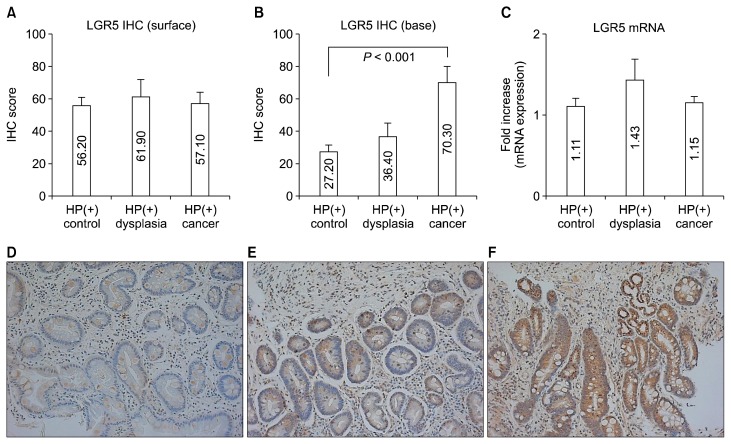
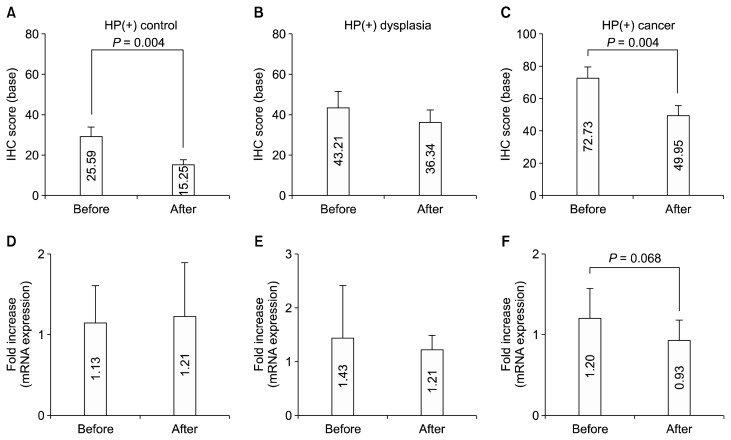
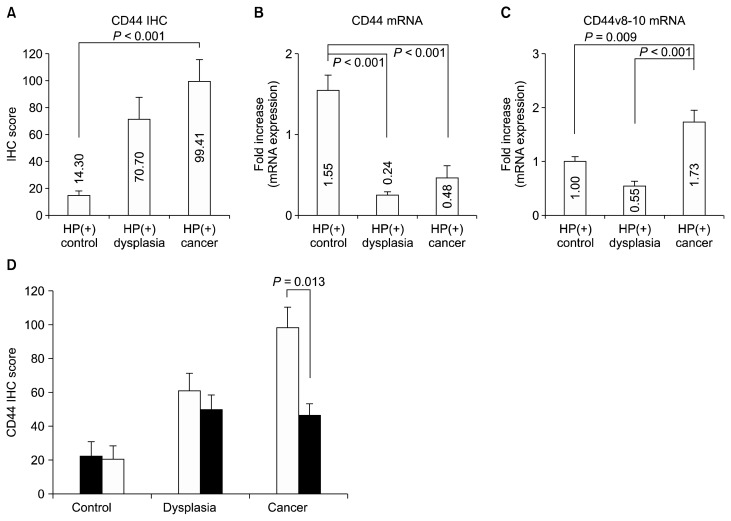
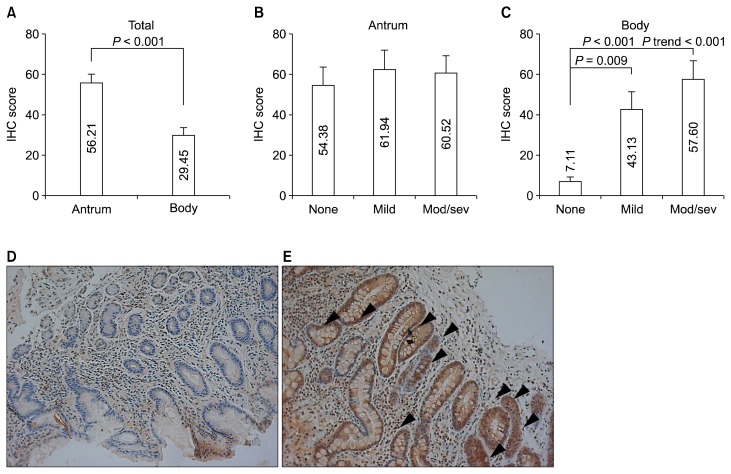
Immunoreactivity of LGR5 in base of antral mucosa was higher in non-cancerous tissues of cancer than those of control ( = 0.006), whereas the expression of LGR5 mRNA was not different among the three groups. Immunostaining of LGR5 was much stronger in the antrum than in the body of stomach ( < 0.001). Although there was no difference in antral immunointensity of LGR5 according to the severity of intestinal metaplasia, stronger immunostaining was found in the body with an aggravation of intestinal metaplasia ( trend < 0.001). The expression of CD44v8-10 mRNA was higher in cancer patients than control subjects and patients with dysplasia ( = 0.018 and 0.009) while the expression of CD44 mRNA was higher in the control groups than the others.
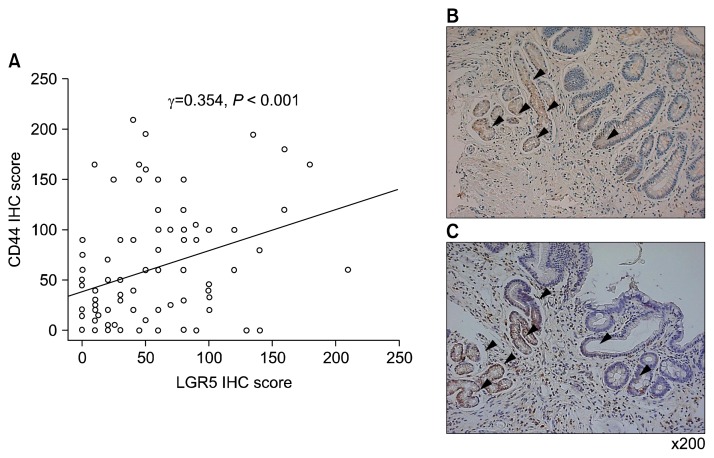
IHC of LGR5 in crypt base and CD44 may be used for gastric CSC markers. LGR5 expression may be associated with the developing of corporal intestinal metaplasia. The expression of CD44v8-10 mRNA would be more suitable for gastric cancer stem cell marker than CD44 or LGR5 mRNA.
富含亮氨酸重复序列的G蛋白偶联受体(LGR)5和CD44是胃癌干细胞标志物的候选者之一。我们比较了对照组、发育异常组和癌症组中这两个基因的表达情况。
我们比较了45名对照组、36名胃发育异常患者和39名早期胃癌患者胃窦黏膜中LGR5、CD44和CD44v8-10的mRNA表达以及LGR5和CD44的免疫组织化学(IHC)情况。此外,还分析了胃体黏膜中LGR5的IHC情况。发育异常或癌症病变附近的正常黏膜用于定量实时PCR和IHC。
癌症非癌组织胃窦黏膜底部LGR5的免疫反应性高于对照组(P = 0.006),而三组中LGR5 mRNA的表达无差异。LGR5的免疫染色在胃窦比胃体更强(P < 0.001)。尽管根据肠化生严重程度,胃窦LGR5的免疫强度无差异,但在胃体中随着肠化生加重免疫染色更强(趋势P < 0.001)。癌症患者中CD44v8-10 mRNA的表达高于对照组和发育异常患者(P = 0.018和P = 0.009),而CD44 mRNA在对照组中的表达高于其他组。
隐窝底部LGR5的IHC和CD44可用于胃癌干细胞标志物。LGR5的表达可能与胃体肠化生的发展有关。CD44v8-10 mRNA的表达比CD44或LGR5 mRNA更适合作为胃癌干细胞标志物。