Godaert Lidvine, Najioullah Fatiha, Bousquet Lionel, Malmontet Thomas, Fournet Benoît, Césaire Raymond, Fanon Jean-Luc, Dramé Moustapha
Department of Geriatrics, University Hospitals of Martinique, Martinique, France.
Department of Virology, University Hospitals of Martinique, Martinique, France.
PLoS Negl Trop Dis. 2017 Jan 5;11(1):e0005256. doi: 10.1371/journal.pntd.0005256. eCollection 2017 Jan.
Chikungunya is an endemo-epidemic infection, which is still considered as an emerging public health problem. The aim of this study was to evaluate in a 65+ population, the accuracy of two chikungunya screening scores that were developed in younger people.
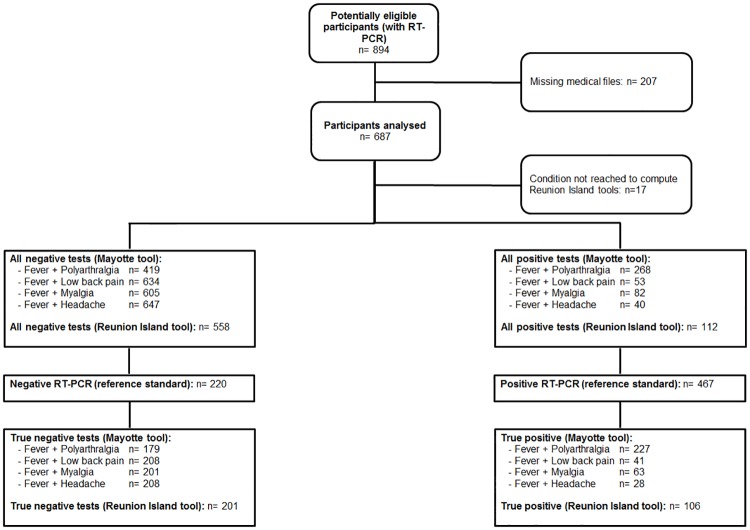
It was performed in the Martinique University Hospitals from retrospective cases. Patients were 65+, admitted to acute care units, for suspected Chikungunya virus infection (CVI) in 2014, with biological testing using Reverse Transcription Polymerase Chain Reaction. Mayotte tool and Reunion Island tool were also computed. Sensitivity, specificity, positive predictive value, negative predictive value, and Youden's statistic were calculated.
In all, 687 patients were included, 68% with confirmed CVI, and 32% with laboratory-unconfirmed CVI. Fever (73.1%) and arthralgia (51.4%) were the most frequent symptoms. Sensitivity ranged from 6% (fever+headache) to 49% (fever+polyarthralgia); and Youden's index ranged from 1% (fever + headache) to 30% (fever+polyarthralgia). PPV and NPV ranged from 70% to 95%, and from 32% to 43%, respectively.
Performances were very poor for both tools, although specificity was good to excellent. Our results suggest that screening scores developed in young population are not accurate in identifying CVI in older people.
基孔肯雅热是一种地方性流行感染病,目前仍被视为一个新出现的公共卫生问题。本研究的目的是评估在65岁及以上人群中,两种在年轻人中开发的基孔肯雅热筛查评分的准确性。
该研究在马提尼克大学医院对回顾性病例进行。患者年龄在65岁及以上,2014年因疑似基孔肯雅病毒感染(CVI)入住急性护理病房,并采用逆转录聚合酶链反应进行生物学检测。同时计算了马约特工具和留尼汪岛工具的得分。计算了敏感性、特异性、阳性预测值、阴性预测值和约登指数。
共纳入687例患者,68%确诊为CVI,32%实验室检查未确诊为CVI。发热(73.1%)和关节痛(51.4%)是最常见的症状。敏感性范围为6%(发热+头痛)至49%(发热+多关节痛);约登指数范围为1%(发热+头痛)至30%(发热+多关节痛)。阳性预测值和阴性预测值分别为70%至95%和32%至43%。
尽管特异性良好至优秀,但两种工具的性能都很差。我们的结果表明,在年轻人群中开发的筛查评分在识别老年人的CVI方面并不准确。