INSERM, CIC1410, CHU de la Réunion, Saint-Pierre, France.
CHU de la Réunion, service de maladies infectieuses-médecine interne-dermatologie, Saint Pierre, France.
PLoS Negl Trop Dis. 2020 Mar 12;14(3):e0007327. doi: 10.1371/journal.pntd.0007327. eCollection 2020 Mar.
The chikungunya virus (CHIKV) is a re-emerging alphavirus that can cause chronic and potentially incapacitating rheumatic musculoskeletal disorders known as chronic chikungunya arthritis (CCA). We conducted a prospective cohort study of CHIKV-infected subjects during the 2013 chikungunya outbreak in Martinique. The aim of this study was to assess the prevalence of CCA at 12 months and to search for acute phase factors significantly associated with chronicity.
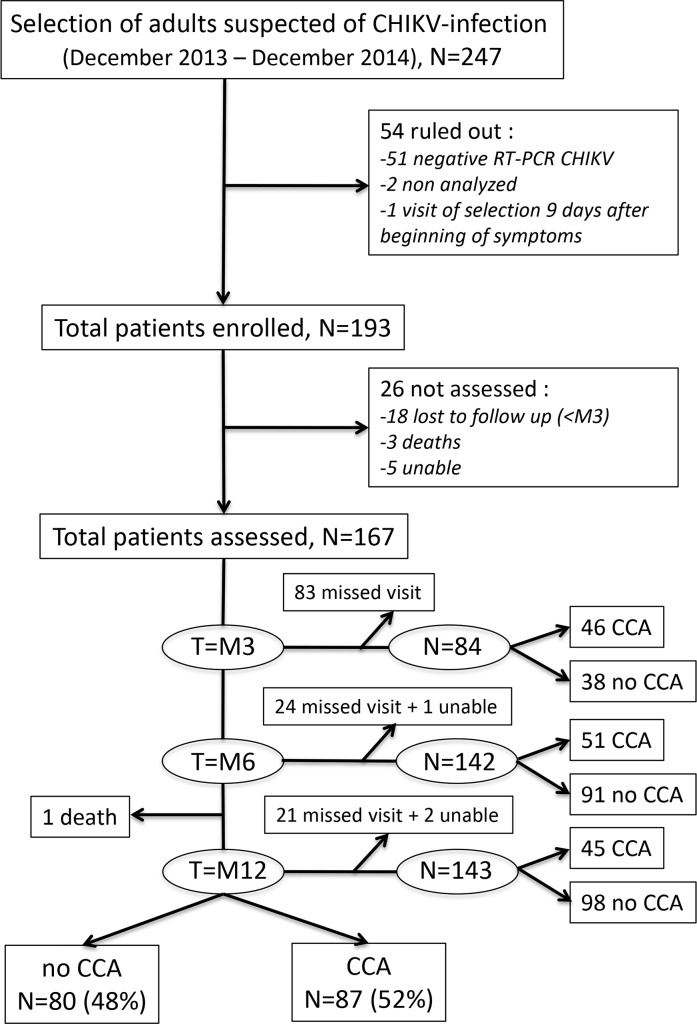
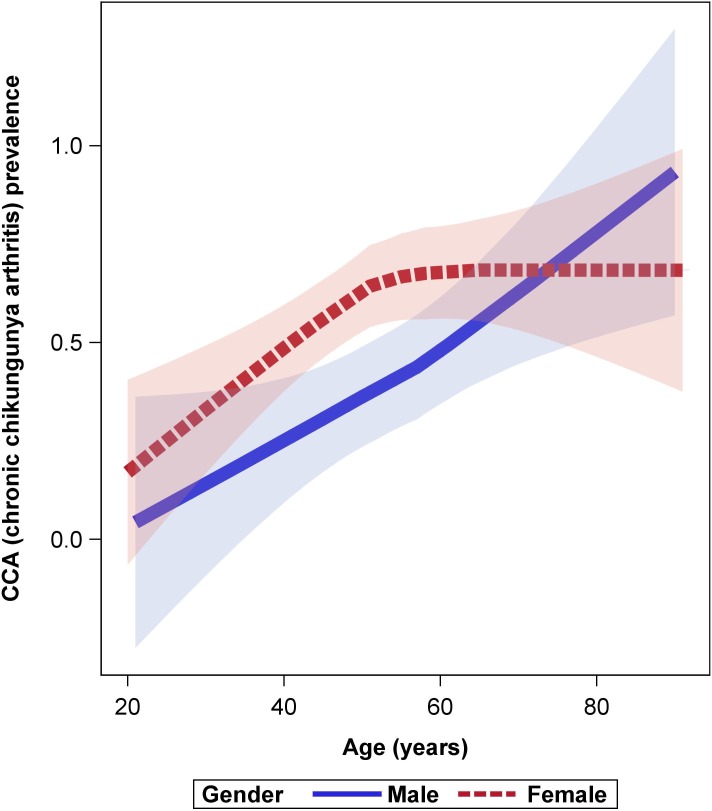
METHODOLOGY/PRINCIPAL FINDINGS: A total of 193 patients who tested positive for CHIKV RNA via qRT-PCR underwent clinical investigations in the acute phase (<21 days), and then 3, 6, and 12 months after inclusion. The Asian lineage was identified as the circulating genotype. A total of 167 participants were classified as either with or without CCA, and were analyzed using logistic regression models. The overall prevalence of CCA at 12 months was 52.1% (95%CI: 44.5-59.7). In univariate analysis, age (RD 9.62, 95% CI, 4.87;14.38, p<0.0001), female sex (RD 15.5, 95% CI, 1.03;30.0, p = 0.04), headache (RD 15.42, 95% CI, 0.65;30.18 p = 0.04), vertigo (RD 15.33, 95% CI, 1.47;29.19, p = 0.03), vomiting (RD 12.89, 95% CI, 1.54;24.24, p = 0.03), dyspnea (RD 13.53, 95% CI, 0.73;26.33, p = 0.04), intravenous rehydration (RD -16.12, 95% CI, -31.58; -0.66 p = 0.04) and urea (RD 0.66, 95% CI, 0.12;1.20, p = 0.02) were significantly associated with the development of CCA. For the subpopulation with data on joint involvement in the acute phase, the risk factors significantly associated with CCA were at least one 1 enthesitis (RD 16.7, 95%CI, 2.8; 30.7, p = 0.02) and at least one tenosynovitis (RD 16.8, 95% CI, 1.4-32.2, p = 0.04).
This cohort study conducted in Martinique confirms that CCA is a common complication of acute chikungunya disease. Our analysis emphasized the importance of age and female sex for CCA occurrence, and highlighted the aggravating role of dehydration during the acute phase. Early and adequate hydration were found to reduce the risk chronic chikungunya disorders.
clinicaltrials.gov (NCT01099852).
基孔肯雅病毒(CHIKV)是一种重新出现的甲病毒,可引起慢性和潜在致残的风湿肌肉骨骼疾病,称为慢性基孔肯雅关节炎(CCA)。我们在马提尼克岛 2013 年基孔肯雅热暴发期间对感染 CHIKV 的患者进行了前瞻性队列研究。本研究的目的是评估 12 个月时 CCA 的患病率,并寻找与慢性相关的急性相因素。
方法/主要发现:共有 193 名通过 qRT-PCR 检测到 CHIKV RNA 呈阳性的患者在急性期(<21 天)接受了临床检查,然后在纳入后 3、6 和 12 个月进行了检查。鉴定出亚洲谱系为循环基因型。共有 167 名参与者被分类为有或没有 CCA,并使用逻辑回归模型进行了分析。12 个月时 CCA 的总体患病率为 52.1%(95%CI:44.5-59.7)。在单变量分析中,年龄(RD 9.62,95%CI,4.87;14.38,p<0.0001)、女性(RD 15.5,95%CI,1.03;30.0,p = 0.04)、头痛(RD 15.42,95%CI,0.65;30.18,p = 0.04)、眩晕(RD 15.33,95%CI,1.47;29.19,p = 0.03)、呕吐(RD 12.89,95%CI,1.54;24.24,p = 0.03)、呼吸困难(RD 13.53,95%CI,0.73;26.33,p = 0.04)、静脉补液(RD-16.12,95%CI,-31.58;-0.66,p = 0.04)和尿素(RD 0.66,95%CI,0.12;1.20,p = 0.02)与 CCA 的发生显著相关。对于有急性期关节受累数据的亚人群,与 CCA 显著相关的危险因素是至少一处附着点炎(RD 16.7,95%CI,2.8;30.7,p = 0.02)和至少一处腱鞘炎(RD 16.8,95%CI,1.4-32.2,p = 0.04)。
这项在马提尼克岛进行的队列研究证实,CCA 是急性基孔肯雅病的常见并发症。我们的分析强调了年龄和女性性别对 CCA 发生的重要性,并强调了急性相脱水的加重作用。早期和充分的水合作用可降低慢性基孔肯雅病的风险。
clinicaltrials.gov(NCT01099852)。