Obua Thomas Ocwa, Adome Richard Odoi, Kutyabami Paul, Kitutu Freddy Eric, Kamba Pakoyo Fadhiru
Department of Pharmacy, School of Health Sciences, Makerere University, P.O. Box 7072, Kampala, Uganda.
Division of Pharmaceutical Services, Ministry of Health, Plot 6, Lourdel Road, P.O. Box 7272, Kampala, Uganda.
Hum Resour Health. 2017 Jan 5;15(1):1. doi: 10.1186/s12960-016-0176-x.
Pharmacists are invaluable resources in health care. Their expertise in pharmacotherapy and medicine management both ensures that medicines of appropriate quality are available in health facilities at the right cost and are used appropriately. Unfortunately, some countries like Uganda have shortage of pharmacists in public health facilities, the dominant providers of care. This study investigated the factors that affect the occupancy of pharmacist positions in Uganda's public hospitals, including hiring patterns and job attraction and retention.
A cross-sectional survey of 91 registered pharmacists practicing in Uganda and desk review of records from the country's health care worker (HCW) recruiting agency was done in the months of May, June, and July, 2016. Pharmacist interviews were done using self-administered structured questionnaire and analyzed by descriptive statistics and chi-square test.
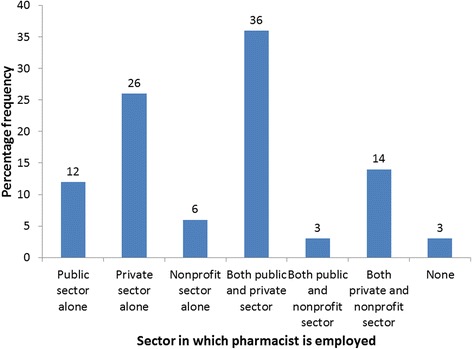
Slight majority (53%) of the interviewed pharmacists work in two sectors. About 60% of the pharmacists had ever applied for public hospital jobs. Of those who received offers (N = 46), 30% had declined them. Among those who accepted the offers (N = 41), 41% had already quit. Meanwhile, the pace of hiring pharmacists into Uganda's public sector is too slow. Low socio-economic status of family in childhood (χ = 2.77, p = 0.10), admission through matriculation and diploma scheme (χ = 2.37, p = 0.12), internship in countryside hospitals (χ = 2.24, p = 0.13), working experience before pharmacy school (χ = 2.21, p = 0.14), salary expectation (χ = 1.76, p = 0.18), and rural secondary education (χ = 1.75, p = 0.19) favored attraction but in a statistically insignificant manner. Retention was most favored by zero postgraduate qualification (χ = 4.39, p = 0.04), matriculation and diploma admission scheme (χ = 2.57, p = 0.11), and working experience in private sector (χ = 2.21, p = 0.14).
The pace of hiring of pharmacists into Uganda's public health sector is too slow and should be stepped up. Besides work incentives, affirmative action to increase admissions into pharmacy degree training programs through matriculation and diploma schemes and for children with rural childhoods should be considered.
药剂师是医疗保健领域的宝贵资源。他们在药物治疗和药品管理方面的专业知识,既能确保卫生机构以合理成本提供质量合适的药品,又能保证药品得到合理使用。不幸的是,像乌干达这样的一些国家,在作为主要医疗服务提供者的公共卫生机构中,药剂师短缺。本研究调查了影响乌干达公立医院药剂师岗位任职情况的因素,包括招聘模式以及工作吸引力和留任意愿。
2016年5月、6月和7月,对在乌干达执业的91名注册药剂师进行了横断面调查,并对该国医护人员招聘机构的记录进行了案头审查。药剂师访谈采用自行填写的结构化问卷进行,并通过描述性统计和卡方检验进行分析。
略超过半数(53%)的受访药剂师在两个部门工作。约60%的药剂师曾申请公立医院工作。在收到录用通知的人中(N = 46),30%拒绝了录用。在接受录用的人中(N = 41),41%已经离职。与此同时,乌干达公共部门招聘药剂师的速度过慢。童年时家庭社会经济地位低(χ = 2.77,p = 0.10)、通过预科和文凭计划录取(χ = 2.37,p = 0.12)、在乡村医院实习(χ = 2.24,p = 0.13)、药学专业学习前的工作经历(χ = 2.21,p = 0.14)、薪资期望(χ = 1.76,p = 0.18)以及接受农村中等教育(χ = 1.75,p = 0.19)对吸引力有一定影响,但在统计学上无显著意义。留任意愿最受以下因素影响:无研究生学历(χ = 4.39,p = 0.04)、预科和文凭录取计划(χ = 2.57,p = 0.11)以及在私营部门的工作经历(χ = 2.21,p = 0.14)。
乌干达公共卫生部门招聘药剂师的速度过慢,应加快步伐。除了工作激励措施外,还应考虑采取平权行动,通过预科和文凭计划增加药学学位培训项目的招生人数,并关注有农村童年经历的儿童。