Mohr David C, Tomasino Kathryn Noth, Lattie Emily G, Palac Hannah L, Kwasny Mary J, Weingardt Kenneth, Karr Chris J, Kaiser Susan M, Rossom Rebecca C, Bardsley Leland R, Caccamo Lauren, Stiles-Shields Colleen, Schueller Stephen M
Center for Behavioral Intervention Technologies (CBITs), Department of Preventive Medicine, Northwestern University, Chicago, IL, United States.
Department of Preventive Medicine, Northwestern University, Chicago, IL, United States.
J Med Internet Res. 2017 Jan 5;19(1):e10. doi: 10.2196/jmir.6645.
Digital mental health tools have tended to use psychoeducational strategies based on treatment orientations developed and validated outside of digital health. These features do not map well to the brief but frequent ways that people use mobile phones and mobile phone apps today. To address these challenges, we developed a suite of apps for depression and anxiety called IntelliCare, each developed with a focused goal and interactional style. IntelliCare apps prioritize interactive skills training over education and are designed for frequent but short interactions.
The overall objective of this study was to pilot a coach-assisted version of IntelliCare and evaluate its use and efficacy at reducing symptoms of depression and anxiety.
Participants, recruited through a health care system, Web-based and community advertising, and clinical research registries, were included in this single-arm trial if they had elevated symptoms of depression or anxiety. Participants had access to the 14 IntelliCare apps from Google Play and received 8 weeks of coaching on the use of IntelliCare. Coaching included an initial phone call plus 2 or more texts per week over the 8 weeks, with some participants receiving an additional brief phone call. Primary outcomes included the Patient Health Questionnaire-9 (PHQ-9) for depression and the Generalized Anxiety Disorder-7 (GAD-7) for anxiety. Participants were compensated up to US $90 for completing all assessments; compensation was not for app use or treatment engagement.
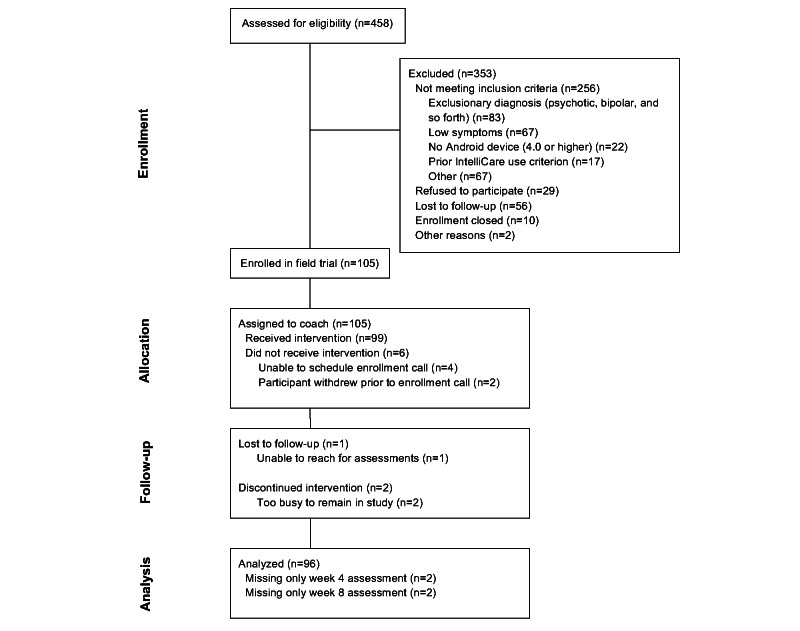
Of the 99 participants who initiated treatment, 90.1% (90/99) completed 8 weeks. Participants showed substantial reductions in the PHQ-9 and GAD-7 (P<.001). Participants used the apps an average of 195.4 (SD 141) times over the 8 weeks. The average length of use was 1.1 (SD 2.1) minutes, and 95% of participants downloaded 5 or more of the IntelliCare apps.
This study supports the IntelliCare framework of providing a suite of skills-focused apps that can be used frequently and briefly to reduce symptoms of depression and anxiety. The IntelliCare system is elemental, allowing individual apps to be used or not used based on their effectiveness and utility, and it is eclectic, viewing treatment strategies as elements that can be applied as needed rather than adhering to a singular, overarching, theoretical model.
Clinicaltrials.gov NCT02176226; http://clinicaltrials.gov/ct2/show/NCT02176226 (Archived by WebCite at http://www.webcitation/6mQZuBGk1).
数字心理健康工具倾向于采用基于在数字健康领域之外开发和验证的治疗方向的心理教育策略。这些特征与人们如今使用手机和手机应用程序的简短但频繁的方式不太匹配。为应对这些挑战,我们开发了一套名为IntelliCare的用于治疗抑郁和焦虑的应用程序,每个应用程序都有明确的目标和交互风格。IntelliCare应用程序将交互式技能训练置于教育之上,并设计用于频繁但简短的交互。
本研究的总体目标是试行一个由教练辅助的IntelliCare版本,并评估其在减轻抑郁和焦虑症状方面的使用情况及疗效。
通过医疗保健系统、网络和社区广告以及临床研究登记处招募参与者。如果他们有抑郁或焦虑症状加重的情况,就被纳入这个单臂试验。参与者可以从谷歌应用商店获取14个IntelliCare应用程序,并接受为期8周的关于IntelliCare使用的指导。指导包括一个初始电话以及在8周内每周2条或更多短信,一些参与者还会接到额外的简短电话。主要结局指标包括用于评估抑郁的患者健康问卷-9(PHQ-9)和用于评估焦虑的广泛性焦虑障碍-7(GAD-7)。完成所有评估的参与者最高可获得90美元的报酬;报酬不是针对应用程序的使用或治疗参与情况。
在开始治疗的99名参与者中,90.1%(90/99)完成了8周的治疗。参与者的PHQ-9和GAD-7得分大幅降低(P<.001)。在8周内,参与者平均使用应用程序195.4(标准差141)次。平均使用时长为1.1(标准差2.1)分钟,95%的参与者下载了5个或更多的IntelliCare应用程序。
本研究支持IntelliCare框架,即提供一套以技能为重点的应用程序,可频繁且简短地使用以减轻抑郁和焦虑症状。IntelliCare系统是基本的,允许根据各个应用程序的有效性和实用性决定是否使用,并且它是折衷的,将治疗策略视为可根据需要应用的元素,而不是遵循单一的、总体的理论模型。
Clinicaltrials.gov NCT02176226;http://clinicaltrials.gov/ct2/show/NCT02176226(由WebCite存档于http://www.webcitation/6mQZuBGk1)。