Department of Neurosurgery, School for Mental Health and Neuroscience, Maastricht University Medical Center, Maastricht, The Netherlands.
Department of Physiology, Cardiovascular Research Institute Maastricht, Maastricht University, Maastricht, The Netherlands.
BMJ Open. 2017 Jan 5;7(1):e013954. doi: 10.1136/bmjopen-2016-013954.
Adequate functioning of the blood-brain barrier (BBB) is important for brain homoeostasis and normal neuronal function. Disruption of the BBB has been described in several neurological diseases. Recent reports suggest that an increased permeability of the BBB also contributes to increased seizure susceptibility in patients with epilepsy. The endothelial glycocalyx is coating the luminal side of the endothelium and can be considered as the first barrier of the BBB. We hypothesise that an altered glycocalyx thickness plays a role in the aetiology of temporal lobe epilepsy (TLE), the most common type of epilepsy. Here, we propose a protocol that allows intraoperative assessment of the cerebrovascular glycocalyx thickness in patients with TLE and assess whether its thickness is decreased in patients with TLE when compared with controls.
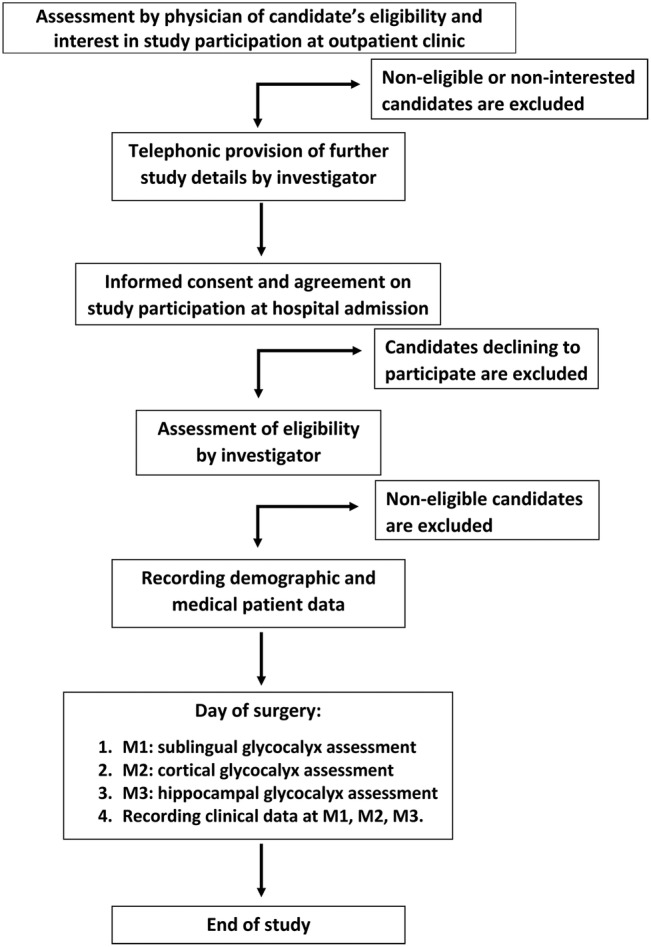
This protocol is designed as a prospective observational case-control study in patients who undergo resective brain surgery as treatment for TLE. Control subjects are patients without a history of epileptic seizures, who undergo a craniotomy or burr hole surgery for other indications. Intraoperative glycocalyx thickness measurements of sublingual, cortical and hippocampal microcirculation are performed by video microscopy using sidestream dark-field imaging. Demographic details, seizure characteristics, epilepsy risk factors, intraoperative haemodynamic parameters and histopathological evaluation are additionally recorded.
This protocol has been ethically approved by the local medical ethical committee (ID: NL51594.068.14) and complies with the Declaration of Helsinki and principles of Good Clinical Practice. Informed consent is obtained before study enrolment and only coded data will be stored in a secured database, enabling an audit trail. Results will be submitted to international peer-reviewed journals and presented at international conferences.
NTR5568.
血脑屏障(BBB)的正常功能对于脑内稳态和正常神经元功能非常重要。在几种神经疾病中已经描述了 BBB 的破坏。最近的报告表明,BBB 的通透性增加也导致癫痫患者癫痫发作易感性增加。内皮糖萼覆盖在内皮的腔侧,可以被认为是 BBB 的第一道屏障。我们假设糖萼厚度的改变在颞叶癫痫(TLE)的发病机制中起作用,TLE 是最常见的癫痫类型。在这里,我们提出了一个方案,允许在 TLE 患者的手术过程中评估脑血管糖萼厚度,并评估与对照组相比,TLE 患者的厚度是否降低。
这是一项在接受切除术治疗 TLE 的患者中进行的前瞻性观察性病例对照研究的方案。对照组为无癫痫发作史的患者,因其他适应症而行开颅或颅骨钻孔手术。术中通过视频显微镜使用边流暗场成像对舌下、皮质和海马微循环的糖萼厚度进行测量。此外,还记录人口统计学细节、癫痫发作特征、癫痫风险因素、术中血流动力学参数和组织病理学评估。
该方案已获得当地医学伦理委员会的伦理批准(ID:NL51594.068.14),并符合赫尔辛基宣言和良好临床实践原则。在研究入组前获得知情同意,仅存储编码数据将存储在安全的数据库中,以实现审核跟踪。结果将提交给国际同行评议期刊,并在国际会议上展示。
NTR5568。