Hutarew Georg
Department of Pathology, University Hospital and Paracelsus Medical University Salzburg, Müllner Hauptstraße 48, Salzburg, 5020 Austria.
Memo. 2016;9(4):201-206. doi: 10.1007/s12254-016-0292-2. Epub 2016 Oct 28.
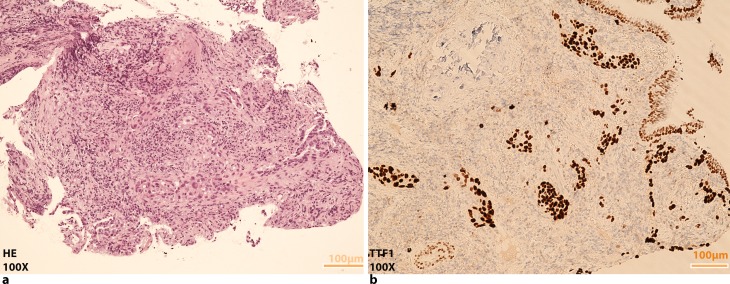
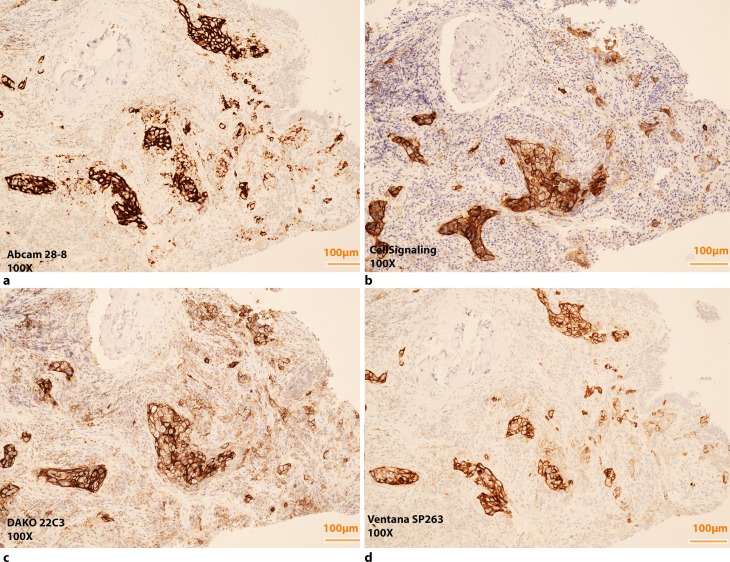
Tumours with high somatic mutation rates escape immune surveillance by upregulating receptors and ligands such as programmed death receptor-1 and its ligand (PD-1/PD-L1). Checkpoint inhibitors (ICI) provide encouraging therapeutic results in non-small cell lung cancers (NSCLC) and may soon be used in 2nd or 1st line therapy. Currently PD-L1 immunohistochemistry (IHC) expression assessed on tumour cells is used as a predictive biomarker, since better patient outcomes are often, but not always associated with increased tumour cell PD-L1 IHC expression. However pre-analytical variables, different anti-PD-L1 clones used on different staining platforms, different specimens types, as well as intra- and interobserver variability influence the results. We will only understand PD-L1 expression on tumour cells if we accept that PD-L1 is an inducible pathophysiological factor with variable levels of PD-L1 expression depending on the immunological status. Should we test PD-L1 during initial diagnostic work up before, or at the point when immune checkpoint therapy is considered? Taking all arguments into account the value of PD-L1 as a predictive biomarker is questionable. Other predictive biomarkers such as high mutation burden, mRNA expression, neo-antigens and the diversity of tumour antigen-specific T cells should be evaluated in the future. Here we review results presented in 30 journal articles and three reviews covering this topic in the last 3 years.
具有高体细胞突变率的肿瘤通过上调程序性死亡受体-1及其配体(PD-1/PD-L1)等受体和配体来逃避免疫监视。检查点抑制剂(ICI)在非小细胞肺癌(NSCLC)中提供了令人鼓舞的治疗效果,并且可能很快用于二线或一线治疗。目前,在肿瘤细胞上评估的PD-L1免疫组织化学(IHC)表达被用作预测生物标志物,因为更好的患者预后通常但并非总是与肿瘤细胞PD-L1 IHC表达增加相关。然而,分析前变量、不同染色平台上使用的不同抗PD-L1克隆、不同标本类型以及观察者内和观察者间的变异性都会影响结果。如果我们承认PD-L1是一种可诱导的病理生理因素,其PD-L1表达水平因免疫状态而异,那么我们才能理解肿瘤细胞上的PD-L1表达。我们应该在初始诊断检查期间、在考虑免疫检查点治疗之前还是之时检测PD-L1?综合考虑所有因素,PD-L1作为预测生物标志物的价值值得怀疑。其他预测生物标志物,如高突变负荷、mRNA表达、新抗原和肿瘤抗原特异性T细胞的多样性,未来应进行评估。在此,我们回顾了过去3年中30篇期刊文章和3篇综述中关于该主题的研究结果。