Yan Xin, Zhang Chen, Wang Jiamin, Zhang Xia, Ren Xiaomin
State Key Laboratory of Information Photonics and Optical Communications, Beijing University of Posts and Telecommunications, Beijing, 100876, China.
Nanoscale Res Lett. 2017 Dec;12(1):14. doi: 10.1186/s11671-016-1785-y. Epub 2017 Jan 5.
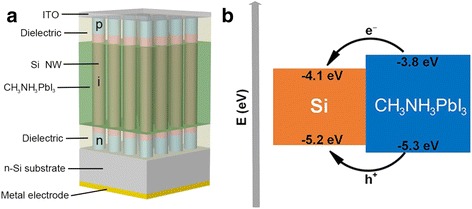
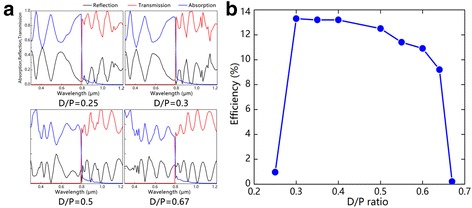
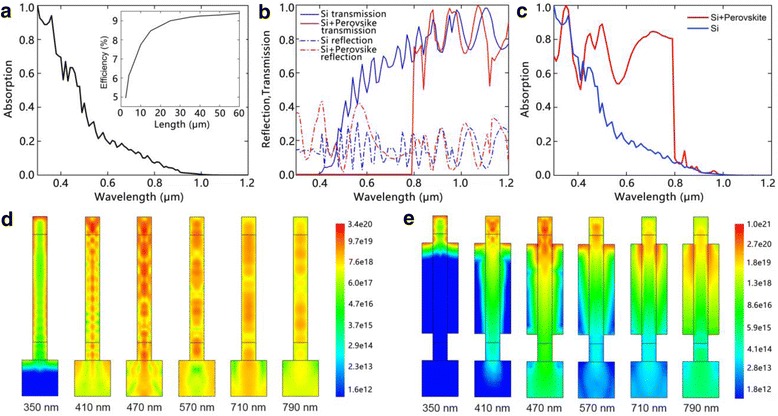
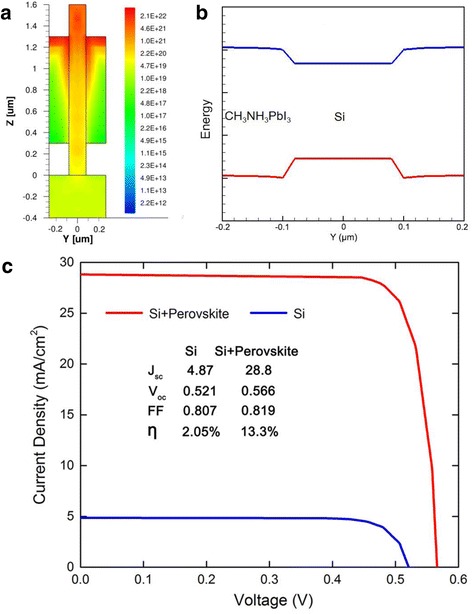
A low-cost Si nanowire array/perovskite hybrid solar cell is proposed and simulated. The solar cell consists of a Si p-i-n nanowire array filled with CHNHPbI, in which both the nanowires and perovskite absorb the incident light while the nanowires act as the channels for transporting photo-generated electrons and holes. The hybrid structure has a high absorption efficiency in a broad wavelength range of 300~800 nm. A large short-circuit current density of 28.8 mA/cm and remarkable conversion efficiency of 13.3% are obtained at a thin absorber thickness of 1.6 μm, which are comparable to the best results of III-V nanowire solar cells.
提出并模拟了一种低成本的硅纳米线阵列/钙钛矿混合太阳能电池。该太阳能电池由填充有CHNHPbI的硅p-i-n纳米线阵列组成,其中纳米线和钙钛矿都吸收入射光,而纳米线充当传输光生电子和空穴的通道。这种混合结构在300~800nm的宽波长范围内具有高吸收效率。在吸收层厚度为1.6μm时,获得了28.8mA/cm²的大短路电流密度和13.3%的显著转换效率,这与III-V族纳米线太阳能电池的最佳结果相当。