Department of Chemistry and Bioscience, Section of Biology and Environmental Science, Aalborg University, Fredrik Bajers Vej 7H, DK-9220 Aalborg E, Denmark.
Department of Bioscience, Section of Genetics, Ecology and Evolution, Aarhus University, Ny Munkegade 114, DK-8000 Aarhus C, Denmark.
Sci Rep. 2017 Jan 6;7:40132. doi: 10.1038/srep40132.
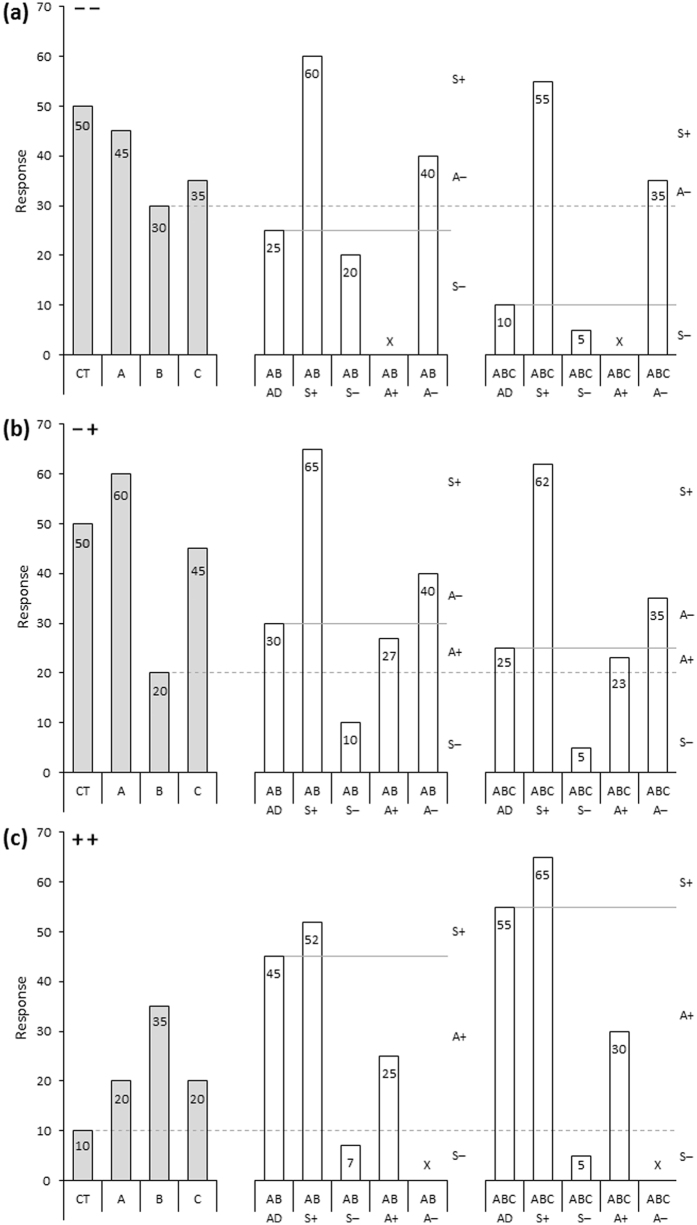
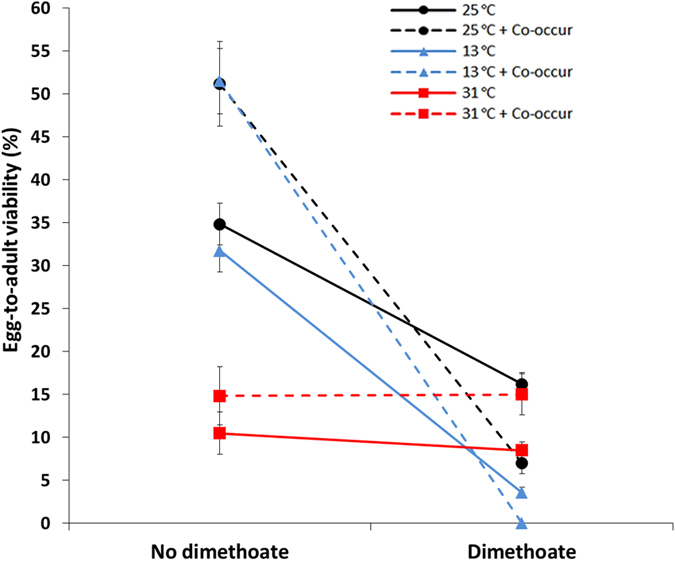
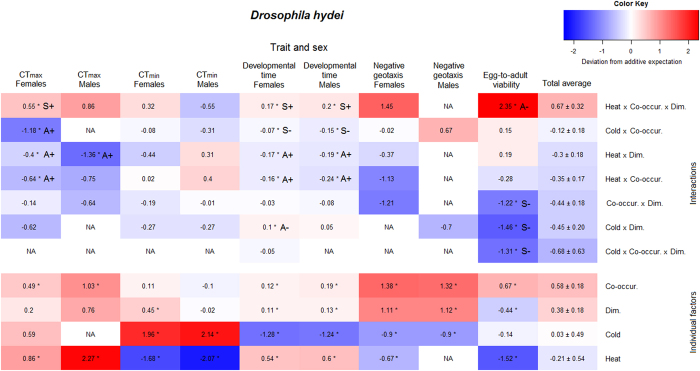
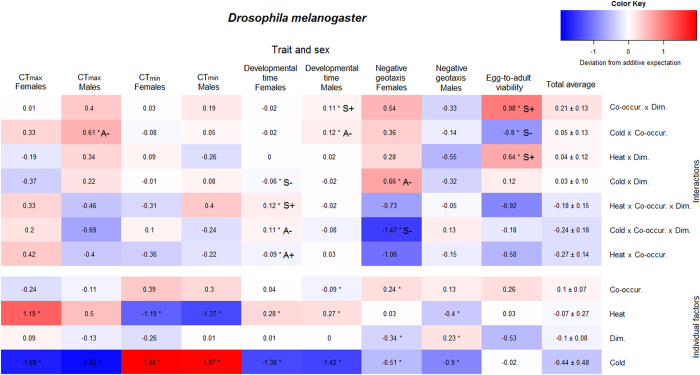
Multiple environmental factors acting in concert can interact and strongly influence population fitness and ecosystem composition. Studies investigating interactions usually involve only two environmental factors; most frequently a chemical and another abiotic factor such as a stressful temperature. Here we investigate the effects of three environmental factors: temperature, an insecticide (dimethoate) and interspecific co-occurrence. We expose two naturally co-occurring species of Drosophila (D. hydei and D. melanogaster) to the different environments during development and examine the consequences on several performance measures. Results are highly species and trait specific with evidence of two- and three-way interactions in approximately 30% of all cases, suggesting that additive effects of combined environmental factors are most common, and that interactions are not universal. To provide more informative descriptions of complex interactions we implemented re-conceptualised definitions of synergism and antagonism. We found approximately equal proportions of synergistic and antagonistic interactions in both species, however the effects of interactions on performance differed between the two. Furthermore, we found negative impacts on performance in only 60% of interactions, thus our study also reveals a high proportion of cases with positive effects of interactions.
多种环境因素共同作用会相互影响,并强烈影响种群适应性和生态系统组成。研究相互作用的通常只涉及两个环境因素;最常见的是一种化学物质和另一种非生物因素,如胁迫温度。在这里,我们研究了三个环境因素的影响:温度、杀虫剂(二甲基硫)和种间共存。我们在发育过程中使两种自然共存的果蝇(D. hydei 和 D. melanogaster)暴露于不同的环境中,并检查了对几种性能指标的影响。结果高度具有物种和特征特异性,约有 30%的情况存在两重和三重相互作用的证据,这表明组合环境因素的附加效应最为常见,而相互作用并非普遍存在。为了更详细地描述复杂的相互作用,我们重新定义了协同作用和拮抗作用的概念。我们在两个物种中都发现了大约相等比例的协同和拮抗相互作用,但是相互作用对性能的影响在两个物种中有所不同。此外,我们只发现了 60%的相互作用对性能有负面影响,因此我们的研究还揭示了具有相互作用积极影响的情况比例很高。