Lu Mengxuan, Kong Xia, Wang Huaigao, Huang Guoliang, Ye Caiguo, He Zhiwei
Sino-American United Cancer Research Institute, Guangdong Medical University, Guangdong Province, China.
Department of Pathophysiology, Guangdong Medical University, Guangdong Province, China.
Oncotarget. 2017 Jan 31;8(5):8775-8784. doi: 10.18632/oncotarget.14452.
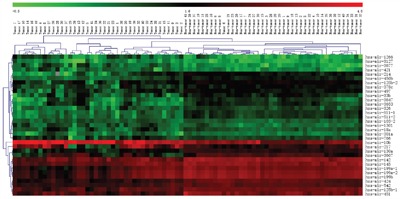
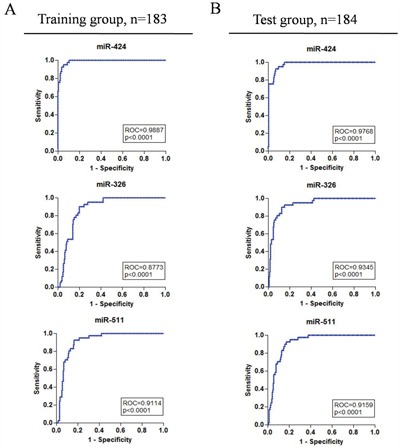
This study aims to identify prognostic microRNAs (miRNAs) biomarkers for diagnosis and survival of hepatocellular carcinoma (HCC) based on large patients cohort analysis. HCC patient cohort data were downloaded from The Cancer Genome Atlas, including paired HCC and adjacent non-cancer tissues. Receiver operating characteristic curve method was used to classify cancer and non-cancer tissues according to microRNAs expression levels. The aberrant microRNAs expression level were ranked and risked for building a prognostic miRNAs signature model. Kaplan-Meier survival was used to analyze the differences among various risk factors in accordance with miRNAs ranking scores. The study showed 33-miRNA signature, 11 were down-regulated and 22 were up-regulated through comparison between cancer samples and non-cancer samples. The maximum correct classification rate is up to 98.7%. Five microRNAs, hsa-mir-3677, hsa-mir-421, hsa-mir-326, hsa-mir-424 and hsa-mir-511-2, significantly correlated with patient survival. The survival rate and time negatively associated with lowering miRNAs index. In the low risk group, over 70% patients showed 5 years survival, while none patients survived longer than 5 years in the high risk group. MiR-424, miR-326 and miR-511 could be applied for HCC diagnostic biomarkers. These five miRNAs were significantly associated with lysosome pathway and D-Glutamine and D-glutamate metabolism pathway via Kyoto Encyclopedia of Genes and Genomes pathway analysis and Gene Ontology annotation. Conclusively, the five miRNAs expression signature could be used as HCC prognostic and diagnostic biomarkers.
本研究旨在基于大量患者队列分析,确定用于肝细胞癌(HCC)诊断和生存预后的微小RNA(miRNA)生物标志物。HCC患者队列数据从癌症基因组图谱下载,包括配对的HCC组织和相邻的非癌组织。采用受试者工作特征曲线法根据miRNA表达水平对癌组织和非癌组织进行分类。对异常的miRNA表达水平进行排序并构建预后miRNA特征模型。采用Kaplan-Meier生存分析根据miRNA排序分数分析各风险因素之间的差异。研究显示,通过癌症样本与非癌症样本的比较,有33个miRNA特征,其中11个下调,22个上调。最大正确分类率高达98.7%。5个微小RNA,即hsa-mir-3677、hsa-mir-421、hsa-mir-326、hsa-mir-424和hsa-mir-511-2,与患者生存显著相关。生存率和生存时间与降低的miRNA指数呈负相关。在低风险组中,超过70%的患者显示5年生存率,而在高风险组中没有患者存活超过5年。MiR-424、miR-326和miR-511可作为HCC诊断生物标志物。通过京都基因与基因组百科全书通路分析和基因本体注释,这5个miRNA与溶酶体途径以及D-谷氨酰胺和D-谷氨酸代谢途径显著相关。总之,这5个miRNA表达特征可作为HCC的预后和诊断生物标志物。