Namløs Heidi M, Zaikova Olga, Bjerkehagen Bodil, Vodák Daniel, Hovig Eivind, Myklebost Ola, Boye Kjetil, Meza-Zepeda Leonardo A
Department of Tumor Biology, Institute for Cancer Research, The Norwegian Radium Hospital, Oslo University Hospital, Oslo, Norway.
Department of Surgery, Oslo University Hospital, Oslo, Norway.
BMC Cancer. 2017 Jan 6;17(1):29. doi: 10.1186/s12885-016-2992-8.
Many patients experience local recurrence or metastases after receiving potentially curative treatment, and early detection of these events is important for disease control. Recent technological advances make it possible to use blood plasma containing circulating cell-free tumour DNA (ctDNA) as a liquid biopsy. In this case report we show how serial liquid biopsies can be used to monitor the disease course and detect disease recurrence in a sarcoma patient.
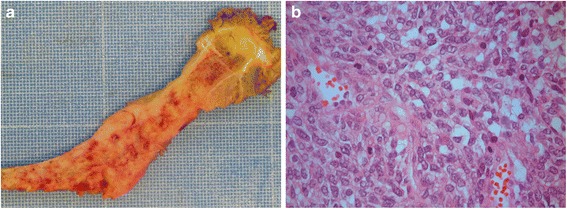
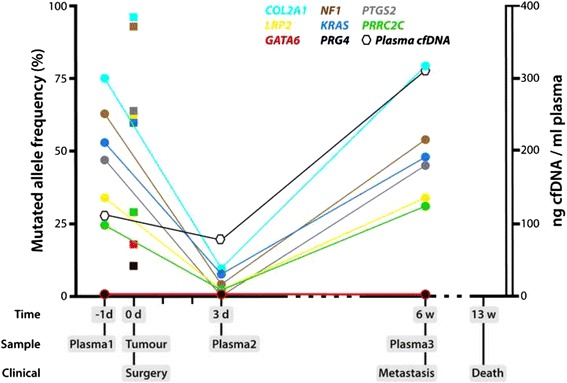
A 55-year-old male presented with a rapidly growing, painful palpable mass in the left groin region, and a biopsy revealed a high-grade malignant spindle cell sarcoma. No metastases were detected on radiologic imaging scans. Using targeted resequencing with a custom 900 cancer gene panel, eight somatic mutations among them KRAS and NF1, were identified in the primary tumour. Targeted resequencing of plasma cell-free DNA (ctDNA) collected before and after surgery and at disease progression confirmed the presence of six of eight mutations at all three time points. The ctDNA level, estimated from the somatic allele frequencies of these six mutations, was high in plasma taken at the time of surgery, at levels similar to the primary tumour. Detection of low levels of ctDNA three days after surgery indicated persistent microscopic disease. Repeated radiologic imaging six weeks postoperatively showed widespread metastatic disease in the lungs, skeleton and the pelvic region. At this time point there was a dramatic increase in the ctDNA level, reflecting the disease progression of the patient. The patient had an unusually aggressive cancer, and succumbed to the disease 13 weeks after surgery.
This case report demonstrated that targeted resequencing of ctDNA from longitudinal collected plasma can be used to monitor disease progression in a soft tissue sarcoma patient, including manifestation of metastatic disease. The ctDNA represented the genomic profile of the tumour, supporting clinical use of liquid biopsies to identify tumour-specific mutations as well as recurrent disease.
许多患者在接受了可能治愈性的治疗后会出现局部复发或转移,而早期发现这些情况对于疾病控制至关重要。最近的技术进步使得利用含有循环游离肿瘤DNA(ctDNA)的血浆进行液体活检成为可能。在本病例报告中,我们展示了如何通过连续的液体活检来监测一名肉瘤患者的病程并检测疾病复发。
一名55岁男性,左腹股沟区出现一个迅速增大、触痛明显的肿块,活检显示为高级别恶性梭形细胞肉瘤。影像学检查未发现转移。使用定制的900个癌症基因面板进行靶向重测序,在原发肿瘤中鉴定出8个体细胞突变,其中包括KRAS和NF1。对手术前后及疾病进展时采集的血浆游离DNA(ctDNA)进行靶向重测序,证实这8个突变中的6个在所有三个时间点均存在。根据这6个突变的体细胞等位基因频率估算的ctDNA水平,在手术时采集的血浆中较高,与原发肿瘤水平相似。术后三天检测到低水平的ctDNA表明存在持续性微小疾病。术后六周重复进行的影像学检查显示肺部、骨骼和盆腔区域广泛转移。此时ctDNA水平急剧上升,反映了患者的疾病进展。该患者患有异常侵袭性的癌症,术后13周死于该疾病。
本病例报告表明,对纵向采集的血浆中的ctDNA进行靶向重测序可用于监测软组织肉瘤患者的疾病进展,包括转移疾病的表现。ctDNA代表了肿瘤的基因组图谱,支持液体活检在临床中用于识别肿瘤特异性突变以及复发疾病。