Heunis J Christo, Kigozi N Gladys, Chikobvu Perpetual, Botha Sonja, van Rensburg Hcj Dingie
Centre for Health Systems Research and Development, University of the Free State, P.O. Box 399, Bloemfontein, 9300, South Africa.
Free State Department of Health, P.O. Box 277, Bloemfontein, 9300, South Africa.
BMC Public Health. 2017 Jan 6;17(1):38. doi: 10.1186/s12889-016-3972-2.
Since 1990, reduction of tuberculosis (TB) mortality has been lower in South Africa than in other high-burden countries in Africa. This research investigated the influence of routinely captured demographic and clinical or programme variables on death in TB patients in the Free State Province.
A retrospective review of case information captured in the Electronic TB register (ETR.net) over the years 2003 to 2012 was conducted. Extracted data were subjected to descriptive and logistic regression analyses. The outcome variable was defined as all registered TB cases with 'died' as the recorded outcome. The variables associated with increased or decreased odds of dying in TB patients were established. The univariate and adjusted odds ratios (OR and AOR) together with their corresponding 95% confidence intervals (CI) were estimated, taking the clustering effect of the districts into account.
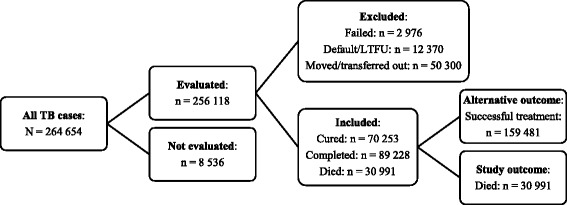
Of the 190,472 TB cases included in the analysis, 30,991 (16.3%) had 'died' as the recorded treatment outcome. The proportion of TB patients that died increased from 15.1% in 2003 to 17.8% in 2009, before declining to 15.4% in 2012. The odds of dying was incrementally higher in the older age groups: 8-17 years (AOR: 2.0; CI: 1.5-2.7), 18-49 years (AOR: 5.8; CI: 4.0-8.4), 50-64 years (AOR: 7.7; CI: 4.6-12.7), and ≥65 years (AOR: 14.4; CI: 10.3-20.2). Other factors associated with increased odds of mortality included: HIV co-infection (males - AOR: 2.4; CI: 2.1-2.8; females - AOR: 1.9; CI: 1.7-2.1) or unknown HIV status (males - AOR: 2.8; CI: 2.5-3.1; females - AOR: 2.4; CI: 2.2-2.6), having a negative (AOR: 1.4; CI: 1.3-1.6) or a missing (AOR: 2.1; CI: 1.4-3.2) pre-treatment sputum smear result, and being a retreatment case (AOR: 1.3; CI: 1.2-1.4).
Although mortality in TB patients in the Free State has been falling since 2009, it remained high at more than 15% in 2012. Appropriately targeted treatment and care for the identified high-risk groups could be considered.
自1990年以来,南非结核病死亡率的下降幅度低于非洲其他高负担国家。本研究调查了常规收集的人口统计学、临床或项目变量对自由邦省结核病患者死亡的影响。
对2003年至2012年期间电子结核病登记册(ETR.net)中记录的病例信息进行回顾性分析。提取的数据进行描述性和逻辑回归分析。结局变量定义为所有记录结局为“死亡”的登记结核病病例。确定与结核病患者死亡几率增加或降低相关的变量。考虑到地区的聚类效应,估计单因素和调整后的优势比(OR和AOR)及其相应的95%置信区间(CI)。
纳入分析的190472例结核病病例中,30991例(16.3%)记录的治疗结局为“死亡”。结核病患者的死亡比例从2003年的15.1%上升至2009年的17.8%,随后在2012年降至15.4%。年龄较大的年龄组死亡几率逐渐升高:8 - 17岁(AOR:2.0;CI:1.5 - 2.7),18 - 49岁(AOR:5.8;CI:4.0 - 8.4),50 - 64岁(AOR:7.7;CI:4.6 - 12.7),≥65岁(AOR:14.4;CI:10.3 - 20.2)。其他与死亡几率增加相关的因素包括:合并感染艾滋病毒(男性 - AOR:2.4;CI:2.1 - 2.8;女性 - AOR:1.9;CI:1.7 - 2.1)或艾滋病毒感染状况未知(男性 - AOR:2.8;CI:2.5 - 3.1;女性 - AOR:2.4;CI:2.2 - 2.6),治疗前痰涂片结果为阴性(AOR:1.4;CI:1.3 - 1.6)或缺失(AOR:2.1;CI:1.4 - 3.2),以及复治病例(AOR:1.3;CI:1.2 - 1.4)。
尽管自2009年以来自由邦省结核病患者的死亡率一直在下降,但2012年仍高达15%以上。可以考虑针对已确定的高危人群进行适当的靶向治疗和护理。