Birchall Elizabeth L, Walker Harrison C, Cutter Gary, Guthrie Stephanie, Joop Allen, Memon Raima A, Watts Ray L, Standaert David G, Amara Amy W
School of Medicine, University of Alabama at Birmingham, Birmingham, AL, United States.
Division of Movement Disorders, Department of Neurology, University of Alabama at Birmingham, Birmingham, AL, United States; Department of Biomedical Engineering, University of Alabama at Birmingham, Birmingham, AL, United States.
Brain Stimul. 2017 May-Jun;10(3):651-656. doi: 10.1016/j.brs.2016.12.014. Epub 2016 Dec 27.
Depression is common in Parkinson's disease (PD) and adversely affects quality of life. Both unilateral and bilateral subthalamic (STN) deep brain stimulation (DBS) effectively treat the motor symptoms of PD, but questions remain regarding the impact of unilateral STN DBS on non-motor symptoms, such as depression.
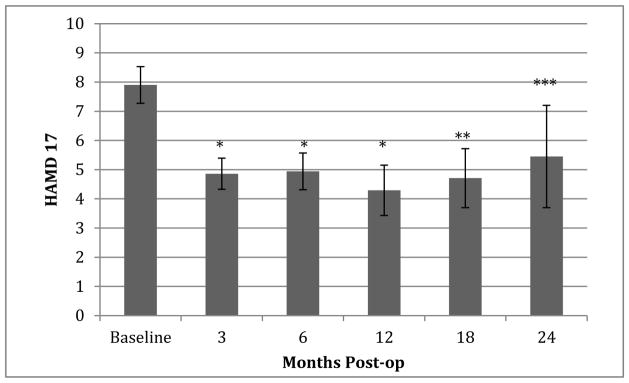
We report changes in depression, as measured by the Hamilton Depression Rating Scale (HAMD-17), in 50 consecutive PD patients who underwent unilateral STN DBS. Participants were also evaluated with UPDRS part III, Parkinson's Disease Questionnaire-39, and Pittsburgh Sleep Quality Index. The primary outcome was change in HAMD-17 at 6 months versus pre-operative baseline, using repeated measures analysis of variance (ANOVA). Secondary outcomes included the change in HAMD-17 at 3, 12, 18, and 24 months post-operatively and correlations amongst outcome variables using Pearson correlation coefficients. As a control, we also evaluated changes in HAMD-17 in 25 advanced PD patients who did not undergo DBS.
Participants with unilateral STN DBS experienced significant improvement in depression 6 months post-operatively (4.94 ± 4.02) compared to preoperative baseline (7.90 ± 4.44) (mean ± SD) (p = <0.0001). HAMD-17 scores did not correlate with UPDRS part III at any time-point. Interestingly, the HAMD-17 was significantly correlated with sleep quality and quality of life at baseline, 3 months, and 6 months post-operatively. Participants without DBS experienced no significant change in HAMD-17 over the same interval.
Unilateral STN DBS improves depression 6 months post-operatively in patients with PD. Improvement in depression is maintained over time and correlates with improvement in sleep quality and quality of life.
抑郁症在帕金森病(PD)中很常见,并且会对生活质量产生不利影响。单侧和双侧丘脑底核(STN)深部脑刺激(DBS)均能有效治疗PD的运动症状,但单侧STN DBS对诸如抑郁症等非运动症状的影响仍存在疑问。
我们报告了50例接受单侧STN DBS的连续PD患者中,通过汉密尔顿抑郁量表(HAMD-17)测量的抑郁变化情况。参与者还接受了统一帕金森病评定量表第三部分(UPDRS part III)、帕金森病问卷-39(Parkinson's Disease Questionnaire-39)和匹兹堡睡眠质量指数(Pittsburgh Sleep Quality Index)的评估。主要结局是使用重复测量方差分析(ANOVA)比较术后6个月与术前基线时HAMD-十七的变化。次要结局包括术后3、12、18和24个月时HAMD-17的变化,以及使用Pearson相关系数分析结局变量之间的相关性。作为对照,我们还评估了25例未接受DBS的晚期PD患者中HAMD-17的变化。
与术前基线(7.90±4.44)(均数±标准差)相比,接受单侧STN DBS的参与者在术后6个月时抑郁状况有显著改善(4.94±4.02)(p =<0.0001)。在任何时间点,HAMD-17评分与UPDRS第三部分均无相关性。有趣的是,在基线、术后3个月和6个月时HAMD-17与睡眠质量和生活质量显著相关。未接受DBS的参与者在同一时间段内HAMD-17无显著变化。
单侧STN DBS可使PD患者术后6个月时的抑郁状况得到改善。抑郁状况的改善会随着时间持续存在,并且与睡眠质量和生活质量的改善相关。