Kong Yee Wen, Baqar Sara, Jerums George, Ekinci Elif I
Department of Endocrinology, Austin Health , Heidelberg, VIC , Australia.
Department of Endocrinology, Austin Health, Heidelberg, VIC, Australia; Department of Medicine, Austin Health, The University of Melbourne, Melbourne, VIC, Australia.
Front Endocrinol (Lausanne). 2016 Dec 23;7:164. doi: 10.3389/fendo.2016.00164. eCollection 2016.
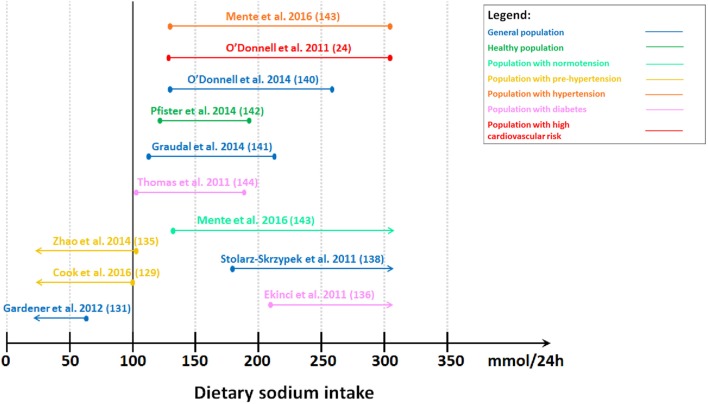
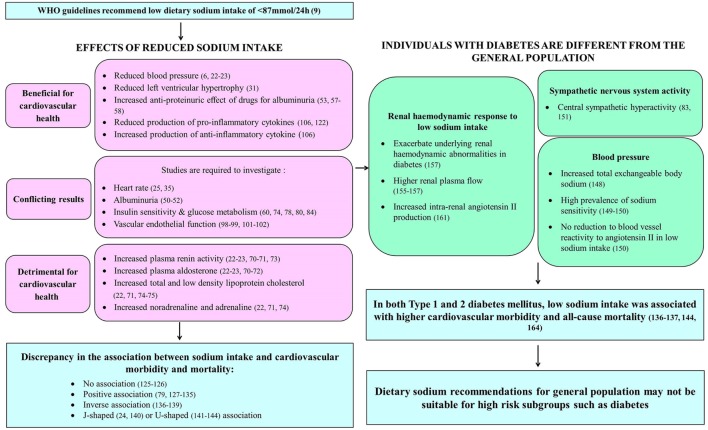
Guidelines have recommended significant reductions in dietary sodium intake to improve cardiovascular health. However, these dietary sodium intake recommendations have been questioned as emerging evidence has shown that there is a higher risk of cardiovascular disease with a low sodium diet, including in individuals with type 2 diabetes. This may be related to the other pleotropic effects of dietary sodium intake. Therefore, despite recent review of dietary sodium intake guidelines by multiple organizations, including the dietary guidelines for Americans, American Diabetes Association, and American Heart Association, concerns about the impact of the degree of sodium restriction on cardiovascular health continue to be raised. This literature review examines the effects of dietary sodium intake on factors contributing to cardiovascular health, including left ventricular hypertrophy, heart rate, albuminuria, rennin-angiotensin-aldosterone system activation, serum lipids, insulin sensitivity, sympathetic nervous system activation, endothelial function, and immune function. In the last part of this review, the association between dietary sodium intake and cardiovascular outcomes, especially in individuals with diabetes, is explored. Given the increased risk of cardiovascular disease in individuals with diabetes and the increasing incidence of diabetes worldwide, this review is important in summarizing the recent evidence regarding the effects of dietary sodium intake on cardiovascular health, especially in this population.
指南建议大幅减少饮食中的钠摄入量,以改善心血管健康。然而,这些饮食钠摄入建议受到了质疑,因为新出现的证据表明,低钠饮食会增加心血管疾病风险,包括2型糖尿病患者。这可能与饮食钠摄入的其他多效性作用有关。因此,尽管包括美国膳食指南、美国糖尿病协会和美国心脏协会在内的多个组织最近对饮食钠摄入指南进行了审查,但关于钠限制程度对心血管健康影响的担忧仍不断被提出。这篇文献综述探讨了饮食钠摄入对心血管健康相关因素的影响,包括左心室肥厚、心率、蛋白尿、肾素 - 血管紧张素 - 醛固酮系统激活、血脂、胰岛素敏感性、交感神经系统激活、内皮功能和免疫功能。在本综述的最后部分,探讨了饮食钠摄入与心血管结局之间的关联,特别是糖尿病患者。鉴于糖尿病患者心血管疾病风险增加以及全球糖尿病发病率上升,本综述对于总结近期关于饮食钠摄入对心血管健康影响的证据非常重要,尤其是在这一人群中。