Luo Yang, Zheng Song Guo
Department of Clinical Immunology of the Third Affiliated Hospital at the Sun Yat-sen University, Guangzhou, China; Division of Rheumatology, Department of Medicine at Penn State Hershey College of Medicine, Hershey, PA, USA.
Front Immunol. 2016 Dec 19;7:604. doi: 10.3389/fimmu.2016.00604. eCollection 2016.
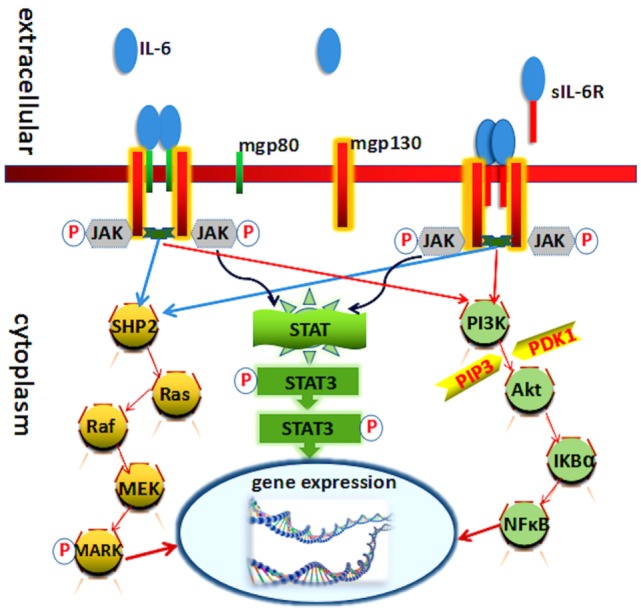
Pro-inflammatory cytokines that are generated by immune system cells and mediate many kinds of immune responses are kinds of endogenous polypeptides. They are also the effectors of the autoimmune system. It is generally accepted that interleukin (IL)-4, IL-6, IL-9, IL-17, and tumor necrosis factor-α are pro-inflammatory cytokines; however, IL-6 becomes a protagonist among them since it predominately induces pro-inflammatory signaling and regulates massive cellular processes. It has been ascertained that IL-6 is associated with a large number of diseases with inflammatory background, such as anemia of chronic diseases, angiogenesis acute-phase response, bone metabolism, cartilage metabolism, and multiple cancers. Despite great progress in the relative field, the targeted regulation of IL-6 response for therapeutic benefits remains incompletely to be understood. Therefore, it is conceivable that understanding mechanisms of IL-6 from the perspective of gene regulation can better facilitate to determine the pathogenesis of the disease, providing more solid scientific basis for clinical treatment translation. In this review, we summarize the candidate genes that have been implicated in clinical target therapy from the perspective of gene transcription regulation.
由免疫系统细胞产生并介导多种免疫反应的促炎细胞因子是一类内源性多肽。它们也是自身免疫系统的效应器。一般认为,白细胞介素(IL)-4、IL-6、IL-9、IL-17和肿瘤坏死因子-α是促炎细胞因子;然而,IL-6在其中成为主角,因为它主要诱导促炎信号传导并调节大量细胞过程。已经确定IL-6与大量具有炎症背景的疾病相关,如慢性病贫血、血管生成急性期反应、骨代谢、软骨代谢和多种癌症。尽管在相关领域取得了很大进展,但针对IL-6反应进行治疗获益的靶向调控仍未完全了解。因此,可以想象,从基因调控的角度理解IL-6的机制可以更好地促进确定疾病的发病机制,为临床治疗转化提供更坚实的科学依据。在本综述中,我们从基因转录调控的角度总结了与临床靶向治疗相关的候选基因。