Veillet Florian, Gaillard Cécile, Coutos-Thévenot Pierre, La Camera Sylvain
Laboratoire Ecologie et Biologie des Interactions, Equipe "SEVE-Sucres et Echanges Végétaux-Environnement," UMR Centre National de la Recherche Scientifique 7267, Université de Poitiers Poitiers, France.
Front Plant Sci. 2016 Dec 20;7:1899. doi: 10.3389/fpls.2016.01899. eCollection 2016.
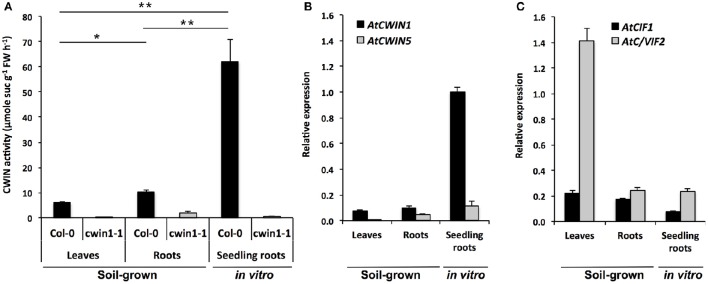
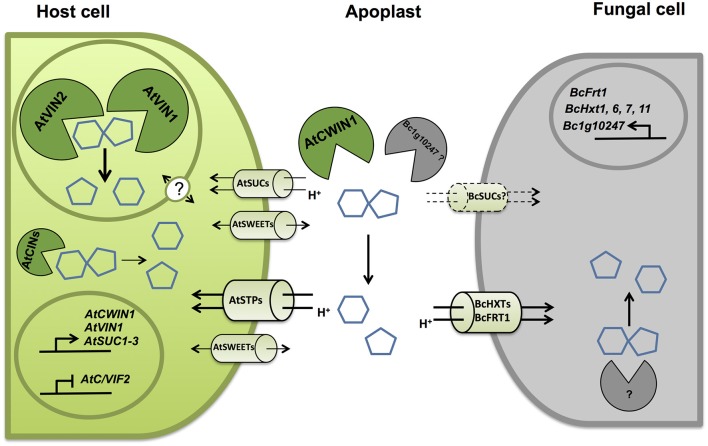
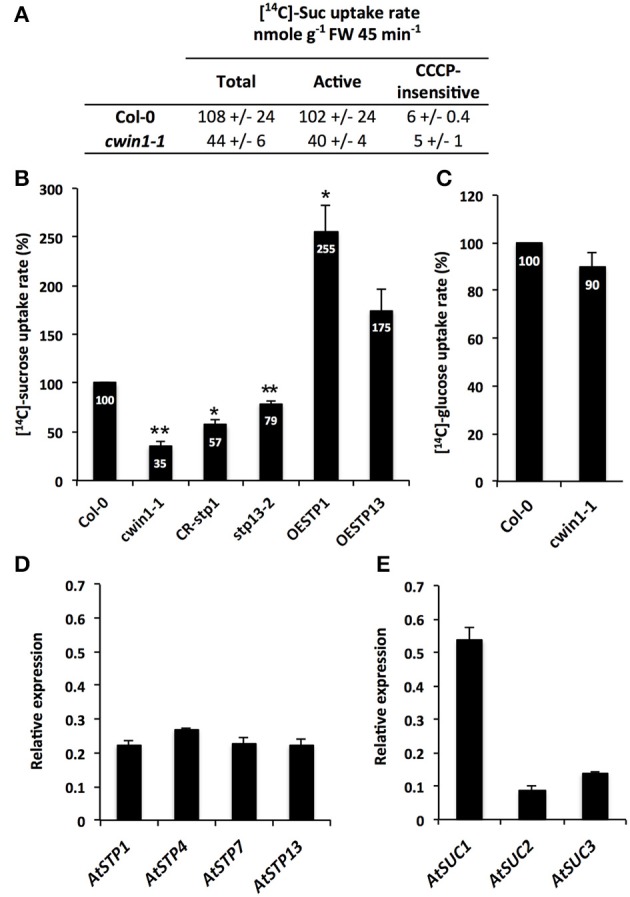
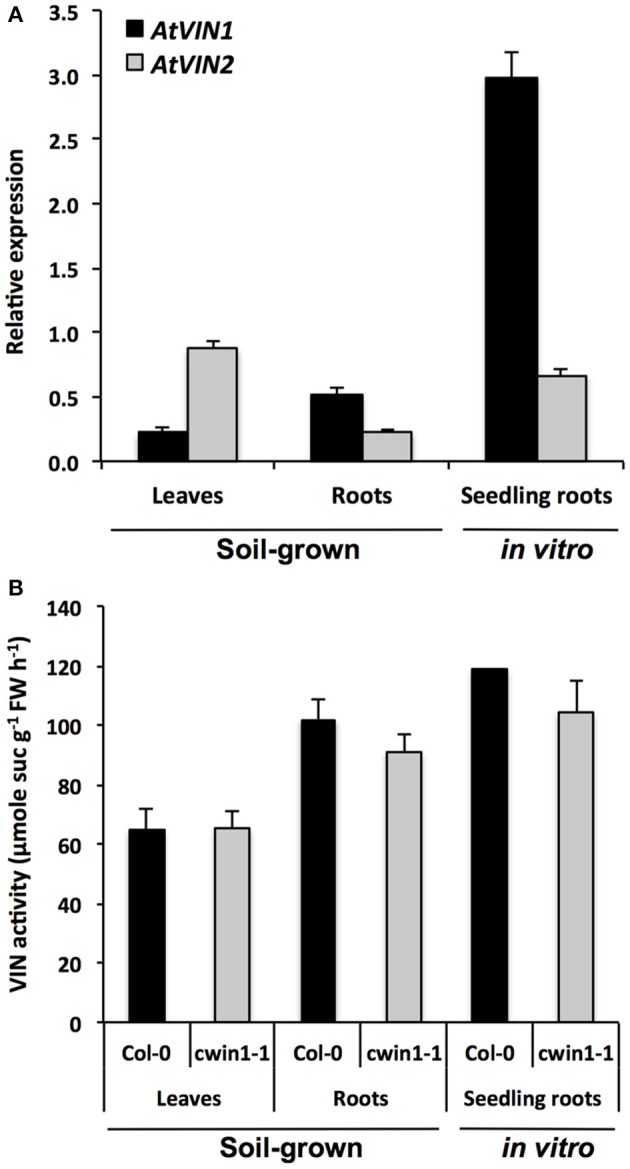
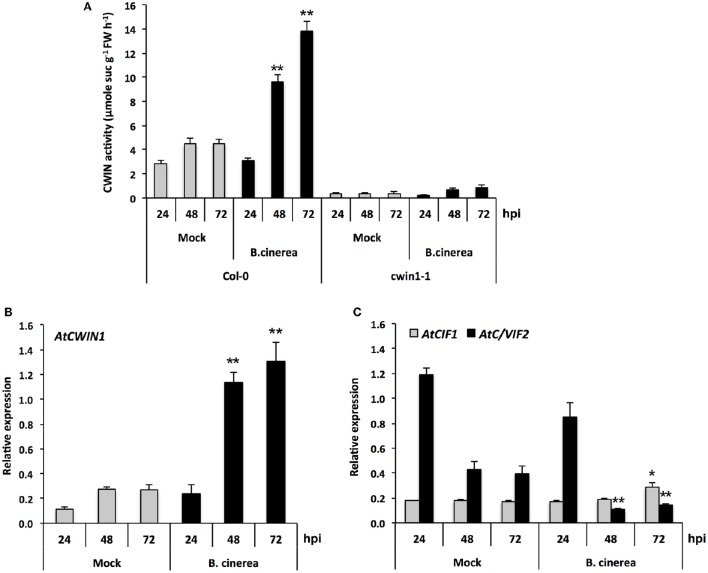
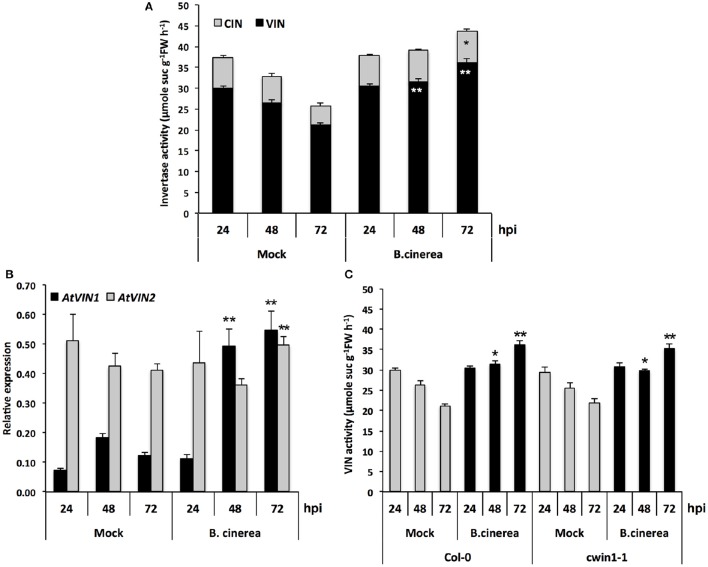
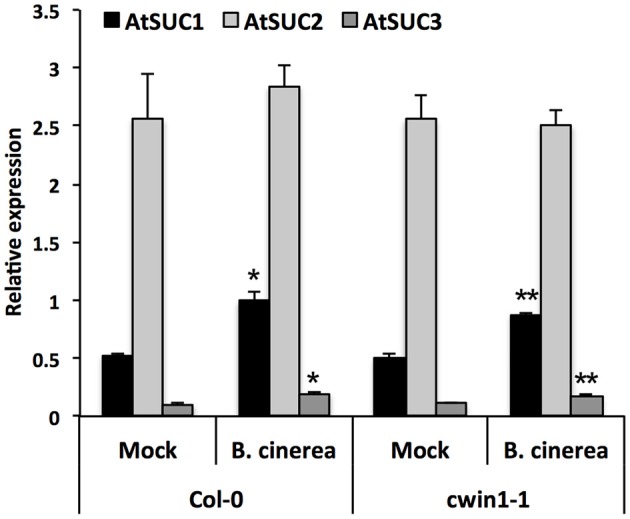
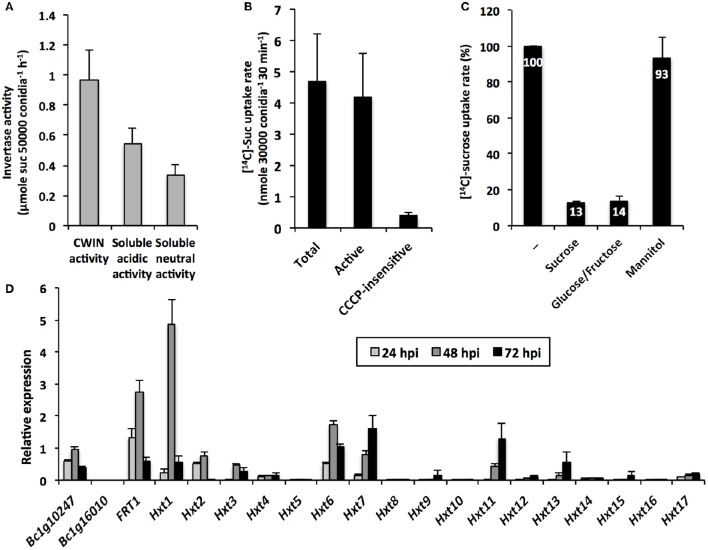
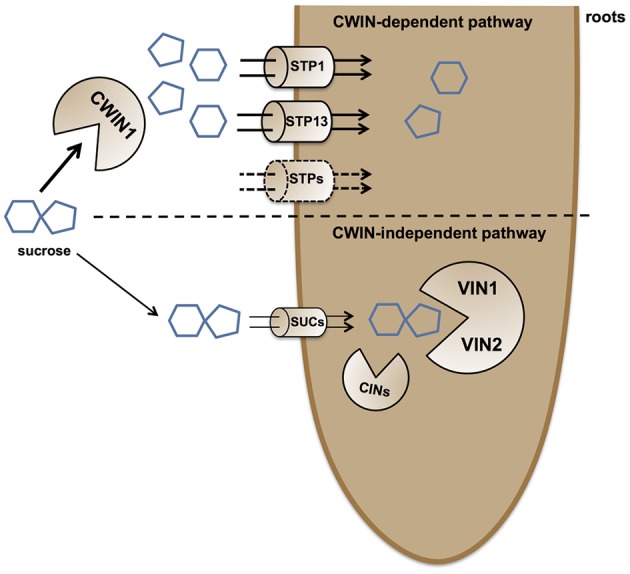
Cell wall invertases (CWIN) cleave sucrose into glucose and fructose in the apoplast. CWINs are key regulators of carbon partitioning and source/sink relationships during growth, development and under biotic stresses. In this report, we monitored the expression/activity of cell wall invertases in organs behaving as source, sink, or subjected to a source/sink transition after infection with the necrotrophic fungus . We showed that organs with different source/sink status displayed differential CWIN activities, depending on carbohydrate needs or availabilities in the surrounding environment, through a transcriptional and posttranslational regulation. Loss-of-function mutation of the cell wall invertase 1 gene, , showed that the corresponding protein was the main contributor to the apoplastic sucrose cleaving activity in both leaves and roots. The CWIN-deficient mutant exhibited a reduced capacity to actively take up external sucrose in roots, indicating that this process is mainly dependent on the sucrolytic activity of . Using T-DNA and CRISPR/Cas9 mutants impaired in hexose transport, we demonstrated that external sucrose is actively absorbed in the form of hexoses by a sugar/H symport system involving the coordinated activity of AtCWIN1 with several Sugar Transporter Proteins (STP) of the plasma membrane, i.e., STP1 and STP13. Part of external sucrose was imported without apoplastic cleavage into seedling roots, highlighting an alternative -independent pathway for the assimilation of external sucrose. Accordingly, we showed that several genes encoding sucrose transporters of the plasma membrane were expressed. We also detected transcript accumulation of vacuolar invertase (VIN)-encoding genes and high VIN activities. Upon infection, was responsible for all the -induced apoplastic invertase activity. We detected a transcriptional activation of several and genes accompanied with an enhanced vacuolar invertase activity, suggesting that the -independent pathway is efficient upon infection. In absence of , we postulate that intracellular sucrose hydrolysis is sufficient to provide intracellular hexoses to maintain sugar homeostasis in host cells and to fuel plant defenses. Finally, we demonstrated that possesses its own functional sucrolytic machinery and hexose uptake system, and does not rely on the host apoplastic invertases.
细胞壁转化酶(CWIN)在质外体中将蔗糖裂解为葡萄糖和果糖。CWIN是生长、发育以及生物胁迫期间碳分配和源/库关系的关键调节因子。在本报告中,我们监测了坏死营养型真菌感染后作为源、库或经历源/库转变的器官中细胞壁转化酶的表达/活性。我们发现,具有不同源/库状态的器官表现出不同的CWIN活性,这取决于周围环境中的碳水化合物需求或可用性,通过转录和翻译后调控实现。细胞壁转化酶1基因( )的功能缺失突变表明,相应蛋白质是叶片和根中质外体蔗糖裂解活性的主要贡献者。CWIN缺陷型突变体 在根中主动吸收外部蔗糖的能力降低,表明该过程主要依赖于 的蔗糖分解活性。使用在己糖转运方面受损的T-DNA和CRISPR/Cas9突变体,我们证明外部蔗糖以己糖形式通过糖/H共转运系统被主动吸收,该系统涉及AtCWIN1与质膜的几种糖转运蛋白(STP)(即STP1和STP13)的协同活性。部分外部蔗糖在没有质外体裂解的情况下被导入 幼苗根中,突出了外部蔗糖同化的一条不依赖 的替代途径。因此,我们表明几个编码质膜蔗糖转运蛋白的基因被表达。我们还检测到液泡转化酶(VIN)编码基因的转录本积累和高VIN活性。感染后, 负责所有由 诱导的质外体转化酶活性。我们检测到几个 和 基因的转录激活以及液泡转化酶活性增强,表明不依赖 的途径在感染时是有效的。在没有 的情况下,我们推测细胞内蔗糖水解足以提供细胞内己糖以维持宿主细胞中的糖稳态并为植物防御提供能量。最后,我们证明 拥有自己的功能性蔗糖分解机制和己糖摄取系统,并且不依赖宿主质外体转化酶。