Shen Si, Ma Si, Liu Yonghua, Liao Shengjin, Li Jun, Wu Limin, Kartika Dewi, Mock Hans-Peter, Ruan Yong-Ling
School of Environmental and Life Sciences, The University of Newcastle, Callaghan, NSW, Australia.
College of Agronomy and Biotechnology, China Agricultural University, Beijing, China.
Front Plant Sci. 2019 Apr 18;10:506. doi: 10.3389/fpls.2019.00506. eCollection 2019.
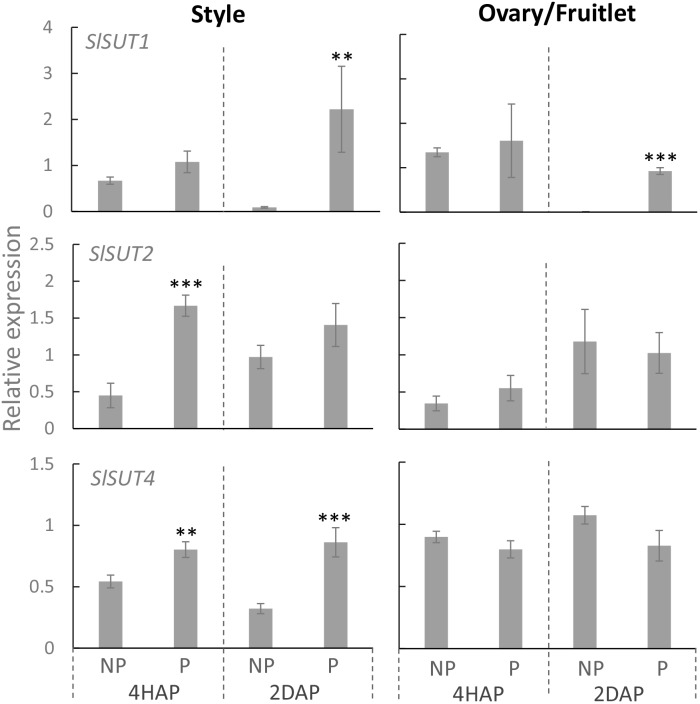
Flowering plants depend on pollination and fertilization to activate the transition from ovule to seed and ovary to fruit, namely seed and fruit set, which are key for completing the plant life cycle and realizing crop yield potential. These processes are highly energy consuming and rely on the efficient use of sucrose as the major nutrient and energy source. However, it remains elusive as how sucrose imported into and utilizated within the female reproductive organ is regulated in response to pollination and fertilization. Here, we explored this issue in tomato by focusing on genes encoding cell wall invertase (CWIN) and sugar transporters, which are major players in sucrose phloem unloading, and sink development. The transcript level of a major CWIN gene, , and CWIN activity were significantly increased in style at 4 h after pollination (HAP) in comparison with that in the non-pollination control, and this was sustained at 2 days after pollination (DAP). In the ovaries, however, CWIN activity and expression did not increase until 2 DAP when fertilization occurred. Interestingly, a CWIN inhibitor gene was repressed in the pollinated style at 2 DAP. In response to pollination, the style exhibited increased expressions of genes encoding hexose transporters, , , , and sucrose transporters , , and from 4 HAP to 2 DAP. Upon fertilization, and and , but not , were also stimulated in fruitlets at 2 DAP. Together, the findings reveal that styles respond promptly and more broadly to pollination for activation of CWIN and sugar transporters to fuel pollen tube elongation, whereas the ovaries do not exhibit activation for some of these genes until fertilization occurs.
Expression of genes encoding cell wall invertases and sugar transporters was stimulated in pollinated style and fertilized ovaries in tomato.
开花植物依靠授粉和受精来激活从胚珠到种子以及从子房到果实的转变,即坐果和结实,这是完成植物生命周期和实现作物产量潜力的关键。这些过程消耗大量能量,并且依赖于蔗糖作为主要营养和能量来源的有效利用。然而,关于导入雌性生殖器官并在其中利用的蔗糖如何响应授粉和受精进行调节,目前仍不清楚。在这里,我们以番茄为研究对象,聚焦于编码细胞壁转化酶(CWIN)和糖转运蛋白的基因,这些基因在蔗糖韧皮部卸载和库发育中起主要作用,从而探讨了这个问题。与未授粉对照相比,主要CWIN基因的转录水平以及CWIN活性在授粉后4小时(HAP)时花柱中显著增加,并在授粉后2天(DAP)持续存在。然而,在子房里,直到受精发生的授粉后2天,CWIN活性和表达才增加。有趣的是,一个CWIN抑制基因在授粉后2天的授粉花柱中受到抑制。响应授粉,花柱中编码己糖转运蛋白、、、和蔗糖转运蛋白、、的基因表达从授粉后4小时到授粉后2天增加。受精后,在授粉后2天的幼果中、以及、但不是也受到刺激。总之,研究结果表明,花柱对授粉反应迅速且更广泛,激活CWIN和糖转运蛋白以促进花粉管伸长,而子房在受精发生之前,对其中一些基因没有表现出激活作用。
番茄授粉花柱和受精子房编码细胞壁转化酶和糖转运蛋白的基因表达受到刺激。