Giubergia Sonia, Phippen Christopher, Nielsen Kristian Fog, Gram Lone
NovoNordisk Foundation Centre for Biosustainability, Technical University of Denmark, Kgs. Lyngby, Denmark; Department of Biotechnology and Biomedicine, Technical University of Denmark, Kgs. Lyngby, Denmark.
Department of Biotechnology and Biomedicine, Technical University of Denmark, Kgs. Lyngby, Denmark.
mSystems. 2017 Jan 3;2(1). doi: 10.1128/mSystems.00141-16. eCollection 2017 Jan-Feb.
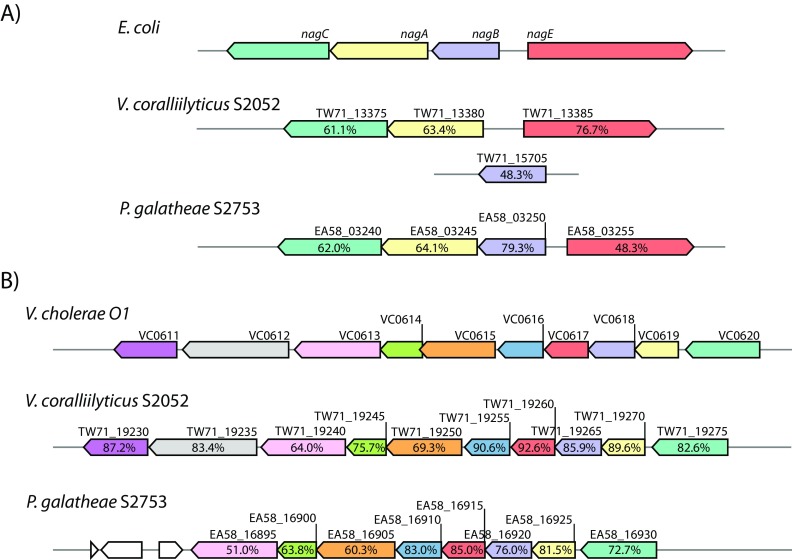
Members of the family are often associated with chitin-containing organisms, and they are thought to play a major role in chitin degradation. The purpose of the present study was to determine how chitin affects the transcriptome and metabolome of two bioactive strains, and . We focused on chitin degradation genes and secondary metabolites based on the assumption that these molecules in nature confer an advantage to the producer. Growth on chitin caused upregulation of genes related to chitin metabolism and of genes potentially involved in host colonization and/or infection. The expression of genes involved in secondary metabolism was also significantly affected by growth on chitin, in one case being 34-fold upregulated. This was reflected in the metabolome, where the antibiotics andrimid and holomycin were produced in larger amounts on chitin. Other polyketide synthase/ nonribosomal peptide synthetase (PKS-NRPS) clusters in were also strongly upregulated on chitin. Collectively, this suggests that both and have a specific lifestyle for growth on chitin and that their secondary metabolites likely play a crucial role during chitin colonization. The bacterial family (vibrios) is considered a major player in the degradation of chitin, the most abundant polymer in the marine environment; however, the majority of studies on the topic have focused on a small number of species. In this study, we analyzed the genomes of two vibrios to assess their genetic potential for the degradation of chitin. We then used transcriptomics and metabolomics to demonstrate that chitin strongly affects these vibrios at both the transcriptional and metabolic levels. We observed a strong increase in production of secondary metabolites, suggesting an ecological role for these molecules during chitin colonization in the marine environment.
该菌科成员常与含几丁质的生物相关联,被认为在几丁质降解中起主要作用。本研究的目的是确定几丁质如何影响两种生物活性菌株的转录组和代谢组。基于自然界中这些分子赋予生产者优势这一假设,我们重点研究了几丁质降解基因和次生代谢产物。在几丁质上生长导致与几丁质代谢相关的基因以及可能参与宿主定殖和/或感染的基因上调。几丁质上的生长对参与次生代谢的基因表达也有显著影响,在一个案例中上调了34倍。这在代谢组中得到体现,在几丁质上产生了更多的抗生素安丝菌素和全霉素。该菌中的其他聚酮合酶/非核糖体肽合成酶(PKS-NRPS)簇在几丁质上也强烈上调。总体而言,这表明两种菌株在几丁质上生长都有特定的生活方式,且其次生代谢产物可能在几丁质定殖过程中起关键作用。细菌科(弧菌)被认为是海洋环境中最丰富的聚合物几丁质降解的主要参与者;然而,关于该主题的大多数研究都集中在少数弧菌物种上。在本研究中,我们分析了两种弧菌的基因组,以评估它们降解几丁质的遗传潜力。然后,我们使用转录组学和代谢组学来证明几丁质在转录和代谢水平上都对这些弧菌有强烈影响。我们观察到次生代谢产物的产量大幅增加,表明这些分子在海洋环境中的几丁质定殖过程中具有生态作用。