Anthropological Institute and Museum, University of Zurich, Switzerland.
School of Psychology and Neuroscience, University of St. Andrews, United Kingdom.
Sci Rep. 2017 Jan 9;7:40052. doi: 10.1038/srep40052.
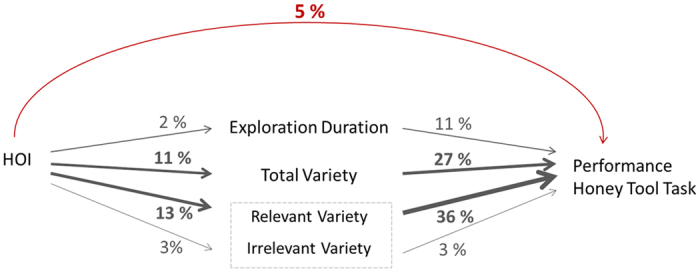
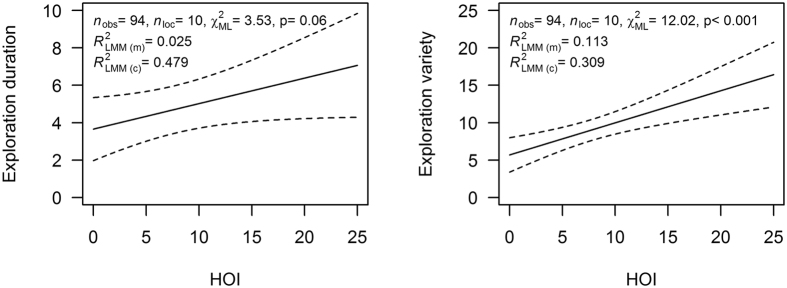
Non-human animals sometimes show marked intraspecific variation in their cognitive abilities that may reflect variation in external inputs and experience during the developmental period. We examined variation in exploration and cognitive performance on a problem-solving task in a large sample of captive orang-utans (Pongo abelii &P. pygmaeus, N = 103) that had experienced different rearing and housing conditions during ontogeny, including human exposure. In addition to measuring exploration and cognitive performance, we also conducted a set of assays of the subjects' psychological orientation, including reactions towards an unfamiliar human, summarized in the human orientation index (HOI), and towards novel food and objects. Using generalized linear mixed models we found that the HOI, rather than rearing background, best predicted both exploration and problem-solving success. Our results suggest a cascade of processes: human orientation was accompanied by a change in motivation towards problem-solving, expressed in reduced neophobia and increased exploration variety, which led to greater experience, and thus eventually to higher performance in the task. We propose that different experiences with humans caused individuals to vary in curiosity and understanding of the physical problem-solving task. We discuss the implications of these findings for comparative studies of cognitive ability.
非人类动物在认知能力方面有时表现出明显的种内变异性,这可能反映了在发育期间外部输入和经验的变化。我们在一个大型的圈养猩猩(红毛猩猩和苏门答腊猩猩,N=103)样本中研究了在解决问题任务中的探索和认知表现的变化,这些猩猩在个体发育过程中经历了不同的饲养和住房条件,包括人类的接触。除了测量探索和认知表现外,我们还对研究对象的心理取向进行了一系列的测定,包括对陌生人类的反应,总结为人类取向指数(HOI),以及对新食物和物体的反应。使用广义线性混合模型,我们发现,HOI 而不是饲养背景,最能预测探索和解决问题的成功率。我们的研究结果表明,存在一系列的过程:对人类的取向伴随着对解决问题的动机的变化,表现为减少对新事物的恐惧和增加探索的多样性,这导致了更多的经验,最终在任务中表现更好。我们提出,与人类的不同经历导致个体在好奇心和对物理解决问题任务的理解方面存在差异。我们讨论了这些发现对认知能力比较研究的意义。