Maleki-Ravasan Naseh, Solhjouy-Fard Samaneh, Beaucournu Jean-Claude, Laudisoit Anne, Mostafavi Ehsan
Malaria and Vector Research Group, Biotechnology Research Center, Pasteur Institute of Iran, Tehran, Iran.
Research Centre for Emerging and Reemerging infectious diseases, Pasteur Institute of Iran, Akanlu, Kabudar Ahang, Hamadan, Iran.
PLoS Negl Trop Dis. 2017 Jan 9;11(1):e0005260. doi: 10.1371/journal.pntd.0005260. eCollection 2017 Jan.
Flea-borne diseases have a wide distribution in the world. Studies on the identity, abundance, distribution and seasonality of the potential vectors of pathogenic agents (e.g. Yersinia pestis, Francisella tularensis, and Rickettsia felis) are necessary tools for controlling and preventing such diseases outbreaks. The improvements of diagnostic tools are partly responsible for an easier detection of otherwise unnoticed agents in the ectoparasitic fauna and as such a good taxonomical knowledge of the potential vectors is crucial. The aims of this study were to make an exhaustive inventory of the literature on the fleas (Siphonaptera) and range of associated hosts in Iran, present their known distribution, and discuss their medical importance.
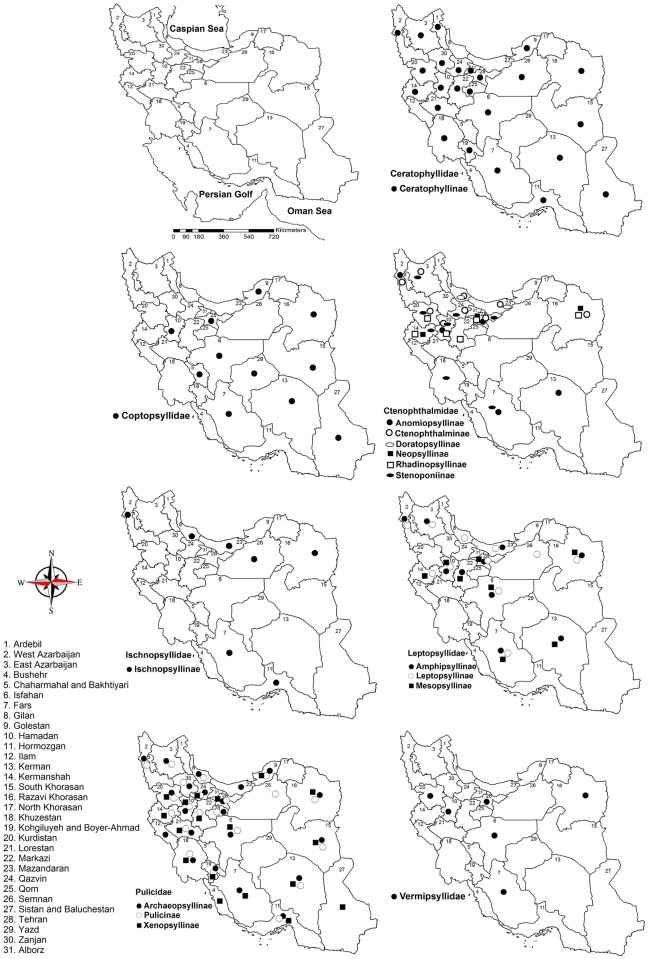
METHODOLOGY/PRINCIPAL FINDINGS: The data were obtained by an extensive literature review related to medically significant fleas in Iran published before 31st August 2016. The flea-host specificity was then determined using a family and subfamily-oriented criteria to further realize and quantify the shared and exclusive vertebrate hosts of fleas among Iran fleas. The locations sampled and reported in the literature were primarily from human habitation, livestock farms, poultry, and rodents' burrows of the 31 provinces of the country. The flea fauna were dominated by seven families, namely the Ceratophyllidae, Leptopsyllidae, Pulicidae, Ctenophthalmidae, Coptopsyllidae, Ischnopsyllidae and Vermipsyllidae. The hosts associated with Iran fleas ranged from the small and large mammals to the birds. Pulicidae were associated with 73% (56/77) of identified host species. Flea-host association analysis indicates that rodents are the common hosts of 5 flea families but some sampling bias results in the reduced number of bird host sampled. Analyses of flea-host relationships at the subfamily level showed that most vertebrates hosted fleas belgonging to 3 subfamilies namely Xenopsyllinae (n = 43), Ctenophthalminae (n = 20) and Amphipsyllinae (n = 17). Meriones persicus was infested by 11 flea subfamilies in the arid, rocky, mountainous regions and Xenopsyllinae were hosted by at least 43 mammal species. These findings place the Persian jird (M. persicus) and the Xenopsyllinae as the major vertebrate and vector hosts of flea-borne diseases in Iran including Yersinia pestis, the etiological agent of plague. We found records of at least seven vector-borne pathogenic agents that can potentially be transmitted by the 117 flea species (or subspecies) of Iran.
CONCLUSIONS/SIGNIFICANCE: Herein, we performed a thorough inventary of the flea species and their associated hosts, their medical importance and geographic distribution throughout Iran. This exercise allowed assessing the diversity of flea species with the potential flea-borne agents transmission risk in the country by arranging published data on flea-host associations. This information is a first step for issuing public health policies and rodent-flea control campaigns in Iran as well as those interested in the ecology/epidemiology of flea-borne disease.
蚤媒疾病在全球分布广泛。对病原体(如鼠疫耶尔森菌、土拉弗朗西斯菌和猫立克次体)潜在传播媒介的种类、数量、分布和季节性进行研究,是控制和预防此类疾病爆发的必要手段。诊断工具的改进使得在外寄生动物区系中更容易检测到原本未被注意的病原体,因此,对潜在传播媒介有良好的分类学认识至关重要。本研究的目的是详尽梳理伊朗有关跳蚤(蚤目)及其相关宿主范围的文献,呈现它们已知的分布情况,并讨论其医学重要性。
方法/主要发现:通过广泛查阅2016年8月31日前发表的有关伊朗具有医学意义跳蚤的文献来获取数据。然后使用以科和亚科为导向的标准确定跳蚤与宿主的特异性,以进一步了解和量化伊朗跳蚤中共享和独占脊椎动物宿主的情况。文献中采样和报告的地点主要来自该国31个省份的人类居住地、畜牧场、家禽场和啮齿动物洞穴。跳蚤区系以七个科为主,即角叶蚤科、细蚤科、蚤科、栉眼蚤科、鬃眼蚤科、蝠蚤科和蠕形蚤科。与伊朗跳蚤相关的宿主范围从小型和大型哺乳动物到鸟类。蚤科与73%(56/77)已确定的宿主物种相关。跳蚤与宿主的关联分析表明,啮齿动物是5个跳蚤科的常见宿主,但一些采样偏差导致鸟类宿主的采样数量减少。在亚科水平上对跳蚤与宿主关系的分析表明,大多数宿主跳蚤属于3个亚科,即客蚤亚科(n = 43)、栉眼蚤亚科(n = 20)和双蚤亚科(n = 17)。在干旱、多岩石的山区,波斯沙鼠被11个跳蚤亚科寄生,客蚤亚科至少寄生于43种哺乳动物。这些发现表明,波斯沙鼠和客蚤亚科是伊朗包括鼠疫病原体鼠疫耶尔森菌在内的蚤媒疾病的主要脊椎动物宿主和传播媒介宿主。我们发现至少有七种媒介传播病原体的记录,它们可能由伊朗的117种跳蚤物种(或亚种)传播。
结论/意义:在此,我们全面梳理了伊朗的跳蚤物种及其相关宿主、它们的医学重要性和地理分布。通过整理已发表的跳蚤与宿主关联数据,这项工作有助于评估该国具有潜在蚤媒传播病原体风险的跳蚤物种多样性。这些信息是伊朗制定公共卫生政策和开展啮齿动物 - 跳蚤控制活动的第一步,也对关注蚤媒疾病生态/流行病学的人士具有重要意义。
