Ctori Irene, Huntjens Byki
Applied Vision Research Centre, The Henry Wellcome Laboratories for Vision Sciences, City, University of London, London, United Kingdom.
PLoS One. 2017 Jan 9;12(1):e0169520. doi: 10.1371/journal.pone.0169520. eCollection 2017.
Macular pigment (MP) spatial distribution varies considerably among individuals. We investigated ethnic variations in MP spatial distribution in relation to foveal architecture.
We measured MP optical density (MPOD) using heterochromatic flicker photometry (MAP test, City, University of London) in 76 white, 80 South Asian and 70 black volunteers (18 to 39 years). MPOD spatial profiles were classified objectively as exponential, ring-like or central dip, based on deviations away from an exponential fit. Measurements including total retinal thickness (RT), inner retinal layer (IRL), inner and outer plexiform layer (IPL and OPL) thickness, foveal width and foveal pit slope were taken from Spectralis SD-OCT (Heidelberg, Germany) scans.
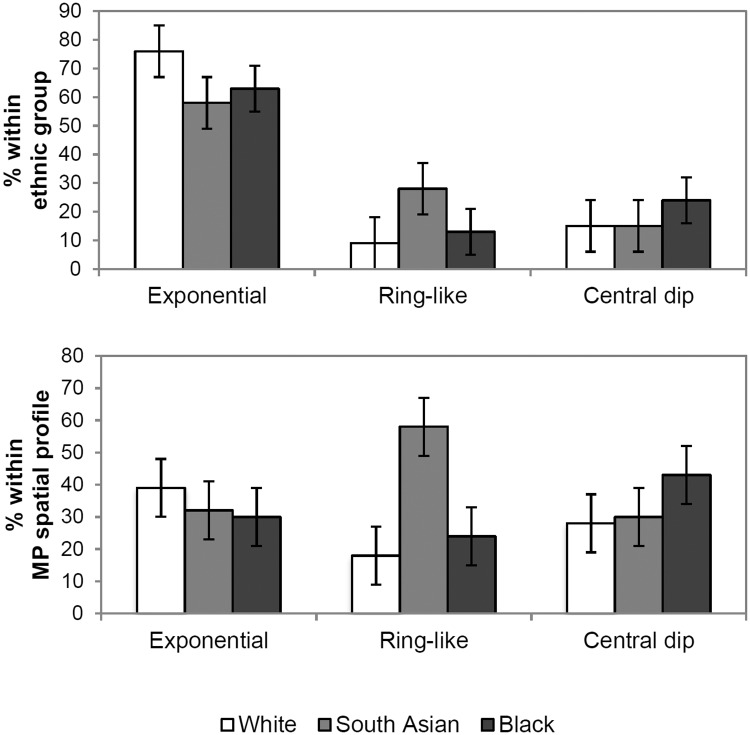
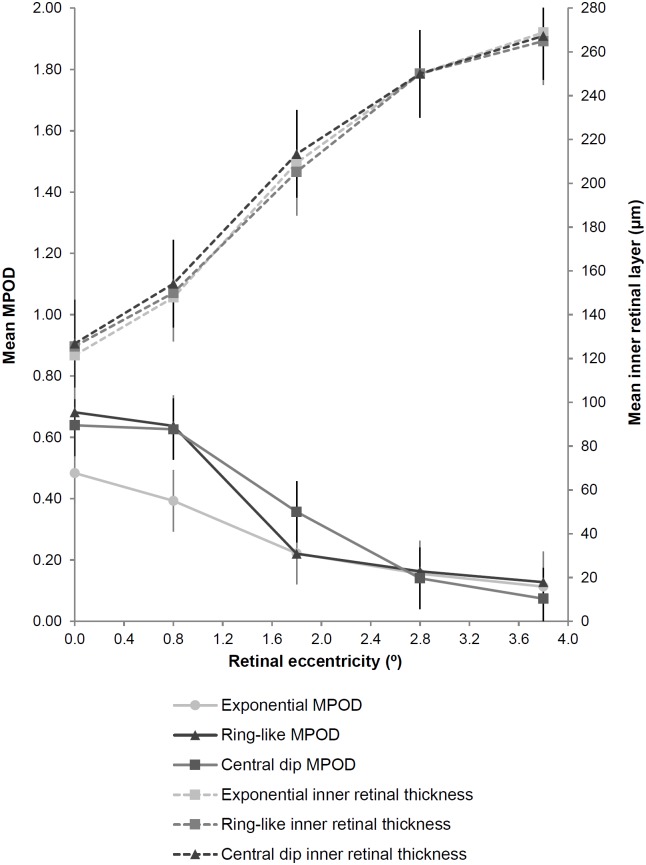
Integrated MPOD up to 1.8° (MPODint) was higher in South Asian (0.84±0.26) and black (0.84±0.31) than whites (0.63±0.24, P<0.0005). Ethnicity explained around 10% of the variance while gender played no significant role. MPOD profile phenotypes were associated with ethnicity: 58% with ring profiles were South Asian and 43% with dip profiles were black (χ2(4,226) = 13.4, P = 0.009). MPODint was lower in exponential (0.66±0.21) compared to ring-like (0.96±0.26) and central dip (1.00±0.32, P<0.0005) groups. White subjects had thicker IRL at 0° (130±21μm) than South Asian (123±16μm) and blacks (116±14μm; F(2) = 12.4, P<0.0005), with comparable results for IPL (P<0.0005) and OPL (P = 0.03). There was no significant difference in IRL, IPL or OPL (from 0 to 3.8° retinal eccentricity) or foveal width between MP profile groups (P>0.05).
We report a significant difference in the amount and distribution of MP between ethnicities that is not explained by variations in foveal morphology.
黄斑色素(MP)的空间分布在个体之间存在很大差异。我们研究了MP空间分布的种族差异及其与中央凹结构的关系。
我们使用异色闪烁光度法(MAP测试,伦敦大学城市学院)测量了76名白人、80名南亚人和70名黑人志愿者(18至39岁)的MP光密度(MPOD)。基于与指数拟合的偏差,MPOD空间分布客观地分为指数型、环状或中央凹陷型。包括总视网膜厚度(RT)、视网膜内层(IRL)、内丛状层和外丛状层(IPL和OPL)厚度、中央凹宽度和中央凹坑斜率等测量值取自Spectralis SD-OCT(德国海德堡)扫描。
高达1.8°的积分MPOD(MPODint)在南亚人(0.84±0.26)和黑人(0.84±0.31)中高于白人(0.63±0.24,P < 0.0005)。种族解释了约10%的变异,而性别没有显著作用。MPOD分布表型与种族相关:58%的环状分布为南亚人,43%的凹陷分布为黑人(χ2(4,226) = 13.4,P = 0.009)。与环状(0.96±0.26)和中央凹陷型(1.00±0.32,P < 0.0005)组相比,指数型组的MPODint较低(0.66±0.21)。白人受试者在0°处的IRL(130±21μm)比南亚人(123±16μm)和黑人(116±14μm)更厚(F(2) = 12.4,P < 0.0005),IPL(P < 0.0005)和OPL(P = 0.03)的结果类似。MP分布组之间在IRL、IPL或OPL(从0到3.8°视网膜偏心率)或中央凹宽度方面没有显著差异(P > 0.05)。
我们报告了不同种族之间MP数量和分布的显著差异,这不能用中央凹形态的变化来解释。