Sabetnejad Zahra, Assarian Fatemeh, Omidi Abdollah, Najarzadegan Mohammad Reza
M.D., Psychiatrist, Department of Psychiatry, Faculty of Medicine, Kashan University of Medical Sciences, Kashan, Iran.
M.D., Psychiatrist, Assistant Professor, Department of Psychiatry, Faculty of Medicine, Kashan University of Medical Sciences, Kashan, Iran.
Electron Physician. 2016 Nov 25;8(11):3156-3163. doi: 10.19082/3156. eCollection 2016 Nov.
Obsessive compulsive disorder (OCD) is a mental health concern due to its various negative consequences, especially in sexual function. Therefore, the treatment of sexual dysfunction in women with OCD is important in order to improve the patient's marital function and mental health.
To compare the sexual behavior and sexual and marital satisfaction in women with obsessive-compulsive disorder (OCD) before and after treatment with fluoxetine and cognitive behavior therapy.
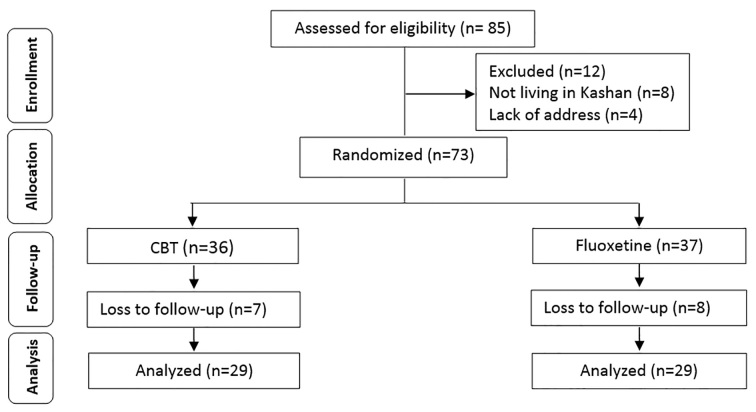
This randomized clinical trial was conducted at psychiatric and psychological counseling centers in Kashan (Iran) from January 2, 2014, to December 29, 2014. Fifty-eight women with OCD were included in the study. In order to compare the effectiveness of pharmacological treatment (fluoxetine) and psychological treatment, cognitive behavior therapy (CBT), 58 female patients with OCD (diagnosed based on DSM-IV-T criteria) were randomized equally to either fluoxetine (at a dose of 60-80 mg daily for 3 months) or CBT (10 45-minute sessions). OCD and sexual behavior status of the patients before and after the intervention was assessed with the Yale-Brown Obsessive Compulsive Scale (Y-BOCS) and Female Sexual Function Index (FSFI) questionnaire, respectively. The data were analyzed using SPSS version 22. To compare changes between the two groups, an independent T-test was used. Finally, the effects of all potential factors on treatment outcome were analyzed using factorial ANCOVA.
The mean score for OCD in the fluoxetine group was 25.6 ± 4.8 at the beginning of the experiment and 18.79 ± 4.26 at the end of the study, while in the CBT group it was 25.6 ± 4.8 and 18.79 ± 4.26, respectively. No significant differences were found between two groups regarding obsession score changes. These scores in fluoxetine group were 58.1 and 52.8, respectively (p=0.046). There was a significant difference between the two groups in terms of sexual performance (p=0.003).
In this study, our findings demonstrate a significant reduction in symptom severity of OCD after treatment with fluoxetine and CBT, indicating CBT can be an alternative for fluoxetine therapy in such patients. Therefore, both pharmacotherapy and CBT can be used for this purpose in clinical practices, but more studies are needed.
The trial was registered at the Iranian Registry of Clinical Trials (http://www.irct.ir) with the Irct ID: IRCT2013091014619N1.
The authors received no financial support for the research, authorship, and/or publication of this article.
强迫症(OCD)因其各种负面后果,尤其是对性功能的影响,成为一个心理健康问题。因此,治疗患有强迫症的女性的性功能障碍对于改善患者的婚姻功能和心理健康很重要。
比较强迫症(OCD)女性患者在接受氟西汀和认知行为疗法治疗前后的性行为、性满意度和婚姻满意度。
这项随机临床试验于2014年1月2日至2014年12月29日在伊朗卡尚的精神病学和心理咨询中心进行。58名患有强迫症的女性被纳入研究。为了比较药物治疗(氟西汀)和心理治疗,即认知行为疗法(CBT)的效果,58名被诊断为强迫症的女性患者(根据DSM-IV-T标准诊断)被平均随机分为氟西汀组(每天剂量为60 - 80毫克,持续3个月)或CBT组(10次45分钟的疗程)。分别使用耶鲁-布朗强迫症量表(Y-BOCS)和女性性功能指数(FSFI)问卷评估干预前后患者的强迫症和性行为状况。使用SPSS 22版软件对数据进行分析。为比较两组之间的变化,采用独立T检验。最后,使用析因协方差分析所有潜在因素对治疗结果的影响。
氟西汀组在实验开始时强迫症的平均评分为25.6 ± 4.8,研究结束时为18.79 ± 4.26,而CBT组分别为25.6 ± 4.8和18.79 ± 4.26。两组在强迫观念评分变化方面未发现显著差异。氟西汀组的这些评分分别为58.1和52.8(p = 0.046)。两组在性表现方面存在显著差异(p = 0.003)。
在本研究中,我们的结果表明,氟西汀和CBT治疗后强迫症的症状严重程度显著降低,表明CBT可作为此类患者氟西汀治疗的替代方法。因此,药物治疗和CBT在临床实践中均可用于此目的,但还需要更多研究。
该试验在伊朗临床试验注册中心(http://www.irct.ir)注册,注册号为:IRCT2013091014619N1。
作者未获得该研究、撰写和/或发表本文的资金支持。