González Maglio D H, Paz M L, Leoni J
Instituto de Estudios de la Inmunidad Humoral (IDEHU), CONICET, Universidad de Buenos Aires, Junín 956, C1113AAD Buenos Aires, Argentina.
Biomed Res Int. 2016;2016:1934518. doi: 10.1155/2016/1934518. Epub 2016 Dec 13.
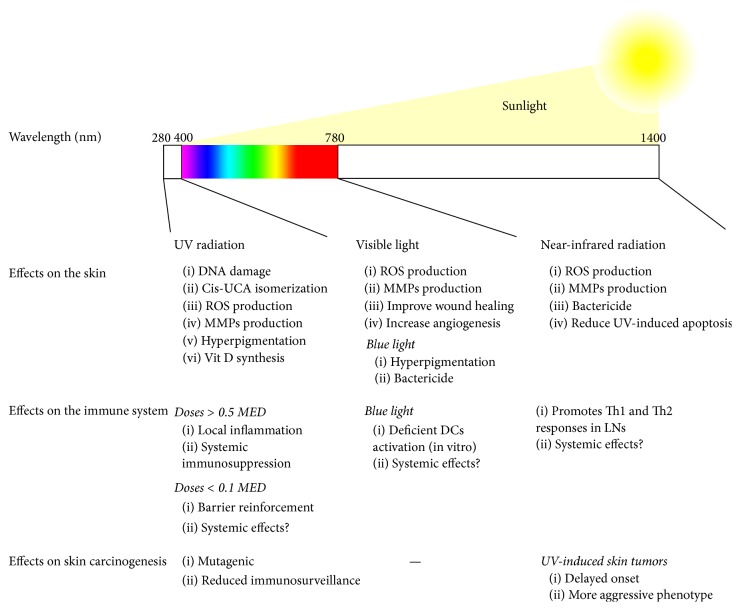
Sunlight, composed of different types of radiation, including ultraviolet wavelengths, is an essential source of light and warmth for life on earth but has strong negative effects on human health, such as promoting the malignant transformation of skin cells and suppressing the ability of the human immune system to efficiently detect and attack malignant cells. UV-induced immunosuppression has been extensively studied since it was first described by Dr. Kripke and Dr. Fisher in the late 1970s. However, skin exposure to sunlight has not only this and other unfavorable effects, for example, mutagenesis and carcinogenesis, but also a positive one: the induction of Vitamin D synthesis, which performs several roles within the immune system in addition to favoring bone homeostasis. The impact of low levels of UV exposure on the immune system has not been fully reported yet, but it bears interesting differences with the suppressive effect of high levels of UV radiation, as shown by some recent studies. The aim of this article is to put some ideas in perspective and pose some questions within the field of photoimmunology based on established and new information, which may lead to new experimental approaches and, eventually, to a better understanding of the effects of sunlight on the human immune system.
阳光由包括紫外线波长在内的不同类型辐射组成,是地球上生命光和热的重要来源,但对人类健康有强烈负面影响,比如促使皮肤细胞发生恶性转化以及抑制人体免疫系统有效检测和攻击恶性细胞的能力。自20世纪70年代末克里普克博士和费舍尔博士首次描述紫外线诱导的免疫抑制以来,这一现象已得到广泛研究。然而,皮肤暴露于阳光下不仅有上述及其他不利影响,例如诱变和致癌作用,还有一个积极作用:诱导维生素D合成,维生素D除了有助于骨骼稳态外,还在免疫系统中发挥多种作用。低水平紫外线暴露对免疫系统的影响尚未得到充分报道,但正如一些近期研究所表明的,它与高水平紫外线辐射的抑制作用存在有趣的差异。本文旨在基于已有的和新的信息,在光免疫学领域提出一些观点并提出一些问题,这可能会带来新的实验方法,并最终有助于更好地理解阳光对人体免疫系统的影响。