Department of Materials Science and Engineering, University of California Los Angeles, Los Angeles, CA 90095, USA.
Department of Chemistry and Biochemistry, University of California Los Angeles, Los Angeles, CA 90095, USA.
Sci Adv. 2017 Jan 6;3(1):e1600615. doi: 10.1126/sciadv.1600615. eCollection 2017 Jan.
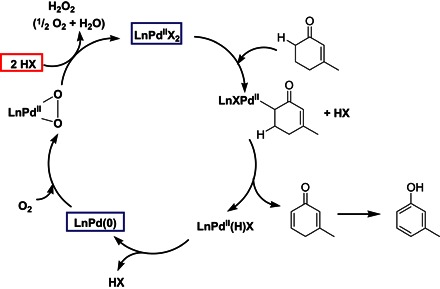
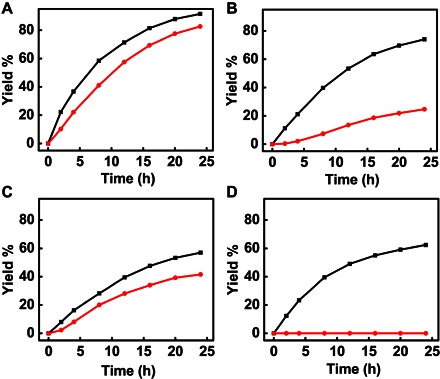
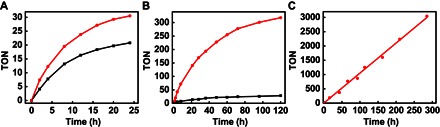
Metallic nanoparticles are emerging as an exciting class of heterogeneous catalysts with the potential advantages of exceptional activity, stability, recyclability, and easier separation than homogeneous catalysts. The traditional colloid nanoparticle syntheses usually involve strong surface binding ligands that could passivate the surface active sites and result in poor catalytic activity. The subsequent removal of surface ligands could reactivate the surface but often leads to metal ion leaching and/or severe Ostwald ripening with diminished catalytic activity or poor stability. Molecular ligand engineering represents a powerful strategy for the design of homogeneous molecular catalysts but is insufficiently explored for nanoparticle catalysts to date. We report a systematic investigation on molecular ligand modulation of palladium (Pd) nanoparticle catalysts. Our studies show that β-functional groups of butyric acid ligand on Pd nanoparticles can significantly modulate the catalytic reaction process to modify the catalytic activity and stability for important aerobic reactions. With a β-hydroxybutyric acid ligand, the Pd nanoparticle catalysts exhibit exceptional catalytic activity and stability with an unsaturated turnover number (TON) >3000 for dehydrogenative oxidation of cyclohexenone to phenol, greatly exceeding that of homogeneous Pd(II) catalysts (TON, ~30). This study presents a systematic investigation of molecular ligand modulation of nanoparticle catalysts and could open up a new pathway toward the design and construction of highly efficient and robust heterogeneous catalysts through molecular ligand engineering.
金属纳米颗粒作为一类新兴的多相催化剂,具有比均相催化剂更高的活性、稳定性、可回收性和易于分离等潜在优势。传统的胶体纳米颗粒合成通常涉及强表面结合配体,这些配体可能会钝化表面活性位,导致催化活性差。随后去除表面配体可以重新激活表面,但通常会导致金属离子浸出和/或严重的奥斯特瓦尔德熟化,从而降低催化活性或稳定性。分子配体工程是设计均相分子催化剂的一种强大策略,但迄今为止,对于纳米颗粒催化剂的研究还不够充分。我们报告了对钯(Pd)纳米颗粒催化剂的分子配体调制的系统研究。我们的研究表明,Pd 纳米颗粒上丁酸配体的β-官能团可以显著调节催化反应过程,从而改变催化活性和稳定性,对于重要的需氧反应具有重要意义。使用β-羟基丁酸配体,Pd 纳米颗粒催化剂在环己烯酮脱氢氧化为苯酚的反应中表现出异常高的催化活性和稳定性,不饱和周转数(TON)>3000,远远超过均相 Pd(II)催化剂的 TON(~30)。这项研究对纳米颗粒催化剂的分子配体调制进行了系统的研究,为通过分子配体工程设计和构建高效、稳定的多相催化剂开辟了新的途径。