Jongen S, Vermeeren A, van der Sluiszen N N J J M, Schumacher M B, Theunissen E L, Kuypers K P C, Vuurman E F P M, Ramaekers J G
Department of Neuropsychology and Psychopharmacology, Faculty of Psychology and Neuroscience, Maastricht University, Universiteitssingel 40, 6200 MD, Maastricht, The Netherlands.
Federal Highway Research Institute (BASt), Section U3/Traffic Psychology, Traffic Education, Bruederstrasse 53, D-51427, Bergisch Gladbach, Germany.
Psychopharmacology (Berl). 2017 Mar;234(5):837-844. doi: 10.1007/s00213-016-4519-z. Epub 2017 Jan 9.
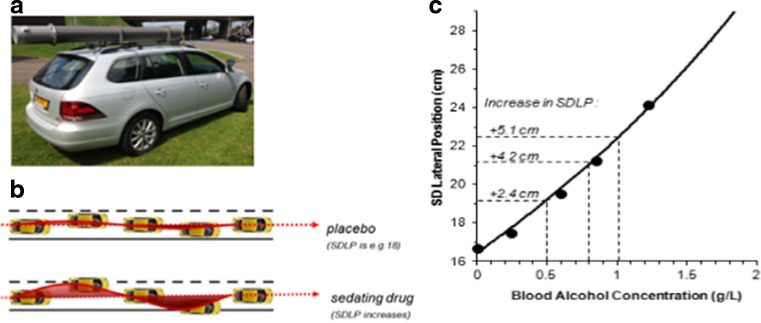
The on-the-road highway driving test is generally regarded as a gold standard for assessing drug-induced driving impairment. The primary outcome measure is the standard deviation of lateral position (SDLP), a measure of road tracking error or "weaving". The test has been calibrated for incremental doses of alcohol almost 30 years ago in order to define the impact of drug-induced impairment in terms of blood alcohol concentration (BAC) equivalents. Drug-induced changes in SDLP exceeding 2.4 cm have been evaluated as clinically relevant ever since. The present analysis was conducted to assess the robustness of the alcohol effect in a range of on-the-road driving studies which have been conducted since the initial alcohol calibration study.
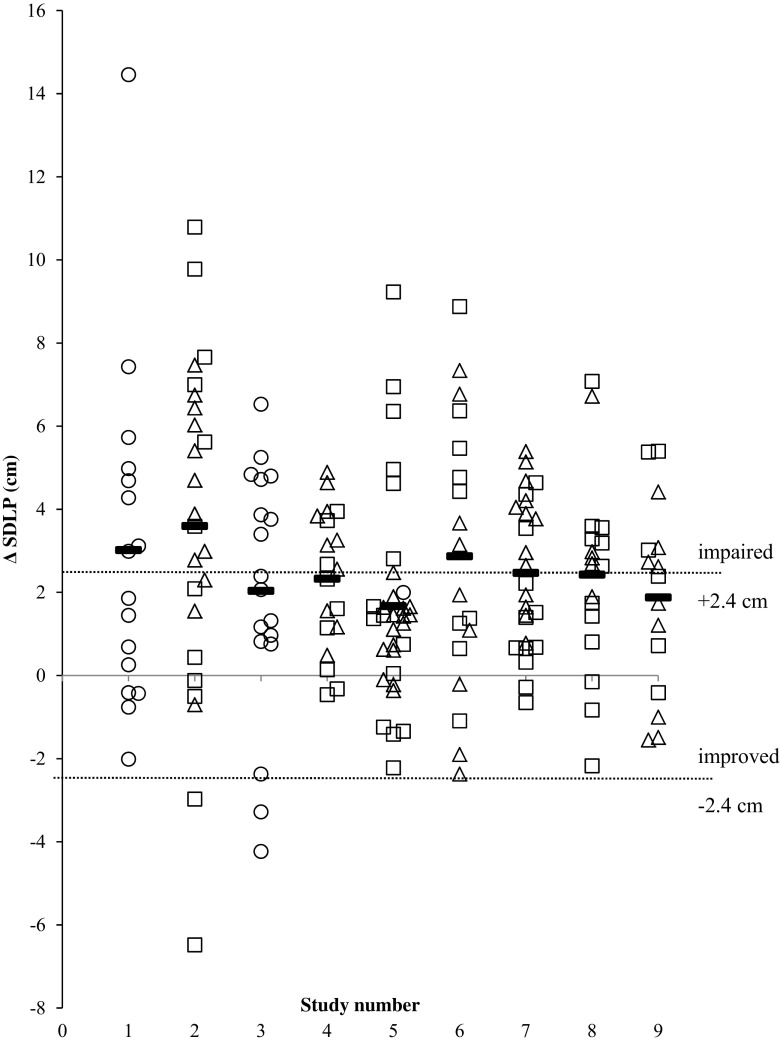
The present study pooled data of 182 participants from nine placebo-controlled crossover studies who performed the highway driving test, while their BAC was at or just below the legal limit for drivers (i.e., 0.5 g/L).
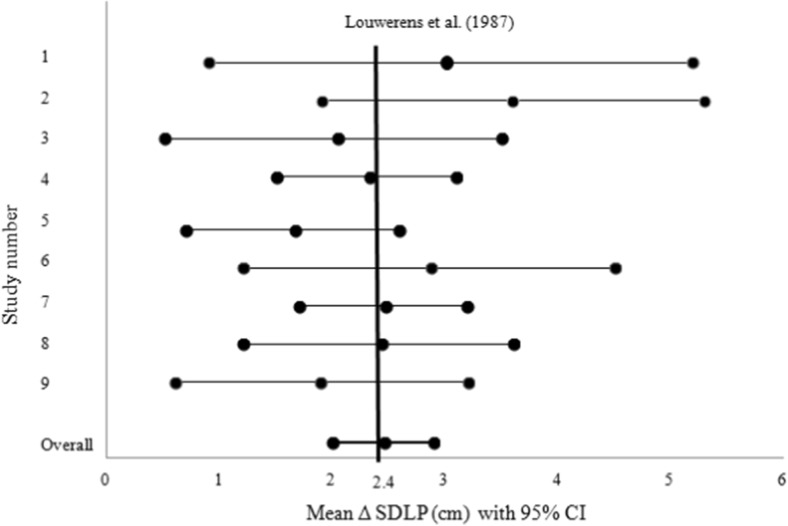
Overall, mean SDLP increased with 2.5 cm (95% CI 2.0-2.9 cm). Equivalence testing showed that the clinical relevance criterion value of 2.4 cm fell well within the 95% CI in each individual study. Gender did not affect alcohol-induced changes in SDLP.
These results demonstrate the robustness and validity of the clinical relevance criterion for SDLP as measured during on-the-road driving.
公路驾驶测试通常被视为评估药物所致驾驶能力损害的金标准。主要结局指标是横向位置标准差(SDLP),这是一种衡量道路跟踪误差或“摆动”的指标。近30年前,该测试已针对酒精递增剂量进行了校准,以便根据血液酒精浓度(BAC)当量来界定药物所致损害的影响。从那时起,SDLP药物诱导变化超过2.4厘米就被评估为具有临床相关性。本次分析旨在评估自最初的酒精校准研究以来进行的一系列公路驾驶研究中酒精效应的稳健性。
本研究汇总了来自9项安慰剂对照交叉研究的182名参与者的数据,这些参与者在BAC处于或略低于驾驶员法定限值(即0.5g/L)时进行了公路驾驶测试。
总体而言,平均SDLP增加了2.5厘米(95%CI为2.0 - 2.9厘米)。等效性检验表明,2.4厘米的临床相关性标准值在每项个体研究的95%CI范围内。性别不影响酒精诱导的SDLP变化。
这些结果证明了公路驾驶期间测量的SDLP临床相关性标准的稳健性和有效性。