Kim Hack-Lyoung, Lim Woo-Hyun, Seo Jae-Bin, Chung Woo-Young, Kim Sang-Hyun, Kim Myung-A, Zo Joo-Hee
Division of Cardiology, Department of Internal Medicine, Boramae Medical Center, Seoul National University College of Medicine, Seoul, Korea.
Medicine (Baltimore). 2017 Jan;96(1):e5783. doi: 10.1097/MD.0000000000005783.
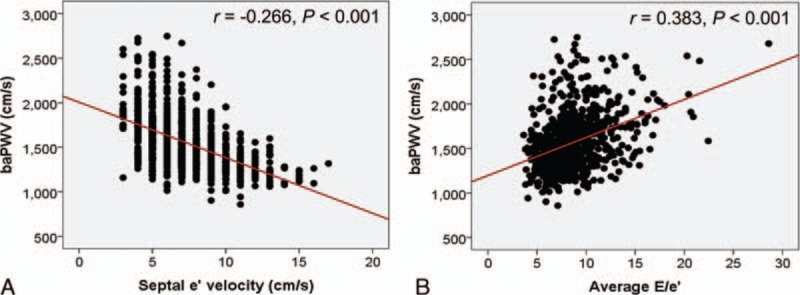
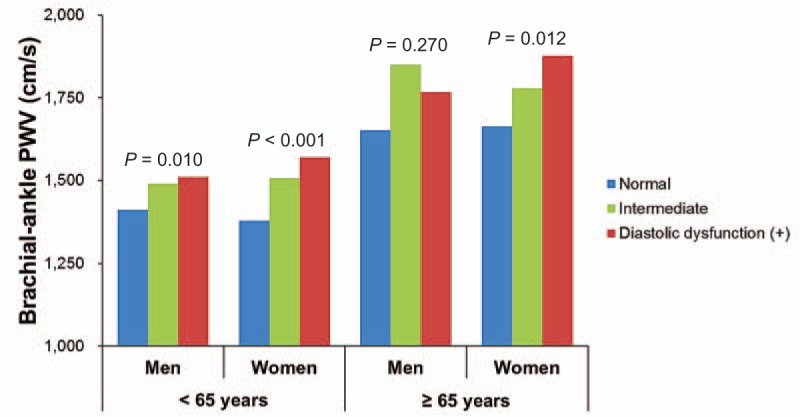
Left ventricular (LV) diastolic dysfunction and subsequent overt heart failure are more prevalent in elderly women. Close interaction between arterial stiffness and LV morphology/function has been reported. The aim of this study was to investigate whether there is an age- and gender-dependent relationship between arterial stiffness and LV diastolic function. A total of 819 subjects (58.6 ± 13.3 years, 50.2% men) without structural heart disease (LV ejection fraction ≥50%) were retrospectively analyzed. All participants underwent transthoracic echocardiography and brachial-ankle pulse wave velocity (baPWV) measurement on the same day. The association of baPWV with septal e' velocity and average E/e' was assessed. In the total study subjects, baPWV was negatively correlated with septal e' velocity (r = 0.383, P < 0.001), and positively correlated with E/e' (r = -0.266, P < 0.001). These linear correlations remained significant even after stratificaion of the study subjects by age (<65 years vs ≥65 years) and genders (P < 0.05 for each). There were obvious differences in baPWV according to groups with normal LV diastolic function, intermediate profile and LV diastolic dysfunction in young (P = 0.010) and elderly (≥65 years) women (P < 0.001) and eldery men (P = 0.012) but not in elderly men (P = 0.270). There was a significant association of baPWV with septal e' velocity (β = -0.258, P = 0.020) and E/e' (β = 0.122, P = 0.030) in elderly women even after controlling for multiple clinical covariates. This independent association was not seen in younger women and men (P > 0.05 for each). In conclusion, baPWV was independently associated with septal e' velocity and E/e' in elderly women but not in younger women or men. The results of this study provide additional evidence that increased arterial stiffness plays an important role in the development of heart failure with preserved ejection fraction as well as LV diastolic dysfunction in elderly women.
左心室(LV)舒张功能障碍及随后的明显心力衰竭在老年女性中更为常见。已有报道称动脉僵硬度与左心室形态/功能之间存在密切相互作用。本研究的目的是调查动脉僵硬度与左心室舒张功能之间是否存在年龄和性别依赖性关系。对819名无结构性心脏病(左心室射血分数≥50%)的受试者(年龄58.6±13.3岁,男性占50.2%)进行了回顾性分析。所有参与者在同一天接受了经胸超声心动图检查和肱踝脉搏波速度(baPWV)测量。评估了baPWV与室间隔e'速度及平均E/e'的相关性。在全部研究对象中,baPWV与室间隔e'速度呈负相关(r = 0.383,P < 0.001),与E/e'呈正相关(r = -0.266,P < 0.001)。即使在按年龄(<65岁与≥65岁)和性别对研究对象进行分层后,这些线性相关性仍然显著(每组P < 0.05)。在年轻(P = 0.010)和老年(≥65岁)女性(P < 0.001)以及老年男性(P = 0.012)中,根据左心室舒张功能正常、中间状态和左心室舒张功能障碍分组,baPWV存在明显差异,但在老年男性中无明显差异(P = 0.270)。即使在控制了多个临床协变量后,在老年女性中baPWV与室间隔e'速度(β = -0.258,P = 0.020)和E/e'(β = 0.122,P = 0.030)仍存在显著相关性。在年轻女性和男性中未观察到这种独立相关性(每组P > 0.05)。总之,baPWV在老年女性中与室间隔e'速度和E/e'独立相关,但在年轻女性或男性中并非如此。本研究结果提供了额外证据,表明动脉僵硬度增加在老年女性射血分数保留的心力衰竭以及左心室舒张功能障碍的发生发展中起重要作用。