Department of Natural Sciences, School of Arts and Sciences, Lebanese American University, P.O. Box 36, Byblos, Lebanon.
School of Pharmacy, Department of Pharmaceutical Sciences, Lebanese American University, P.O. Box 36, Byblos, Lebanon.
BMC Complement Altern Med. 2017 Jan 10;17(1):36. doi: 10.1186/s12906-016-1531-0.
Previous studies in our laboratory showed that the Lebanese Daucus carota ssp. carota (wild carrot) oil extract possesses in vitro and in vivo anticancer activities. The present study aims to examine the cytotoxic effect of Daucus carota oil fractions on human epidermal keratinocytes and evaluate the chemopreventive activity of the pentane diethyl ether fraction on DMBA/TPA induced skin carcinogenesis in mice.
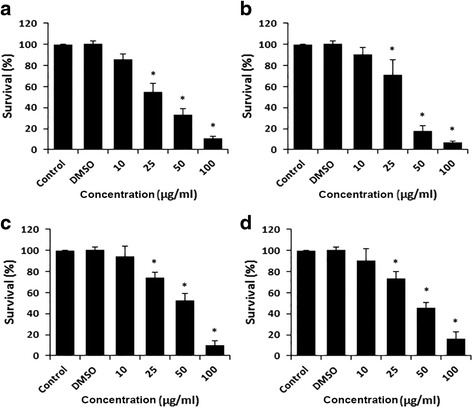
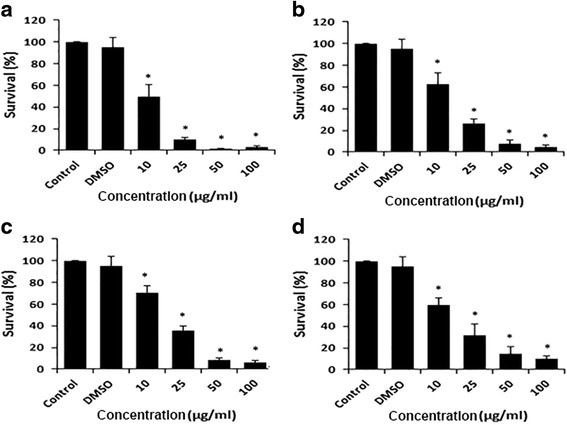
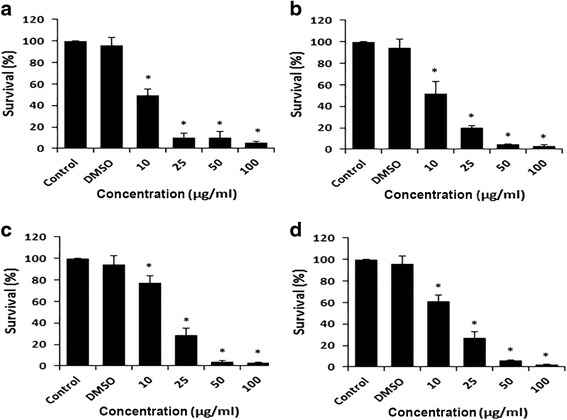
Wild carrot oil extract was chromatographed to yield four fractions (F1, 100% pentane; F2, 50:50 pentane:diethyl ether; F3, 100% diethyl ether; F4 93:7 chloroform:methanol). The cytotoxic effect of fractions (10, 25, 50 and 100 μg/mL) was tested on human epidermal keratinocytes (non-tumorigenic HaCaT cells and tumorigenic HaCaT-ras variants) using WST a ssay. Cell cycle phase distribution of tumorigenic HaCaT-ras variants was determined by flow cytometry post-treatment with F2 fraction. Apoptosis related proteins were also assessed using western blot. The antitumor activity of F2 fraction was also evaluated using a DMBA/TPA induced skin carcinoma in Balb/c mice.
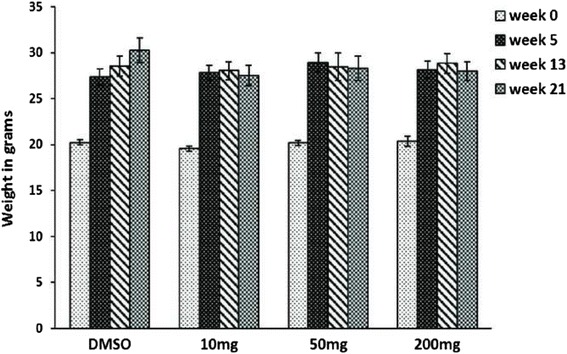
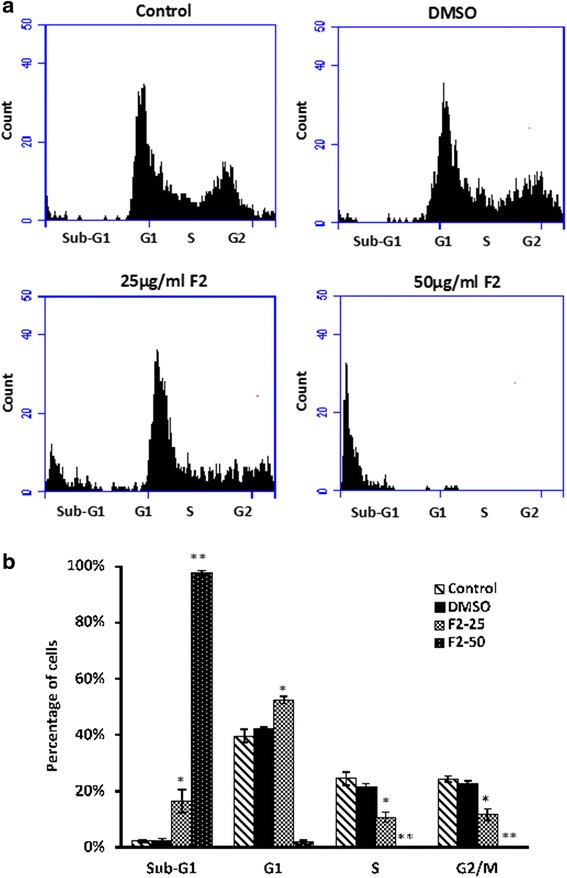
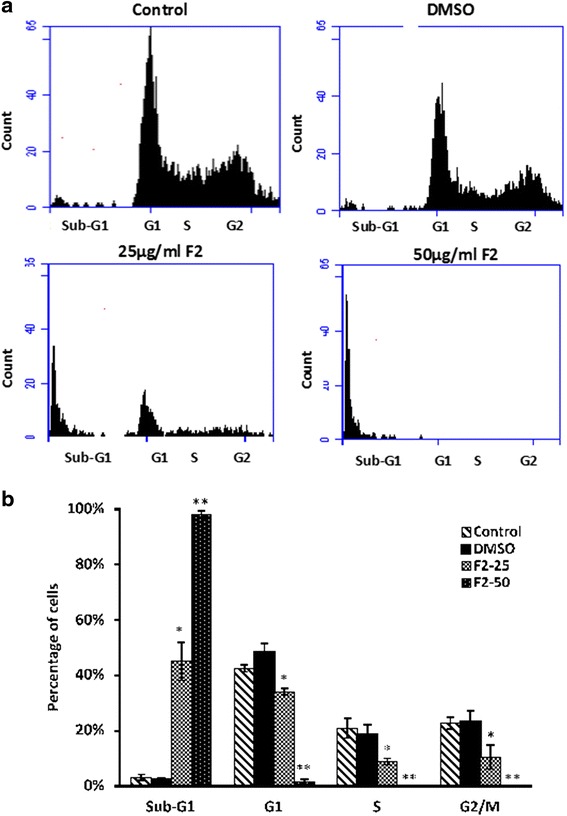
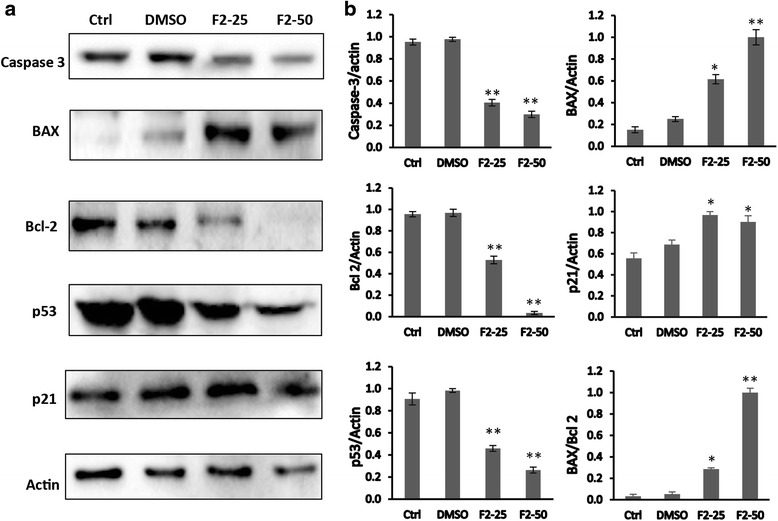
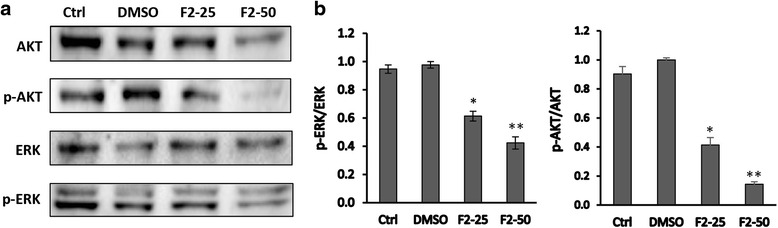
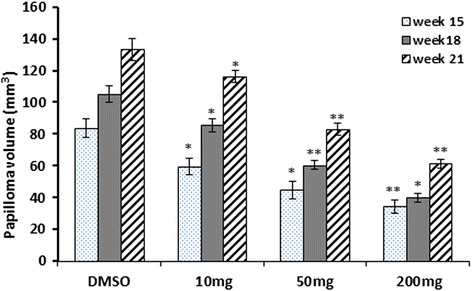
All fractions exhibited significant cytotoxicity, with HaCaT cells being 2.4-3 times less sensitive than HaCaT-ras A5 (benign tumorigenic), and HaCaT-ras II4 (malignant) cells. GC-MS analysis revealed the presence of a major compound (around 60%) in the pentane/diethylether fraction (F2), identified as 2-himachalen-6-ol. Treatment of HaCaT-ras A5 and HaCaT-ras II4 cells with F2 fraction resulted in the accumulation of cells in the sub-G1 apoptotic phase and decreased the population of cells in the S and G2/M phases. Additionally, F2 fraction treatment caused an up-regulation of the expression of pro-apoptotic (Bax) and down-regulation of the expression of anti-apoptotic (Bcl2) proteins. A decrease in the phosphorylation of AKT and ERK was also observed. Intraperitoneal treatment with F2 fraction (50 or 200 mg/kg) in the DMBA/TPA skin carcinogenesis mouse model showed a significant inhibition of papilloma incidence (mice with papilloma), yield (number of papilloma/mouse) and volume (tumor relative size) at weeks 15, 18 and 21.
The present data reveal that F2 fraction has a remarkable antitumor activity against DMBA/TPA-induced skin carcinogenesis, an effect that may be mediated through inhibition of the MAPK/ERK and PI3K/AKT pathways.
本实验室之前的研究表明,黎巴嫩胡萝卜(野生胡萝卜)油提取物具有体外和体内抗癌活性。本研究旨在研究胡萝卜油馏分对人表皮角质形成细胞的细胞毒性作用,并评估戊烷二乙醚馏分对 DMBA/TPA 诱导的小鼠皮肤癌变的化学预防活性。
野生胡萝卜油提取物经色谱分离得到四个馏分(F1,100%戊烷;F2,50:50 戊烷:二乙醚;F3,100%二乙醚;F4,93:7 氯仿:甲醇)。采用 WST 法检测馏分(10、25、50 和 100μg/ml)对非肿瘤性 HaCaT 细胞和肿瘤性 HaCaT-ras 变体的细胞毒性作用。用 F2 馏分处理后,通过流式细胞术测定肿瘤性 HaCaT-ras 变体的细胞周期相分布。用 Western blot 法也评估了与细胞凋亡相关的蛋白质。还采用 DMBA/TPA 诱导的 Balb/c 小鼠皮肤癌评估 F2 馏分的抗肿瘤活性。
所有馏分均表现出显著的细胞毒性,HaCaT 细胞比 HaCaT-ras A5(良性肿瘤)和 HaCaT-ras II4(恶性)细胞敏感 2.4-3 倍。GC-MS 分析表明,在戊烷/二乙醚馏分(F2)中存在一种主要化合物(约 60%),鉴定为 2-himachalen-6-ol。F2 馏分处理 HaCaT-ras A5 和 HaCaT-ras II4 细胞后,细胞在亚 G1 凋亡期积聚,S 和 G2/M 期的细胞减少。此外,F2 馏分处理导致促凋亡(Bax)蛋白的表达上调和抗凋亡(Bcl2)蛋白的表达下调。还观察到 AKT 和 ERK 的磷酸化减少。在 DMBA/TPA 皮肤致癌小鼠模型中,腹腔内给予 F2 馏分(50 或 200mg/kg)可显著抑制 15、18 和 21 周时的肿瘤发生率(有肿瘤的小鼠)、产率(每只小鼠的肿瘤数)和体积(肿瘤相对大小)。
本数据显示,F2 馏分对 DMBA/TPA 诱导的皮肤癌变具有显著的抗肿瘤活性,其作用可能是通过抑制 MAPK/ERK 和 PI3K/AKT 通路介导的。